


What if speaking up didn’t have to mean being the funniest or most confident person in the room? If you second-guess what to say, worry about being judged, or want to join in but can’t find an easy opening, an improv class to overcome shyness may offer a gentler kind of practice. You don’t have to perform, be quick-witted, or arrive feeling ready. The point is to try small moments of participation with other people, one step at a time.
Improv won’t change everyone’s experience in the same way, and it isn’t a substitute for therapy. Shared games and group reflection can give you room to listen, respond, and let go of finding the perfect words. In this guide, you’ll learn how that practice may carry into everyday conversations, how to take manageable social risks, and what to look for in a welcoming first experience. Lila Joy Seminars offers an eight-week live online improv seminar for adults, with weekly Zoom sessions and no previous improv or acting experience required. The first session is free, so you can experience the format before deciding whether to continue.
Key Takeaways
- Improv can be shared, unscripted practice, not a demand to entertain or take center stage.
- Responding to another person’s idea gives you something to focus on and may make it easier to contribute.
- An improv class to overcome shyness can offer manageable ways to practice joining in, but it can’t promise a particular outcome.
- Choose a small intention for your first session, such as listening closely or sharing one thought, then reflect on how it felt.
- Learn what to expect from a supportive online seminar and how to decide whether this kind of group practice feels right for you.
Can an Improv Class Help You Overcome Shyness? Start With What You Want to Feel
You can want to speak more easily without wanting to become the loudest person in the room. Maybe you’d like to join a conversation without rehearsing every sentence, or share an idea before the moment passes. That wish is valid. Being naturally quiet isn’t a problem to fix. Your goal might simply be to feel more present and able to participate when you choose.
In this context, improv means shared, unscripted exercises where people listen and respond in the moment. Improv practice is collaborative play, not acting instruction or therapy. The forms of improvisational theatre can vary, but a personal-growth setting can use improv to practice small social actions, such as offering a response or building on someone else’s thought. Repeating those actions may make participation feel more familiar, but improv can’t promise to remove shyness or make every social situation easy.
What does overcoming shyness mean in everyday life?
It doesn’t have to mean becoming outgoing. Progress might mean staying in a conversation instead of retreating into your thoughts, adding one comment when meeting a group, or speaking once during a video call. You might still feel shy. The difference could be having a little more room to choose what to do next, rather than feeling that hesitation makes the decision for you.
These small moments matter because they’re specific and within reach. Instead of measuring yourself against someone who seems effortlessly chatty, notice whether you listened, stayed present, or shared something you wanted to say. A gentle goal lets you explore an improv class to overcome shyness without treating quietness as a flaw.
Is improv about being loud, clever, or funny?
No. Playful participation isn’t the same as performing for an audience. You don’t need a clever line ready or a funny idea to contribute. Listening matters just as much as speaking: notice what another person offers, then respond in a simple way. A brief reply can be enough.
You also don’t need to know what you’re doing before you start. Lila’s eight-week live online seminar is for adults and requires no previous acting or improv experience. You can come as you are, with whatever mix of curiosity and nerves you’re carrying. Instead of asking, “Will I be entertaining?” try asking, “Could I join in for one small moment?”
How Improv Practice Can Make Speaking Up Feel More Natural
When it feels hard to speak in a group, your attention can turn inward: Am I making sense? Was that the right moment? Improv gives you something else to focus on. You listen to what someone has just said, then respond to that idea. The exchange gives you something concrete to work with instead of asking you to invent the perfect thing to say from scratch.
Short, shared activities offer repeated chances to contribute without scripting each response in advance. A turn might be as simple as agreeing, asking a question, or adding one small detail. No single moment needs to feel like a breakthrough. With practice, responding before you’ve planned every word may become more familiar, though what feels comfortable varies from person to person.
How listening and accepting an idea supports participation
A familiar improv principle is to accept what another person offers and build on it, often summed up as “Yes, and.” That doesn’t mean you must agree with everything in everyday life. In a playful exercise, it means acknowledging the idea and giving the interaction somewhere to go. A simple response is enough. Cleverness isn’t the goal.
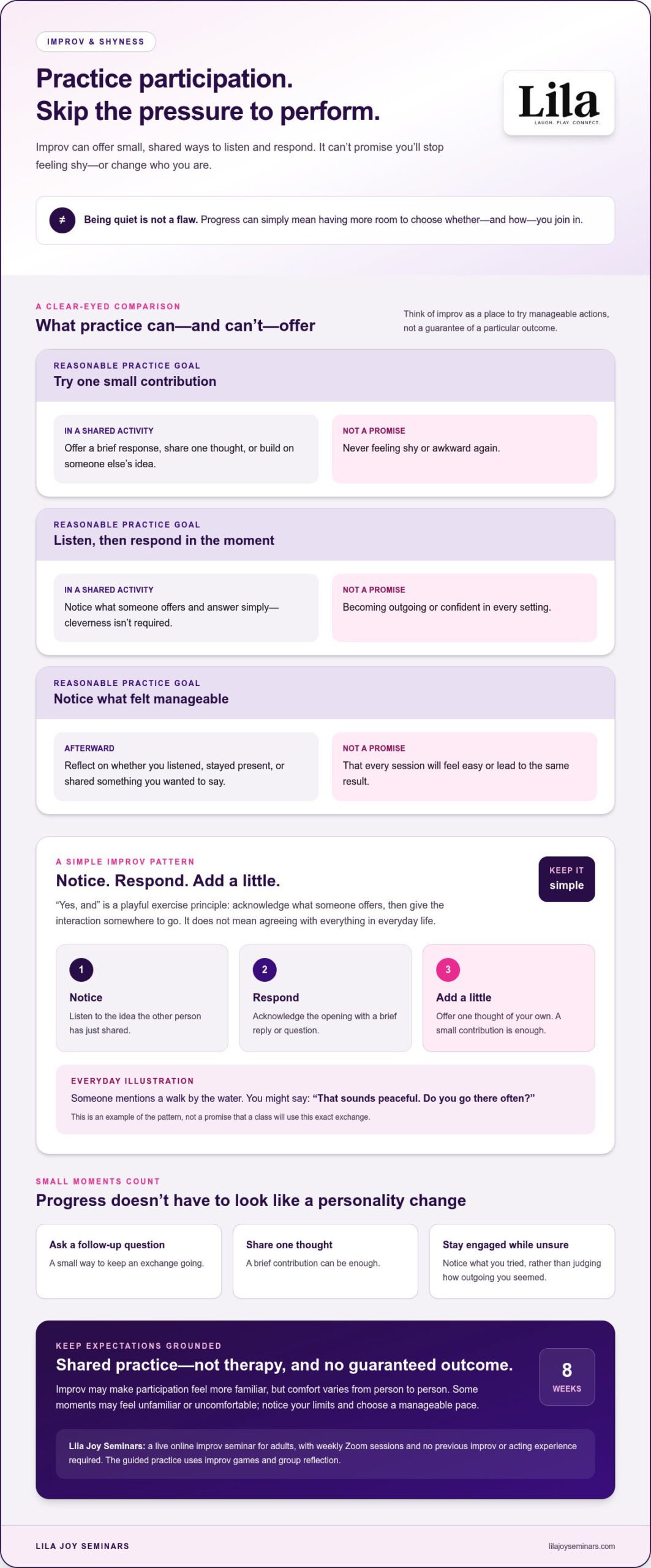
Imagine someone mentions taking a walk by the water. You might respond, “That sounds peaceful. Do you go there often?” You’ve listened, accepted the opening, and added a thought of your own. This is an everyday illustration, not a promise that a class will use this exact exchange. The useful pattern is simple: notice, respond, add a little.
Why small contributions can matter more than big breakthroughs
Feeling more at ease doesn’t require a sudden personality change. You might notice that you asked a follow-up question, shared one thought, or stayed engaged while feeling uncertain. These are modest actions, but they give you something real to reflect on afterward.
Group reflection can help you notice those moments. Instead of judging whether you were outgoing enough, consider what you tried and what felt manageable. That keeps practice grounded in your own experience, without assuming every session will feel easy or produce the same result. Lila’s live online improv seminar uses improv games and group reflection for guided practice.
Improv and Shyness: What It Can, and Cannot, Do
If the word “improv” makes you picture standing under a spotlight, take a breath. A beginner’s improv class doesn’t have to mean preparing a show, playing a character for an audience, or trying to earn a laugh. In a personal-growth setting, the focus can be shared activities and connection. Some moments may feel unfamiliar or uncomfortable, so notice your limits and choose a pace that feels manageable.
An improv class to overcome shyness can offer practice participating with others, but it can’t promise a change in personality or a particular result. It helps to separate reasonable practice goals from promises no class can make.
| Reasonable practice goals | Unrealistic promises |
|---|---|
| Trying a small contribution in a shared activity | Never feeling shy or awkward again |
| Practicing listening and responding in the moment | Becoming outgoing or confident in every setting |
| Noticing what felt manageable afterward | A guaranteed fix for social anxiety |
Does an improv class have to involve performing?
No. Group exercises and acting for an audience are different things. You don’t have to pursue a role, deliver a polished scene, or prove you’re funny to take part in guided improv practice. The aim is to explore participation and connection, not performance. Not every activity will feel comfortable for every person, so it’s reasonable to move at a pace that respects your boundaries.
When is improv not a substitute for mental-health care?
A personal-growth seminar is not therapy. It doesn’t diagnose or treat social anxiety, and it shouldn’t be presented as a cure. It may offer a structured space to practice being with a group, but that’s different from clinical care. If distress is significant or is making daily life hard, consider seeking support from an appropriately qualified mental-health professional.
Both things can be true: improv may be a useful way to explore small social steps, and it may not be the support you need on its own. The right next step is the one that feels appropriate for you, whether that means trying a group activity, pausing to reflect, or reaching out for professional care.
How to Try Improv When You Feel Shy: A Gentle First Step
You don’t have to wait until you feel confident to try something new. Make the first step small and give yourself room to notice how it feels, without expecting one session to change everything.
- Name the concern. Is it being put on the spot, not knowing anyone, or worrying about what to say? Naming it can help you plan for the experience without judging yourself for feeling nervous.
- Choose one manageable intention. You might listen closely, respond once, or share one thought. The aim isn’t to be talkative. It’s to try a step that feels possible.
- Attend and take part at your pace. Let the session unfold without demanding that every moment feel easy.
- Reflect afterward. Notice one moment of attention, participation, or connection, even if it was small.
What can you do before your first session?
Put your uncertainty into a simple sentence: “I’m not sure what to say,” or “I’m worried everyone will notice me.” You don’t need to argue with the feeling. Then set an intention that doesn’t depend on being confident, such as listening carefully or offering one response. Lila’s seminar requires no previous improv or acting experience, so you can begin without preparation or background knowledge.
For more context, read this guide to online improv classes for adults. Lila’s live seminar meets weekly on Zoom, and sessions last about two hours. Joining from home lets you explore the format in a familiar setting while sharing the experience with a group.
How can you reflect afterward without grading yourself?
Skip the scorecard. Instead of asking whether you were funny, confident, or the most involved person, ask what you noticed. Did you listen closely? Did you respond, even briefly? Was there a moment when you felt connected to the group? Curiosity gives you more useful information than self-criticism, and leaves room for the next session to feel different.
An improv class to overcome shyness is best approached as practice, not a test you have to pass. Lila’s first session is free, so you can experience the live online format and decide how it feels for you.
A Supportive Online Improv Seminar: A Possible Next Step With Lila
If you’re curious about practicing participation in a group, Lila’s eight-week live online improv seminar for adults offers a guided way to explore it. The focus is personal growth, with room to try responding in the moment and notice how it feels. It isn’t about preparing for a performance or achieving a particular result.
What does Lila’s eight-week online seminar involve?
The seminar meets weekly on Zoom, with each session lasting about two hours. Sessions use improv games and group reflection. Games create shared opportunities to take part, while reflection gives you space to notice what you experienced. Confidence, spontaneity, and connection are aims of the seminar, not guaranteed outcomes.
You don’t need previous acting or improv experience. You can arrive as a beginner, with no lines to learn and no need to prove you’re naturally quick or outgoing. If you’re considering an improv class to overcome shyness, that distinction matters: the seminar offers practice and exploration, not a promise to change who you are.
How can you decide whether this feels like a kind next step?
Consider what you’re hoping for. Are you interested in a regular space to practice joining in, listening, and responding with other people? Does a live online group feel like a manageable way to explore that? You don’t have to be certain. You might approach the first session with a small intention, such as noticing what feels comfortable or simply getting a sense of the format.
The first session is free, and no prior experience is required. It gives you a chance to experience the seminar before deciding whether to continue. There’s no need to turn that choice into a test of courage. Curiosity is enough for a first step.
If gentle group practice sounds like something you’d like to try, explore Lila’s free first session.
Take One Small Step Toward Speaking More Freely
Feeling shy doesn’t mean you have to become someone else. Progress might look like listening closely, sharing one thought, or joining a conversation at your own pace. Improv can offer a shared place to practice those small moments, but it can’t promise to remove shyness or replace mental-health care when that’s needed.
If you’re curious about an improv class to overcome shyness, Lila’s eight-week live online seminar for adults offers weekly Zoom sessions of about two hours, with improv games and group reflection. No previous acting or improv experience is required, and the first session is free. Try the format, notice how it feels, and decide what suits you without needing to prove anything.
Explore Lila’s free first session. A small, unhurried step is still a step, and you’re welcome to begin exactly as you are.
Frequently Asked Questions
Can an improv class help you overcome shyness?
Yes, an improv class may offer practice speaking up, responding in the moment, and joining shared activities, but it can’t promise to remove shyness. Set a small goal, such as sharing one thought or staying engaged in a group exchange. Progress can mean participating in ways that feel more manageable, not becoming outgoing or feeling confident in every social situation. The experience differs from person to person.
Is improv good for shy people?
It can be a useful way for shy people to explore group participation without making loudness or quick wit the goal. Improv involves listening and responding as well as speaking, so a small contribution can be enough. You may still feel nervous, and not every activity will suit everyone. Think of it as a chance to practice at a manageable pace, not a test of how social you can be.
Do you have to be funny to take an improv class?
No, you don’t have to be funny. Improv practice isn’t about delivering jokes or entertaining an audience. It’s about paying attention to what someone offers and responding in the moment. A simple answer, question, or added idea can keep an interaction going. Lila’s seminar uses improv games and group reflection for personal growth, so you don’t need to arrive with clever lines or a polished performance.
What happens in an improv class for shy beginners?
In Lila’s eight-week live online seminar for adults, weekly Zoom sessions last about two hours and use improv games and group reflection. Expect guided group practice, not a requirement to perform onstage. Activities can vary, so there’s no need to prepare lines or arrive with ideas ready. No previous improv or acting experience is required.
Can online improv help if I feel nervous in groups?
Online improv offers a way to try shared group practice from home, which may feel like a more familiar starting point for some people. Lila’s seminar meets live on Zoom, so it still involves participating with others. Being at home doesn’t guarantee you’ll feel comfortable, and nervousness may still come up. Approach the experience with a small intention, such as listening closely or making one contribution.
Is an improv class a treatment for social anxiety?
No. An improv class or seminar is not therapy or clinical treatment for social anxiety, and it shouldn’t be presented as a cure. It can offer a setting to practice communication and connection, but that’s different from care provided by a qualified mental-health professional. If anxiety or distress is significant or affecting daily life, consider reaching out to an appropriately qualified professional for support suited to your needs.
Do I need acting experience to join an improv class?
No acting experience is needed to join Lila’s seminar, and previous improv experience isn’t required either. It’s designed for adults and uses group games and reflection as guided practice, rather than acting or performance training. You don’t need to know improv terms, memorize lines, or be naturally outgoing. You can begin as a complete beginner and focus on taking part in whatever way feels manageable.