


What if confidence didn’t mean always knowing what to say? If you replay conversations in your head, worry about awkward pauses, or hold back until you’ve found the perfect words, you’re not alone. Improv to build confidence isn’t about becoming the loudest person in the room or making everyone laugh. It’s a chance to practise being present, responding to what’s happening, and letting a small mistake pass without treating it as a verdict on yourself.
You don’t have to be naturally outgoing to begin, and you don’t need to feel fearless before you try. Improv uses simple, shared activities to help you practise responding with less self-editing. You can start with a small contribution, notice how it feels, and decide what you’d like to try next. Those moments of showing up can make everyday conversations feel more manageable.
In this article, you’ll learn what confidence-building through improv can realistically look like, why listening matters more than being quick or clever, and how to try small exercises in daily life. You’ll also see what happens in a supportive live group, so you can decide whether practising with others feels like a comfortable next step.
Key Takeaways
- Confidence can mean joining in while you’re still unsure, not changing your personality or waiting to feel fearless.
- Improv to build confidence gives you practice responding to unexpected moments without searching for perfect words.
- You don’t need to be funny or outgoing to try improv. Experiences vary, and no class can guarantee a particular change.
- Start gently: notice when you hesitate, then try one small, optional response in an everyday conversation.
- A supportive group offers space to practise and reflect. Lila’s eight-week live online seminar meets weekly on Zoom for about two hours.
What Does It Mean to Build Confidence Through Improv?
Wanting to speak with a little more ease doesn’t mean you need to become a different person. You might be thoughtful, quiet, or someone who likes to choose words carefully. Still, it can feel freeing to share an idea before you’ve polished every sentence, or to join a conversation without rehearsing what you’ll say next. You can practise that kind of ease in small, manageable ways.
Building confidence through improv means practising a willingness to participate, listen, and respond while you’re still unsure of what comes next. It isn’t a promise that you’ll always feel certain. It’s a chance to notice what happens when you loosen the need to prepare every response in advance.
Confidence can look quiet, gradual, and personal
Confidence doesn’t have one look. It may mean offering a suggestion in a meeting, adding a thought to a group conversation, or allowing a pause without rushing to fill it. These moments can be easy to overlook because they aren’t dramatic. But they reflect a small shift: you’re taking part, even if you still feel unsure.
You don’t have to be loud, funny, quick with a reply, or comfortable in every social situation. Ordinary self-consciousness doesn’t mean there’s something wrong with you. The aim isn’t to erase your temperament or never feel awkward. It’s to have more room to choose how you respond, rather than letting the search for perfect words make the choice for you.
Why improv offers a different kind of practice
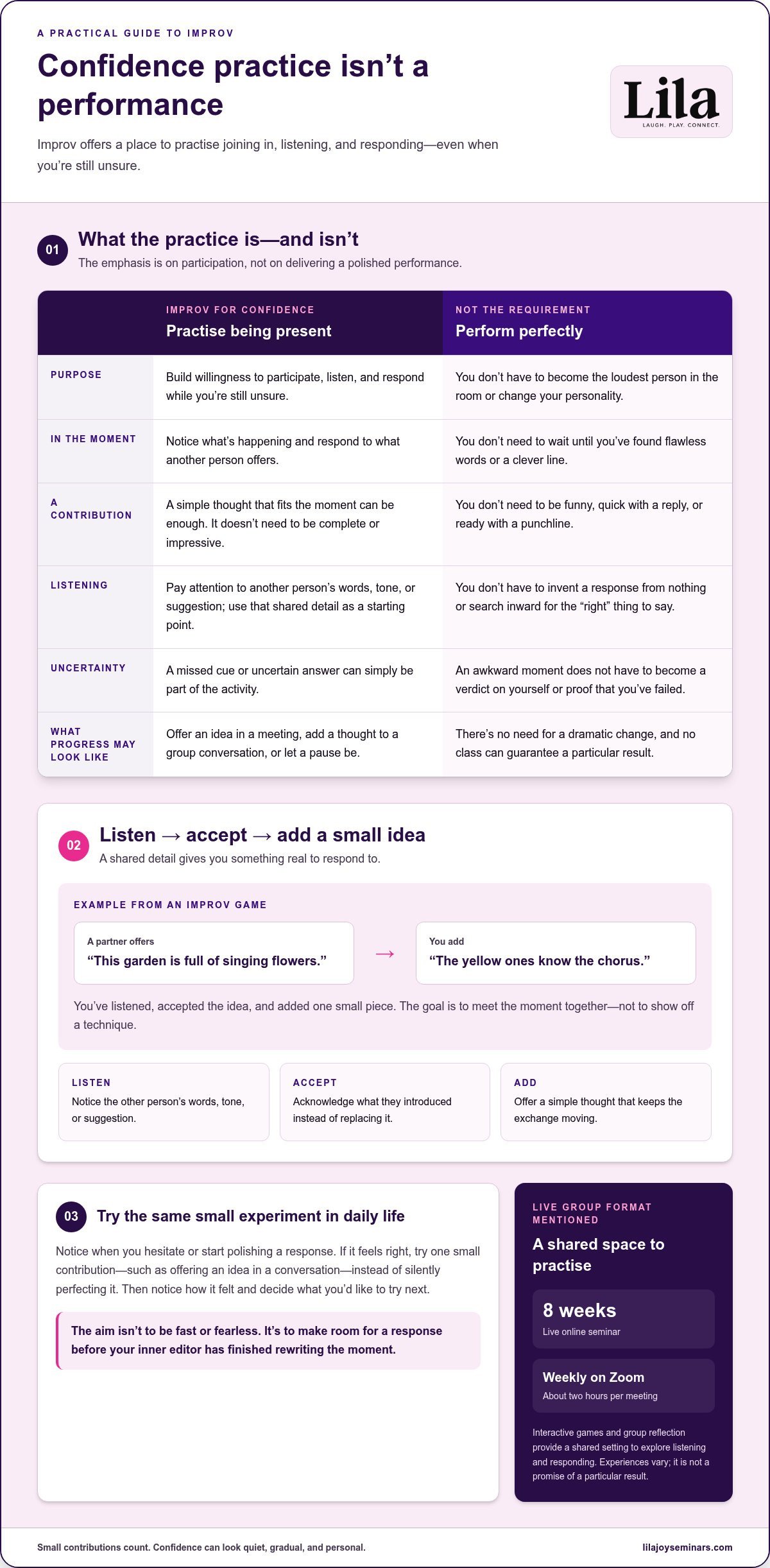
In everyday conversation, you might quietly plan several replies while someone else is speaking. Improv invites you to notice what’s happening and respond to it, rather than waiting for a flawless line. A partner might offer an unexpected idea in a game; you can listen, accept what’s there, and add a simple thought of your own. The moment keeps moving, but you don’t need to make your contribution impressive.
This approach reflects the broader idea of improvisation: adapting to what arises instead of relying on a fully prepared script. In a shared practice space, trying a response can feel more manageable because the focus is on exploring together, not delivering a polished performance. A missed cue or uncertain answer becomes part of the activity, not proof that you’ve failed.
That’s the difference between using improv to build confidence and training to become a polished performer. The practice is about participation, attention, and flexibility, not mastering a stage or making people laugh. Try a small response, notice how it felt, and decide what you’d like to carry into daily life. The practice creates opportunities to explore feeling more at ease, though each person’s experience is different.
How Improv Practice Can Make Confidence Feel More Reachable
It can be hard to speak when part of your attention is busy checking every possible reply. Improv offers a different rhythm: hear what’s happening, take in an unexpected prompt, and respond with what you have now. Your response doesn’t need to be clever or complete. The practice is to participate before your inner editor has finished rewriting the moment.
Responding before you have the perfect words
A short prompt gives you a chance to notice self-editing in action. You might feel the urge to wait until you’ve found the best answer, then try sharing the first simple thought that fits. The point isn’t to be fast. It’s to see whether a response can be enough without being polished.
For example: In a group game, someone might say, “We’ve just opened a tiny bakery on the moon.” You could add, “The cookies float off the shelves.” That’s all. You don’t need a punchline or a clever story. You’re accepting the invitation to play and discovering what comes next.
In everyday life, the same kind of small experiment might be offering one idea in a conversation instead of silently perfecting it. Improv gives you a setting to notice your usual pause and try a different response, without turning the moment into a test.
Listening, accepting, and building on an idea
Careful listening gives you something real to respond to. Rather than searching inward for the right thing to say, pay attention to another person’s words, tone, or suggestion. That shared detail becomes a starting point. You don’t have to invent a response from nothing.
In improv, accepting an offer means acknowledging what another person has introduced and adding something that keeps the exchange moving. If a partner says, “This garden is full of singing flowers,” you might answer, “The yellow ones know the chorus.” You’ve listened, accepted the idea, and added your own small piece. It’s about meeting one another in the moment, not showing off a technique.
Wikipedia’s overview of improvisation describes it as creating or performing without preparation. In a group exercise, each person’s contribution gives the next person a fresh detail to notice and build on. That exchange can make participation feel more shared and less focused on judging every word you say.
Trying this with others gives you a place to explore listening and responding. Lila’s 8-week live online improv seminar uses interactive games and group reflection, creating a shared setting to practise. It’s an invitation to explore, not a promise of a particular result.
Does Improv Build Confidence or Must You Be Funny?
You don’t need to arrive with jokes, quick comebacks, or a big personality. It’s natural to wonder whether improv means being put on the spot and expected to entertain everyone. But confidence practice and comedy performance aren’t the same thing. In a supportive class, the focus is on trying an idea, listening to others, and taking part in a shared activity. A pause is allowed, and so is a simple response.
Improv can offer a place to practise responding and contributing with less preparation. It isn’t a comedy test, a cure for anxiety, or a guarantee that you’ll feel confident everywhere.
You do not need to arrive with jokes or quick comebacks
A quiet contribution still counts. You might agree with an idea, add one detail, or ask a question that helps the group keep going. You may pause while you find your words, or not feel playful every time. None of that means you’re doing it wrong. The focus is on participating at your own pace, not earning laughs or being the quickest person in the room.
Being introverted or naturally reserved isn’t a flaw that improv needs to fix. You can keep your thoughtful nature and still explore more flexibility in how you join in. If a prompt catches you off guard, start small. There’s no need to turn every moment into a clever line or prove that you’re comfortable.
What improv can offer and what it cannot promise
With practice, some people find it useful to explore presence, flexibility, and willingness to contribute. A group exercise invites you to try a response before you’ve worked out every possible outcome. Reflection afterward can help you notice what felt comfortable or unfamiliar. These are opportunities to practise, not proof that a particular change will happen.
People bring different temperaments, experiences, and hopes to an improv group. Confidence can develop gradually, unevenly, or in ways you didn’t expect. One class can’t promise lasting change, and a supportive seminar isn’t a substitute for mental health care. Improv to build confidence is an educational, shared practice, not clinical treatment.
If worry or distress is significantly affecting your daily life, a qualified mental health professional can help you explore appropriate support. You don’t have to choose between seeking that help and enjoying a creative group activity, but it’s useful to understand what each can offer. Improv may be a way to practise everyday participation. It isn’t designed to diagnose or treat a mental health condition.
How to Practise Improv Confidence in Everyday Moments
You don’t need to turn every conversation into an exercise. Notice your habits and, if it feels comfortable, try one different response. Improv to build confidence can begin with ordinary moments, not a big leap or a strict routine.
Try this gentle progression when a familiar conversation feels manageable:
- Notice the pause. When you catch yourself searching for the perfect words, simply notice it. You don’t have to judge the hesitation or push yourself to speak.
- Choose a small opening. Look for a low-stakes moment, perhaps a casual chat with someone you know. If the conversation doesn’t feel comfortable, let this opportunity pass.
- Offer one unpolished thought. Share a simple reaction or idea without editing it several times first. It can be a sentence, not a story.
- Stay curious. Instead of planning your next reply while the other person speaks, ask a genuine follow-up question. Let their answer shape what you say next.
Try small, low-stakes experiments
These are options, not assignments. You might mention a meal you enjoyed, offer a small suggestion about weekend plans, or ask someone what they thought of a film. The goal isn’t to sound spontaneous or keep the conversation going at all costs. It’s to make room for one response that feels like yours, before you’ve made it perfect.
If a moment starts to feel too uncomfortable, you can stop, listen, or choose not to practise then. There’s no need to explain or push through. A manageable experiment should leave you with a choice, not the feeling that you have to prove something.
Notice progress without turning it into a test
Afterward, take a moment to reflect, only if that feels useful. You could ask yourself:
- Was there a moment when I felt present with the other person?
- Did I share something before I had fully polished it?
- What helped me feel connected, even briefly?
There’s no score to keep. Perhaps you spoke; perhaps you chose to listen and stay engaged. Either can be a meaningful moment of participation. Try not to compare your response with someone else’s or turn one conversation into a verdict on your confidence. Everyday experiments are one way to practise; a group activity adds the chance to respond and build on ideas with others.
If you’d like to practise with others, explore Lila’s live online improv seminar. Its interactive games and group reflection offer a shared space to try responding and notice what the experience is like for you.
A Supportive Live Improv Seminar: A Gentle Next Step
Practising on your own can help you notice your habits, but a live group adds other people’s ideas, reactions, and presence. You respond together, then reflect on what the experience was like. If you’re curious about improv to build confidence, a guided group gives you a place to explore without needing to arrive with a polished answer or a particular personality.
What a low-pressure group practice can feel like
A group setting doesn’t mean speaking constantly or holding everyone’s attention. You can listen, take in the activity, and offer a thought when you’re ready. The practice is shared, so each person’s contribution helps shape what happens next. There may be laughter, unexpected turns, and moments of uncertainty, all part of exploring spontaneity and connection together.
Lila’s seminar is an eight-week experience for adults, with live Zoom sessions each week lasting about two hours. Sessions use interactive improv games followed by group reflection. You have time to try activities with others and consider what you noticed, rather than treating a response as something to get right. No prior acting or improv experience is required. It’s a space for shared practice, not performance training.
The weekly rhythm gives the experience a familiar shape: join the group, take part in the activities, and reflect together. There’s no need to decide in advance that you’ll be outgoing or that every exercise will feel comfortable. Approach the experience with curiosity and see how it feels to practise alongside other adults.
Consider whether a first session feels right for you
Guided group practice may suit you if you’d like more than a solo exercise and are curious about responding and connecting with others in a supportive setting. You might also prefer to take time before joining a group. Either way, consider what feels manageable right now. The seminar runs for eight weeks, and the first session is free, so you can experience the format before deciding whether to continue.
If you’re ready to explore, try the free first session. You don’t need to arrive certain that improv is for you. Notice how it feels to join, take part at your own pace, and reflect on whether this kind of shared practice feels like a helpful next step.
Let Your Next Step Be Small
You don’t have to wait until you feel completely at ease to try something new. Sometimes the next step is simply noticing your curiosity and giving it a little room. Improv to build confidence can be less about becoming someone different and more about finding moments when you can show up as yourself, even if you’re still a bit unsure.
There’s no need to turn this into another goal to measure or a promise you have to make to yourself. Explore, see how the experience feels, and decide what you’d like to do from there. A small beginning is still a beginning.
If you’re curious about practising with a supportive group, try the first session of Lila’s live online improv seminar for free. Come as you are, with no previous improv or acting experience needed. Take the experience one moment at a time, and let your next step be as small as it needs to be.
Frequently Asked Questions
Can improv help build confidence in everyday life?
Improv gives you a place to practise responding and joining in, which may feel useful in everyday conversations. For example, you could try sharing a brief thought in a team discussion instead of waiting until you’ve rehearsed it perfectly. Improv to build confidence isn’t a guaranteed way to change how you feel, but the practice can help you notice how you respond when plans or conversations take an unexpected turn.
Do you have to be funny to build confidence through improv?
No. Being funny isn’t a requirement for taking part in improv for personal growth. You might contribute a simple observation, ask a question, or build on someone else’s idea. A quiet response can be just as welcome as a playful one. The aim is to engage with what’s happening, not to keep a group entertained. If humor comes naturally, that’s fine, but you don’t need to arrive with jokes prepared.
How long does it take to feel more confident after starting improv?
There’s no set timeline, and improv can’t promise that you’ll feel more confident after a particular number of sessions. Some people may notice small shifts in how they join an activity, while others may need more time or find their experience varies from week to week. Instead of looking for a dramatic change, notice whether you’re more willing to try, listen, or contribute in a moment that once felt daunting.
Is online improv useful for practising confidence with other people?
It can be. A live online session lets you respond to real people in real time, rather than practising only in your head. You hear others’ ideas and can explore how it feels to join a shared activity from your own space. The online format won’t suit everyone, and it doesn’t guarantee a particular result, but it offers a way to try group participation without travelling to a class.
Can improv help you speak up when you are unsure what to say?
Improv gives you practice contributing without having a complete answer ready. In an everyday conversation, that might mean saying, “I’m not sure yet, but one thought is…” or asking someone to explain what they mean. You don’t have to speak immediately or fill every silence. The useful part is exploring small, honest responses, so uncertainty doesn’t have to mean you have nothing to add.
What happens in a live online improv seminar for adults?
At Lila Joy Seminars, adults meet weekly on Zoom for about two hours in an eight-week seminar. Sessions include interactive improv games and group reflection, offering time to take part and consider the experience with others. No previous acting or improv experience is required. The first session is free, so you can get a feel for the group format before deciding whether you’d like to continue.