


Online improv isn’t simply an in-person class moved onto a screen. What to expect in an online improv seminar is a mix of playful exercises, attentive listening, and shared ideas over a video call. You can practise responding in the moment, building on someone else’s ideas, and connecting with others, without needing acting experience or a polished punchline.
It’s natural to wonder whether a screen makes it harder to feel present with other people. Online classes have a different rhythm from in-person ones, but joining from home can make it easier to take part and meet people from other places. This article looks at the activities you might try, how improv can encourage confidence and connection, and what changes when a class happens online. You’ll get a clearer sense of whether this kind of shared, low-pressure play feels right for you.
Key Takeaways
- Practice listening without rushing to fill a pause, then build on a scene partner’s idea to keep a shared moment moving.
- Use simple improv exercises to try responding spontaneously and communicating with less overthinking, without needing prior experience.
- Meet participants joining from different places and notice how shared play can create a sense of connection through a screen.
- Compare the online format with in-person classes, including how screens shape timing, movement, and the way partners read one another.
Listening and allowing scene partners room to speak
In an online improv seminar, listening means noticing what your partner offers before deciding what to say next. Try this simple rhythm: pause, take in the offer, then respond to one detail. If a partner says, “The train is late,” you might play the passenger checking the station clock rather than changing the scene to a beach. That response shows you heard them and gives the shared moment somewhere to go.
Exercises make this practice easy to see. One person starts with a simple line, and the other adds a detail that fits. “We’re opening a bakery” could become “The first loaf is still warm.” The next person might describe its smell or offer a slice. Each addition gives the other person room to contribute again. The aim isn’t to invent the cleverest idea, but to stay with the idea taking shape.
This kind of listening can help in everyday conversations, too. When a friend mentions a difficult morning, for example, you can respond to what they actually said before moving to your own story or advice. In improv, partners practise noticing words, tone, and the direction of a scene. Those small choices can make a conversation feel more attentive, rather than like two people waiting for their turn.
Video calls give you a practical reason to slow down: you can’t rely on every physical cue you’d notice in the same room. Look toward the screen, let your partner finish a thought, and leave a brief pause before replying. If you start speaking at the same time, one of you can stop and invite the other to continue. These simple choices help each voice come through clearly. Listening becomes an active way to share the scene, not just a pause before your next line.
Confidence and communication skills
Confidence in improv doesn’t mean always knowing what to say. It can mean staying with a moment when a scene takes an unexpected turn. If a partner offers an imaginary map, for example, you can pick a detail and respond: “This road leads to the old lighthouse.” The scene continues without a perfect idea. Small, low-pressure choices like this let you practise speaking before planning every word.
Prompt-based storytelling gives this practice a simple shape. One person offers a starting idea, and each partner adds a fitting detail. A prompt about a lost umbrella might grow into a story about a rainy bus stop, a mistaken bag, or a stranger who recognizes its owner. You’re not following a script. You’re trying an idea, noticing the response, and adding what makes sense next.
These moments can also bring communication habits into view. Do you respond to what someone said, or jump ahead to what you think they mean? If a partner says, “I’m nervous about the trip,” you could ask where they’re going or respond as a friend helping them pack. Either choice gives the other person something clear to build on. In everyday conversation, a similar pause can help you address someone’s point instead of rehearsing your next sentence.
Improv exercises make room for different comfort levels. You might start with a short response, then try adding a place, a relationship, or a feeling to a scene. Each detail offers a gentle stretch, not a demand to be louder or funnier. Online improv classes can welcome beginners, who can explore the same basic ideas as everyone else: listening, creativity, and spontaneity. Often, the change is practical: you get more comfortable contributing one clear thought, then staying open to what comes back.
Connecting with people in different places
An online improv group can bring together people from different cities and countries. That means a mix of voices, everyday references, and places can enter a shared scene. Imagine one participant describing a rainy commute while another knows only dry roads. Their different starting points add texture without anyone having to travel to the same classroom. Connection begins with a simple shared activity: notice an idea, respond, and let someone else add the next detail.
Short introductions can help turn a grid of faces into scene partners. Someone might share their first name and an ordinary object nearby, such as a mug or houseplant. Another person can use it as a playful prompt. The mug becomes a captain’s compass; the plant becomes a quiet audience. These small exchanges bring names and details into the group’s shared imagination. They also offer an easy way to join in before a longer scene feels comfortable.
Different locations can shape how people respond to the same prompt. A pretend train station might remind one person of a daily commute and another of a family trip. Each person can contribute what they know while leaving space for new details. There’s no single correct version of a place: the scene grows through different viewpoints. It’s a gentle way to practise curiosity. Ask what a partner’s character sees, then build on the answer instead of assuming you share the same reference.
A screen gives connection its own rhythm. You can see a partner’s expression, but the small frame may hide gestures or the room around them. Start clearly, keep your response focused, and make room for everyone to contribute. In a group scene, one person might name the setting, another add a character’s need, and a third introduce a small surprise. This shared structure helps everyone find a way in. Online improv can connect people who might not otherwise meet, with collaboration as common ground.
Differences between online and in-person improv
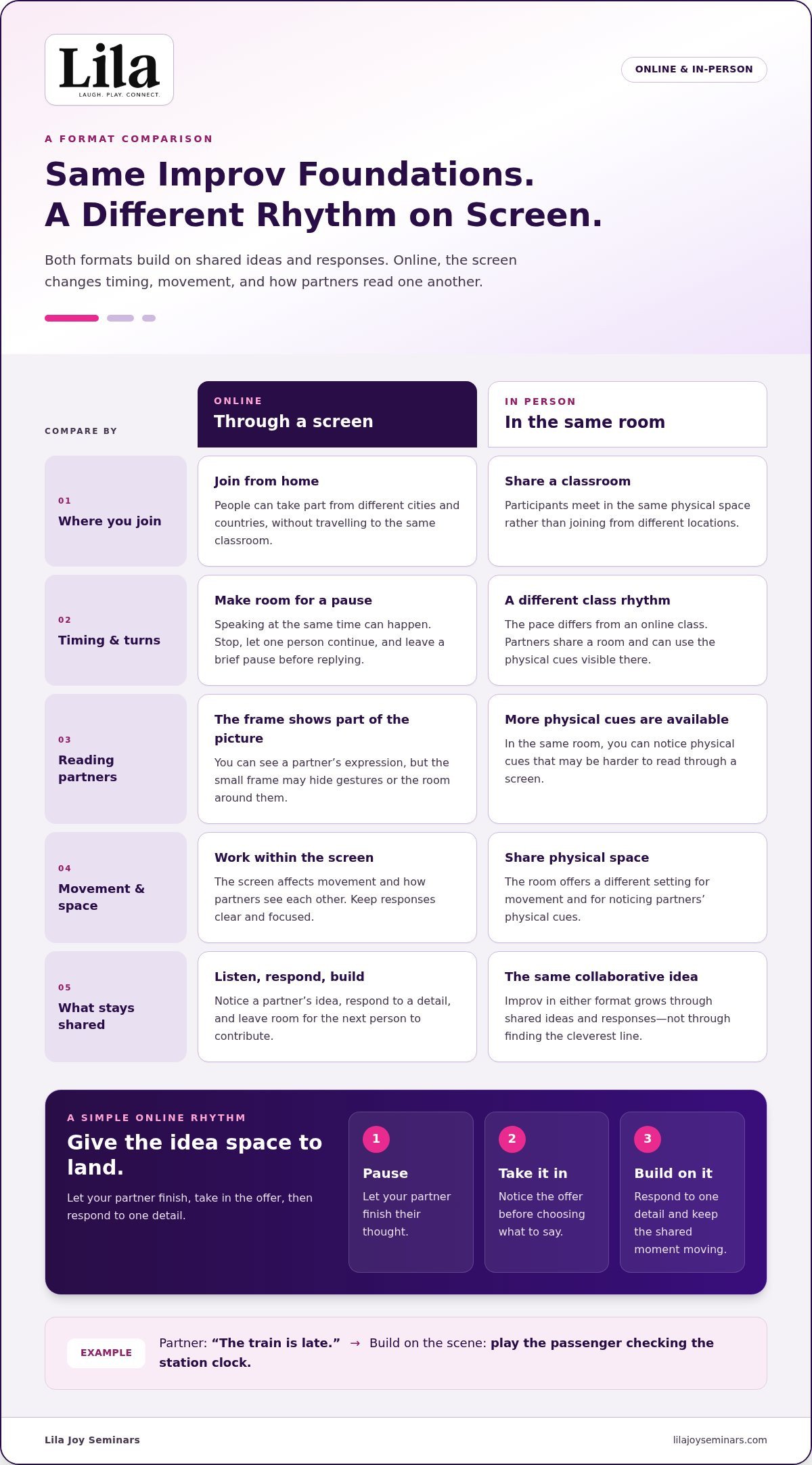
Both formats build on shared ideas and responses, but a screen changes the timing, movement, and way partners read one another. Knowing the differences can help you choose the setting that feels comfortable.
Online Class Participation Rules
Simple online class habits help everyone follow the scene and share speaking space. Listen closely, focus on your partner, and pause before responding. If you start speaking at the same time, stop and let one person continue. Build on your partner’s idea instead of replacing it with an unrelated one. These habits matter because turn-taking can be less clear on a video call than in person.
Common online exercises include listening games, creative prompts, and spontaneous storytelling. One person might suggest a setting while others add details to build a scene. No acting or improv experience is needed to join Lila, a live online improv membership for adults. Sessions use games and group reflection to explore confidence, spontaneity, and connection.
Equipment and Internet Setup
For Lila, you’ll need a device for Zoom and an internet connection. Joining from a quiet spot can make it easier to hear your partners and follow the conversation. Keeping your camera positioned so your face is visible also helps others read your expressions and respond to you.
Online scenes rely on clear speech and visible facial expressions, while an in-person room allows more movement and lets partners see more of one another. Both formats can support playful collaboration, but each asks you to adjust how you communicate. Lila takes place live on Zoom, so you can join from home.
In the United States, online improv class costs depend on the format and how often you attend, so check what’s included before signing up. To find a reputable class, look for a clear outline of its activities, format, instructor, and participation expectations. If you’d like a live online setting, try a free class with Lila.
Take a Gentle First Step
Curiosity doesn’t need to become a big commitment all at once. As you consider what to expect in an online improv seminar, notice what feels inviting: trying an unfamiliar idea, sharing a moment with others, or making room for more play in your week. You don’t need to know how you’ll respond before you begin. A willingness to explore is enough to start.
If you’d like a place to continue that exploration, Lila offers live online improv classes, and your first class is free. You can try one and decide whether it feels like a comfortable next step for you.
Try a free class when you’re ready. A little curiosity can be a lovely place to begin.
Frequently Asked Questions
Are Online Improv Classes Worth It?
An online improv seminar can be worthwhile if you want a playful way to practise responding in the moment and sharing ideas. If you’re wondering what to expect, think about the kind of practice you want: speaking up in a group, following an unexpected idea, or trying a new way to join a conversation. The value is in the experience, not a promised personality change.
What happens in an online improv seminar?
A useful picture of what to expect in an online improv seminar is a series of guided games and creative exercises shaped by the people taking part. A facilitator might offer a situation, such as finding an unusual note on your doorstep. You could respond as the person who found it while others add details. The prompt gives you a starting point, not a required answer.
How is an online improv seminar structured and how long does it last?
Schedules and session lengths vary. Lila is an ongoing membership: live Zoom classes last one to two hours, and members can join as many as they like from the class calendar. Classes use improv games and group reflection. Your first class is free, and continuing is optional. Classes are designed for adults, and you can join from anywhere with a laptop and Wi-Fi.
How do online improv seminars compare with in-person workshops?
Online seminars let you join from home, while in-person workshops bring partners together in the same physical space. For example, a scene about crossing a busy street can be described and mimed within a camera frame online. In a room, participants can use more space and see each other’s movement. Consider which setting makes it easier for you to participate and focus.
What are the benefits and challenges of learning improv online?
Online classes can bring together people who live in different places and remove the need to travel to a shared venue. The screen may limit visible gestures, and a weak internet connection can interrupt an exchange. A basic internet connection is enough for online classes that don’t require special software or technical skills. Joining from a quiet spot can help you follow the conversation.