


You don’t have to silence every anxious thought to be present with someone. Learning how to get out of your head in social situations can start with noticing your breath, naming a few things you can see, and gently questioning the thought that’s pulling you away from the moment. Small steps can help you return your attention to the people and conversation around you.
If your mind replays every word or scans for signs you’ve said something wrong, you’re not alone. Social moments can feel awkward or tiring, and you don’t need to perform perfectly to connect. This guide offers practical ways to ground yourself, question anxious thoughts, and make conversations feel more manageable, one moment at a time.
You’ll also learn how everyday nerves can differ from anxiety that keeps getting in the way, and when extra support may be worth considering. You don’t have to change everything at once. Start with one breath, one curious question, or one small step toward the conversation in front of you.
Key Takeaways
- Pause to notice what your anxious thoughts are predicting, then consider what you’d say to a friend thinking the same thing.
- Build comfort gradually by choosing a manageable social step and repeating it at your own pace.
- Use your senses to reconnect with the room when your attention turns inward.
- Keep conversations simple: ask a small question, listen to the answer, and let the exchange unfold naturally.
Challenging negative thoughts
When anxiety rises, pause and name the thought driving it. Then separate what you know from what you fear might happen.
-
Identify Thoughts Behind Anxious Reactions
Notice when your feelings shift, then write down the thought that appeared. At a gathering, you might think, “I’m being boring,” after a brief pause in conversation. Check what happened just before that thought: a silence, a glance, or uncertainty about what to say. Naming the trigger helps you distinguish the event from the negative meaning your mind gives it.
Describe your reaction plainly, too. You might notice a tight chest and a wish to leave after thinking, “They’re judging me.” Don’t treat that prediction as proof. Record the situation, thought, and feeling in a few words. Reviewing those details later can reveal which moments tend to start the anxious loop.
-
Use Questions to Challenge Anxious Thoughts
Ask what you fear will happen, then consider how likely that outcome seems. If you worry that one awkward comment will ruin the evening, look at what evidence supports that prediction. Could the other person simply move on? Has a brief stumble ended every conversation before? These questions make room for possibilities your first anxious thought may overlook.
Next, imagine the outcome you fear most and ask how you would cope. If someone doesn’t respond warmly, you could ask another question, talk with someone else, or take a quiet break. This isn’t pretending nothing uncomfortable can happen. It’s reminding yourself that one uncertain moment isn’t the whole interaction, and one awkward conversation doesn’t define you.
- Review the moment afterward. Once you’re settled, note what triggered your reaction and what actually happened. Compare your prediction with the conversation you had. For example, if you expected someone to laugh at your comment but they simply changed the subject, record the difference. Use this review to choose one small adjustment for next time, rather than replaying every sentence as proof of failure.
- Reach for support when needed. If anxious thoughts keep making social activities hard to manage, a mental health professional can offer advice and support. If you’re in the United States and face a life-threatening situation, call 911, according to the United States government. Immediate safety comes first; thought-challenging can wait until you’re safe.
How Can You Build Confidence in Social Settings Over Time?
Choose one manageable social step, repeat it, then work toward situations you usually avoid. Progress can be gradual; it isn’t a test of how outgoing you are.
-
Practice Gradually with Avoided Situations
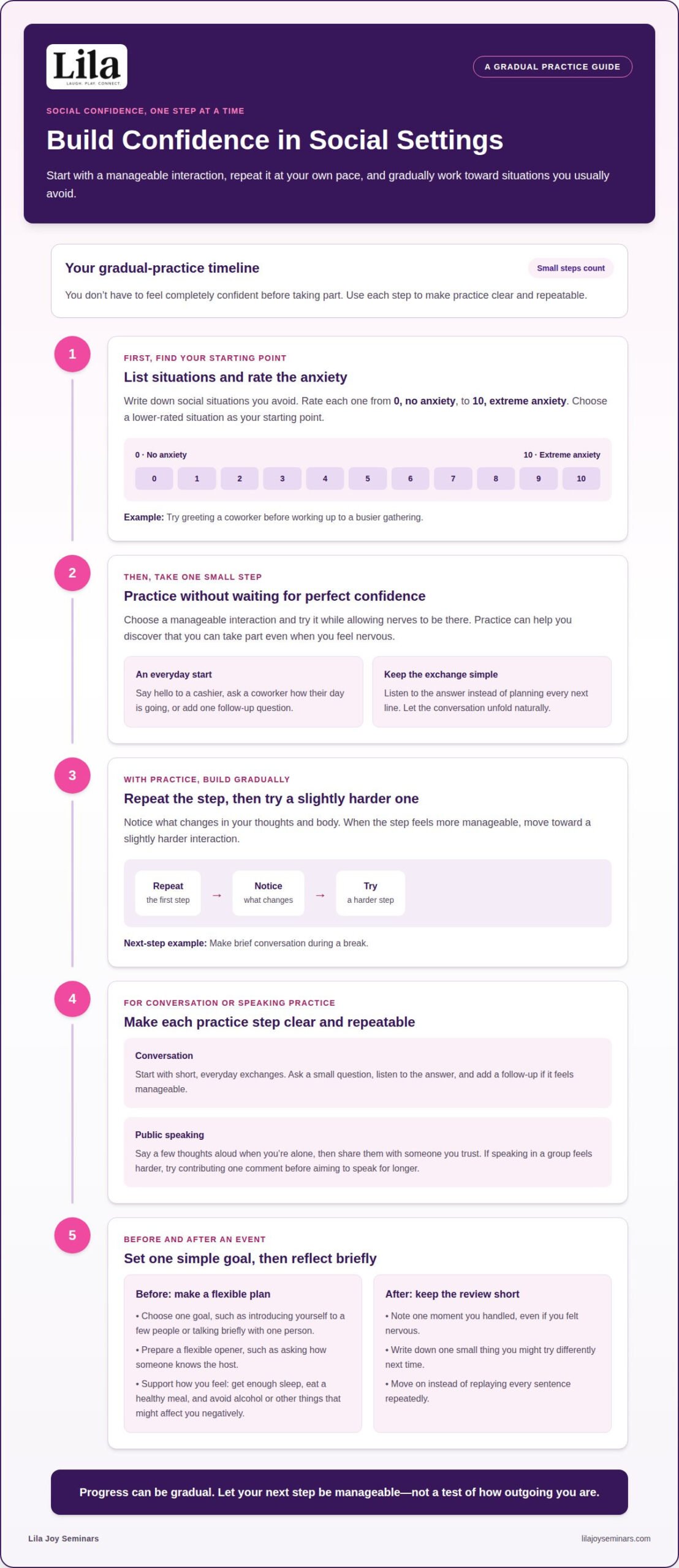
List social situations you avoid, then rate each one from 0 for no anxiety to 10 for extreme anxiety. Choose a lower-rated example, such as greeting a coworker, before trying a busier gathering. This gives you a clear starting point without asking you to jump straight into the hardest situation.
Repeat the step and notice what changes in your thoughts and body. When it feels more manageable, try a slightly harder interaction, such as making brief conversation during a break. Don’t wait until you feel completely confident. Practice helps you discover that you can take part while feeling nervous.
-
Practice Conversation and Public Speaking
Build social skills through short, everyday interactions. Say hello to a cashier, ask a coworker how their day is going, or add one follow-up question. Listen to the answer instead of planning every next line. These small exchanges let you practice talking without making each conversation feel like a performance.
For public speaking, start by saying a few thoughts aloud when you’re alone, then share them with someone you trust. You might describe a familiar topic or tell a short story. If speaking in a group feels harder, try contributing one comment before aiming to speak for longer. Keep each practice step clear and repeatable.
-
Prepare for Events Without Rehearsing Interactions
Choose one simple goal before an event, such as introducing yourself to a few people or talking with one person briefly. Prepare a flexible opener, like asking how someone knows the host, rather than scripting a whole conversation. A small plan gives your attention somewhere useful to go.
Before leaving, focus on basics that support how you feel: get enough sleep, eat a healthy meal, and avoid alcohol or other things that might affect you negatively. You don’t need to predict every pause or response. Let your goal guide you, then respond to the people who are actually there.
- Review the event without replaying it. Afterward, write down one moment you handled and one small thing you’d try differently next time. For example, note that you introduced yourself even while nervous. Keep the review brief, then move on to another activity instead of analyzing every sentence repeatedly.
Mindfulness and sensory grounding in social situations
Grounding shifts your attention from anxious predictions to what’s happening around you. If you’re wondering how to get out of your head in social situations, try one of these steps during a conversation or before entering a room.
- Notice your body and surroundings. Name the moment anxiety appears, then quietly observe your thoughts and bodily reactions. You might notice tense shoulders, warm cheeks, or racing thoughts while someone speaks. Don’t judge these signals or try to force them away. Treat them as information, then choose one visible detail, such as the pattern on a cup, to anchor your attention.
- Use the 5-4-3-2-1 exercise. Silently identify five things you can see, four you can feel, three sounds, two scents, and one thing you can taste. At a gathering, you might notice a window, your feet on the floor, nearby voices, coffee, and a mint. Move through each sense slowly, then return your attention to the person speaking.
- Try steady breathing. If you want a clear rhythm, use the 4-7-8 method: inhale for 4 counts, hold for 7, then exhale for 8. Repeat gently, and stop if the counting feels uncomfortable. You can also take a few quiet minutes each day to sit and follow your breath. Practicing outside social moments can make the action familiar when negative thoughts begin to crowd in.
- Support your body beyond the event. Regular exercise, enough sleep, and reducing caffeine may help regulate your body during anxiety. Before a social occasion, eat a meal that helps you feel steady rather than distracted by hunger. These actions can support mental health, but healthy habits don’t replace treatment when anxiety needs professional care. If you’re learning how to get out of your head in social situations, choose one sensory detail, such as the other person’s voice, and listen for their next point.
How can you start and maintain a conversation when feeling self-conscious?
Keep your attention on the person and the shared moment, rather than searching for perfect words. A conversation can begin with one small opening and grow from there.
- Use what’s happening around you. At dinner, you could ask, “Have you tried the soup?” At a community event, comment on the music or ask how people know the host. A simple question gives the other person an easy way into the exchange. Choose something relevant to the setting instead of searching for a clever line.
- Listen for one detail to follow up on. If someone says they spent the weekend gardening, ask what they planted or how they got interested. You don’t need to invent a new topic after every answer. Following up on one detail makes talking feel more like a shared exchange than a test of quick thinking.
- Let your attention rest on the speaker. Notice their words and the point they’re making instead of checking how your face or voice might look. Comfortable eye contact and a small smile can make an interaction feel warmer. If eye contact feels distracting, look near the person’s face and keep listening.
- Speak when a natural opening appears. If someone mentions a film you’ve seen, add a thought or ask what they liked about it. Waiting for the perfect sentence can give self-conscious thoughts more room to grow. A short, genuine response is enough to join in; you can build on it if the other person responds.
- Give the conversation a comfortable shape. It’s fine to keep an exchange brief, especially in a busy room. You might say, “It was nice talking with you. I’m going to get a drink.” Nobody communicates perfectly every time, so let a pause or stumble pass without turning it into a verdict on yourself. Focus on the conversation, not a replay afterward.
- Practice through playful interaction. If you’d like a welcoming space to try listening, responding, and staying present with others, explore live online improv classes. Improv games invite spontaneous exchanges without requiring you to arrive with a polished script.
Let Your Next Social Moment Be a Small Beginning
You don’t need to wait until you feel completely ready to take one gentle step. Choose an upcoming moment, and give yourself permission to be curious rather than impressive. Learning how to get out of your head in social situations isn’t about becoming someone else. It’s about making a little more room for the person you already are.
That room can come from trying a fresh response, joining a conversation, or practicing with other people in a welcoming setting. If you’d like support finding a comfortable way to practice connection, try a free online improv class with Lila. You can also explore whether online life coaching fits your goals.
Try a free class when you’re ready to take that next step. Start small, stay open, and let each moment unfold in its own time.
Frequently Asked Questions
What Should You Remember When Social Anxiety Feels Too Big?
You don’t have to solve the whole situation at once. Step somewhere quieter if you can, and focus on one immediate need, such as getting water or sitting beside someone you trust. If fear repeatedly stops you from taking part in daily life, talking with a mental health professional can help you consider appropriate support.
How Can You Stop Overthinking Every Conversation?
Give yourself a short, specific review instead of putting the whole conversation on trial. For example, write down one thing you learned about the other person and one moment you appreciated. Then close your notes and move to another activity. This creates a stopping point, so a pause or imperfect phrase doesn’t become the only thing you remember.
What Small Steps Can Help You Feel More Comfortable Around People?
Choose a low-pressure interaction that fits your day, such as asking a neighbor about their garden or making a brief comment to someone in a shared waiting room. Decide what “done” looks like before you begin. Afterward, recognize that you showed up, even if the exchange was short or felt a little clumsy.
Why Do Social Situations Feel So Overwhelming Sometimes?
Social moments can feel intense when you’re monitoring yourself while also trying to follow other people. A noisy room, unfamiliar faces, or uncertainty about what someone thinks can add to that load. Anxiety may also bring physical reactions, such as a pounding heart or trembling, which can make ordinary conversation harder to manage.
Why Do You Feel Nervous Before Meeting People?
Before a meeting, your mind may start predicting what could go wrong before you have new information. You might worry about silence, being judged, or not knowing how to join in. That anticipation can feel uncomfortable, but it may shift once the interaction begins and you have something real to respond to.
What are practical ways to stop overthinking during social situations?
Try a simple sequence: notice that your attention has turned inward, identify one thing the other person just said, then respond to that detail. If your mind returns to self-criticism, gently repeat the sequence rather than arguing with every thought. A pause is allowed. You can take a breath, listen, and let your next words come naturally.