

Social practice doesn’t have to begin with a big conversation. Activities for adults with social anxiety can start with noticing an anxious belief, trying a small group exercise, rehearsing a familiar social moment, or gently shifting your attention toward someone else. The aim isn’t to perform perfectly. It’s to explore what happens when you take part at your own pace.
It makes sense if group activities feel uncomfortable at first. You don’t have to be the loudest person in the room or have the right words ready. Some exercises invite you to listen, observe, or respond simply. In this article, you’ll learn how activities can help you question anxious assumptions, what group practice can look like, and how role-play can make everyday interactions more familiar. You’ll also find ways to shift your focus outward, so a conversation isn’t only about how you think you’re coming across.
Key Takeaways
- Pause when an anxious prediction appears, then consider what supports it and what might offer a more balanced view.
- Use simple role-play to rehearse everyday moments, such as making an introduction or expressing a need.
- Ease attention away from self-monitoring by listening closely and noticing what the other person is saying.
- Try gentle solo practices, such as mindfulness or physical activity, as a low-pressure way to build moments of calm.
1. Challenging beliefs about how others perceive you
In a group, an anxious thought can sound like a fact: “They noticed I paused, so they think I’m awkward.” Treat it as a prediction about one situation, not proof of what everyone thinks. Thoughts can feel certain before you’ve checked what actually happened. Naming that difference gives you a moment to pause.
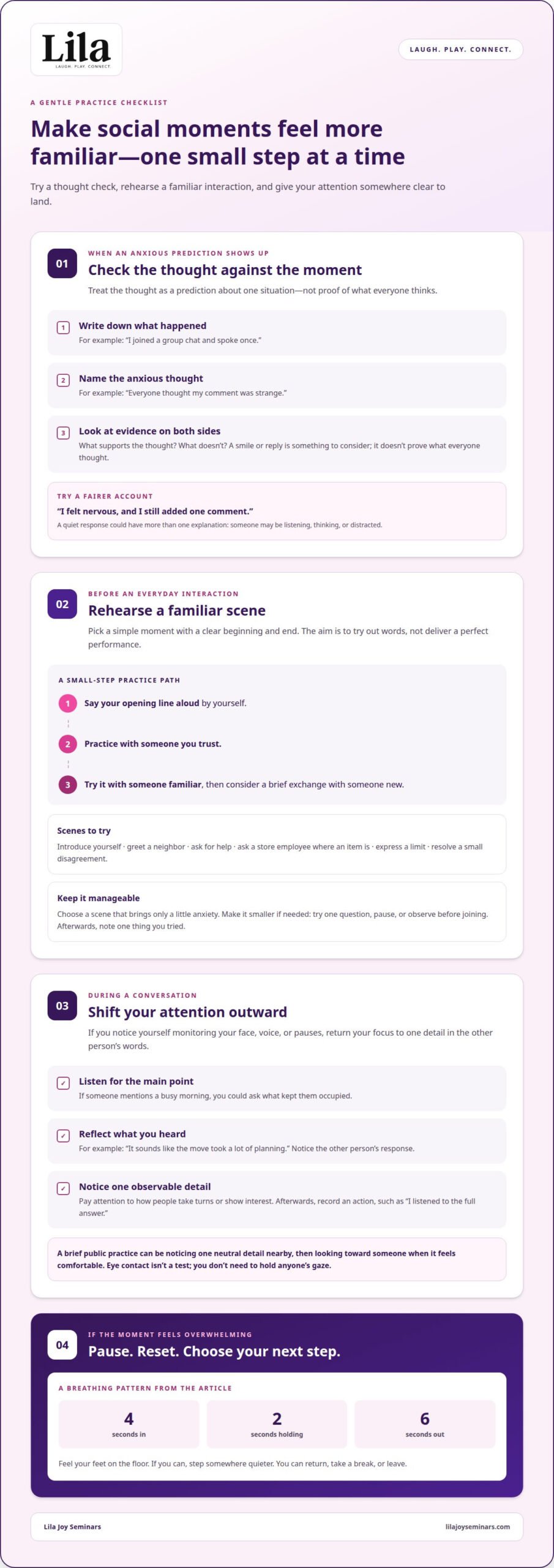
Try a three-step thought check after a conversation. First, write down the situation: “I joined a group chat and spoke once.” Next, note the anxious thought: “Everyone thought my comment was strange.” Then ask what evidence supports it and what evidence doesn’t. Perhaps someone smiled and replied, while nobody criticized you. That doesn’t prove what everyone thought, but it gives you more to consider than fear alone.
Now test how certain the prediction is. Ask, “Could there be another explanation?” A quiet response might mean someone was listening, thinking, or distracted. Replace the harsh conclusion with a balanced thought, such as, “I felt nervous, and I still added one comment.” This isn’t forced positivity. It’s a fairer account of the same moment. These activities for adults with social anxiety can make room for more than one interpretation.
If anxiety becomes overwhelming during a social activity, pause and step somewhere quieter if you can. Feel your feet on the floor, then try breathing in for 4 seconds, holding for 2, and breathing out for 6. You can return, take a break, or leave. You don’t have to push through the activity to prove anything.
Notice what triggered the thought: a pause, a missed greeting, or a memory of an earlier interaction. Record the situation and your first interpretation, then compare it with what you could observe. If the same fear returns, use the same check again rather than treating repetition as proof. The aim isn’t to erase anxious thoughts, but to meet them with specific evidence and a less punishing explanation.
2. Role-playing social scenarios
Role-play lets you rehearse a social moment before it happens. Keep the scene familiar, such as greeting a neighbor or joining a conversation. One person can play the neighbor while you practice a simple opening, like, “How has your day been?” Then switch roles and notice how the exchange feels from each side. The point is to try out words, not deliver a perfect performance.
Choose a scene with a clear beginning and end. For example, practice introducing yourself, asking for help, resolving a small disagreement, or expressing a limit. A group can act out a short skit after ten minutes of preparation. Keep the goal modest: say your name, ask one question, or try one calm response. Afterwards, discuss what felt manageable and what brought up distress, without grading anyone’s effort.
Free or low-cost practice in the U.S. can start at home with someone you trust. Rehearse a brief introduction, or take turns practicing how to ask a store employee where an item is. These activities don’t require a formal group or special equipment. A shared walk can also provide a gentle setting to practice greetings and short exchanges.
For gradual practice, begin with a scene that brings only a little anxiety. First, say your opening line aloud by yourself. Next, practice it with someone you trust. Then try the same greeting with someone familiar before attempting a brief exchange with someone new. Move at a pace that feels workable. The point is to approach a situation in small steps, not force yourself into the hardest one.
If a scene feels too intense, make it smaller. Replace a full conversation with one question, or ask your practice partner to pause. You can also observe a role-play before joining. Afterwards, name one thing you tried, such as staying in the conversation for another moment. That specific detail gives you a useful record of the experience without turning practice into a test.
3. Shifting attention toward other people
During a conversation, focusing on your face, voice, or pauses can pull your attention inward. The Centre for Clinical Interventions explains that unhelpful attention patterns can maintain social anxiety. Try a simple reset: notice when you start monitoring yourself, then listen for one detail in the other person’s words. If someone says they’ve had a busy morning, you might ask what kept them occupied. That gives your attention somewhere clear to land.
Try a simple observation exercise with someone familiar. Listen for their main point, then reflect it back: “It sounds like the move took a lot of planning.” Notice their response rather than judging your own delivery. You can also pay attention to a conversation’s rhythm, such as how people take turns or show interest. These details give you something concrete to focus on instead of guessing whether you seem anxious.
For a brief public practice, the Centre for Clinical Interventions describes catching a stranger’s eye for a moment. Keep it natural and respectful, perhaps with a small smile as you pass someone. Eye contact isn’t a test, and you don’t need to hold anyone’s gaze. If that feels like too much, start by noticing one neutral detail nearby, then briefly look toward someone when it feels comfortable.
Afterward, note one sign of progress: “I listened to the full answer” or “I asked a follow-up question.” This records an observable action, not a verdict on how the interaction went. Repeat the same practice in a low-pressure conversation before trying it in a larger group. These attention exercises can support social practice, but they aren’t therapy or treatment for social anxiety. If anxiety makes daily interactions difficult, professional support is a separate option.
Think of outward attention as a direction to return to, not a standard you have to meet throughout an interaction. The Centre for Clinical Interventions’ social anxiety materials note that attention can automatically settle on unhelpful things and sustain social anxiety, and describe a way to retrain it. One small practice is to briefly catch a stranger’s eye while keeping your broader focus on others rather than yourself.
4. What low-pressure solo activities can help with social anxiety?
A quiet practice can give your attention somewhere steady to rest. Try a 10-minute mindfulness practice: sit comfortably, notice your breathing, and gently return your focus when thoughts wander. A daily practice may support physical and psychological functioning. Regular mindfulness is also associated with reduced anxious and depressive symptoms, alongside positive mood, compassion, and resilience. Treat it as a small pause, not another task to do perfectly.
Grounding can bring attention back to the present moment. Try the 5-4-3-2-1 method: notice five things you see, four you feel, three you hear, two you smell, and one you taste. Take your time with each sense. You might do this while sitting at home or waiting in a public place. The steps give your mind specific details to notice instead of leaving it caught in anxious predictions.
Gentle movement is another solo option. A walk around your neighborhood, stretching at home, or riding a bicycle can make physical activity feel more approachable. Regular exercise supports physical and mental health. If possible, make 30 minutes per day a priority, while choosing movement that fits your body and day. A short walk can be a starting point; you can decide whether to continue once you’re outside.
After an activity, write one brief observation. During mindfulness, that might be, “I noticed the sound of the fan.” After a walk, note how your body felt before and afterwards. Focus on what you observed, not on scoring your progress. If an exercise feels uncomfortable, choose another, such as quiet stretching instead of sitting still. These solo activities can offer moments of calm and help you become more familiar with your responses. They can complement social practice, but they don’t replace therapy or other professional support when anxiety disrupts daily life.
Lila Online Improv Classes
Lila offers adults live online improv classes, where playful group activities create space to respond, listen, and connect in the moment. These classes offer a way to practice social interaction, not therapy or treatment for social anxiety. If you’re curious but unsure about joining, you can try your first online class for free, with no credit card required.
Classes take place on Zoom, and members can choose from the class calendar. The ongoing membership offers unlimited live classes for $100/month, with the option to cancel any time. This may suit you if you’d like regular, low-pressure opportunities to take part rather than practice alone.
For a gentle first step, try a free class with Lila.
Choose one small step to carry forward
You don’t have to turn a new idea into a big plan. Pick one moment that feels within reach, such as asking a follow-up question or joining a short group activity. Make room to practice in a manageable way, then notice what you learn about yourself. Activities for adults with social anxiety can be invitations to explore, not tests you need to pass.
If you’d like a playful place to practice listening, responding, and connecting with others, an improv class could be one option. It isn’t therapy or treatment for social anxiety, and you can participate at your own pace. Your first step can simply be deciding whether this kind of group activity appeals to you.
Explore a next step with Lila’s classes whenever you feel ready. You can begin gently, one moment at a time.
Frequently Asked Questions
What activities help adults with social anxiety?
Structured, low-pressure activities can offer an easier starting point, such as a board game with a friend, a small craft gathering, or helping prepare snacks for a shared event. A clear, shared task gives you something to focus on besides conversation. Choose an activity that interests you and a manageable way to participate, such as asking someone about the game or helping with one simple task.
When should adults with social anxiety seek professional help before trying group activities?
Consider professional support if anxiety makes everyday interactions difficult or disrupts daily life. You can still approach group activities at a workable pace, taking a break or observing before you join.