


What if building confidence for introverts didn’t mean becoming the loudest person in the room? It can start with treating nerves as a feeling, not a verdict on your social skills, and choosing small ways to join in. You don’t have to become someone else to feel more at ease around people.
If small talk feels tiring or you replay conversations afterward, you’re not alone. Confidence can grow at your own pace, without forcing yourself to perform. You can reframe nerves, set personal goals, take manageable initiative, and build rapport beyond small talk. Focus on listening, sharing a little more, and finding genuine points of connection, so social moments feel less like a test and more like a chance to connect.
Key Takeaways
- Notice when nerves lead to harsh self-talk, then try a kinder, more useful way to describe what you’re feeling.
- Set social goals that fit your own pace and values instead of measuring yourself against more outgoing people.
- Take small, manageable initiatives in conversations, while paying attention to your energy and giving yourself room to pause.
- Move beyond small talk with attentive listening and genuine curiosity about the other person.
1. Reframing nerves, stress, and self-critical thinking
Before a gathering, notice what your nerves are saying. Perhaps your shoulders tighten, or you think, “I’ll have nothing to say.” That feeling is information, not proof that you’re bad at connecting. Try naming it plainly: “I feel tense because this is unfamiliar.” This small shift can interrupt the jump from a physical sensation to a harsh judgment. Your self-image shapes how you enter conversations, but it doesn’t dictate what every friend or new acquaintance thinks of you.
Replace sweeping labels with specific, kinder observations. “I’m awkward” can become “I felt quiet at the start, then asked Maya about her weekend.” The second thought gives a concrete example and leaves room for growth. Before a social call, write down one worry and one grounded response, such as, “A pause might happen, and I can take a breath.” Positive self-talk isn’t pretending everything feels easy. It’s choosing words that help you stay present instead of judging yourself mid-conversation.
To build self-esteem and recognize your strengths, write down one moment from the day when you showed a quality you value. Perhaps you listened closely to a friend, made someone laugh, or spoke up even while nervous. Naming the action gives your thinking something concrete to return to, rather than a vague verdict about your personality. A quiet nature isn’t a flaw to correct; qualities like thoughtfulness and careful listening can support meaningful connections. Keep the examples in one note and add to it when you notice another strength.
Consider therapy if fear or low confidence causes ongoing distress or makes everyday activities, relationships, or work harder to manage. A licensed mental health professional can help you explore what’s happening and discuss support suited to your needs. Everyday practice for building confidence for introverts is different from therapy, which can offer dedicated help when anxiety feels difficult to handle alone. You don’t need to wait until things feel unbearable to seek that conversation.
2. Setting personal goals rather than comparing yourself with others
Introversion describes a preference for quieter settings or time alone to recharge; it isn’t the same as social anxiety. Social anxiety involves fear of social judgment that may feel intense or interfere with everyday life. Choosing a quiet dinner over a crowded party, for example, can reflect personal preference. Avoiding a needed conversation because of persistent fear may be worth discussing with a mental health professional.
Choose a goal you can control instead of trying to match someone else’s ease in a group. If a confident friend starts conversations with everyone, your goal might be to ask one person about a shared interest. Afterward, note what you did, such as, “I asked Jordan about the book they brought.” This gives you a clear measure of progress: you acted on your intention, regardless of how long the conversation lasted.
Choose events for a reason that matters to you. A gardening talk, board-game night, or book-club meeting gives you a natural topic and a shared point of interest. You might aim to stay for the part you enjoy and speak with one person about the activity. That can feel more comfortable than attending a large gathering only because friends expect you to go. You don’t need to replace your reserved nature; let it shape how you take part.
Accepting your qualities also means making space for the ones you sometimes find difficult. If you need quiet after a busy day, treat that need as useful information when choosing plans, not evidence that you’re failing socially. Keep a short record of moments you value, such as listening carefully or asking a thoughtful follow-up. If you’d like support turning personal reflections into workable goals, one-to-one online life coaching is available, and many coaches offer a free intro session.
3. Taking initiative in social interactions
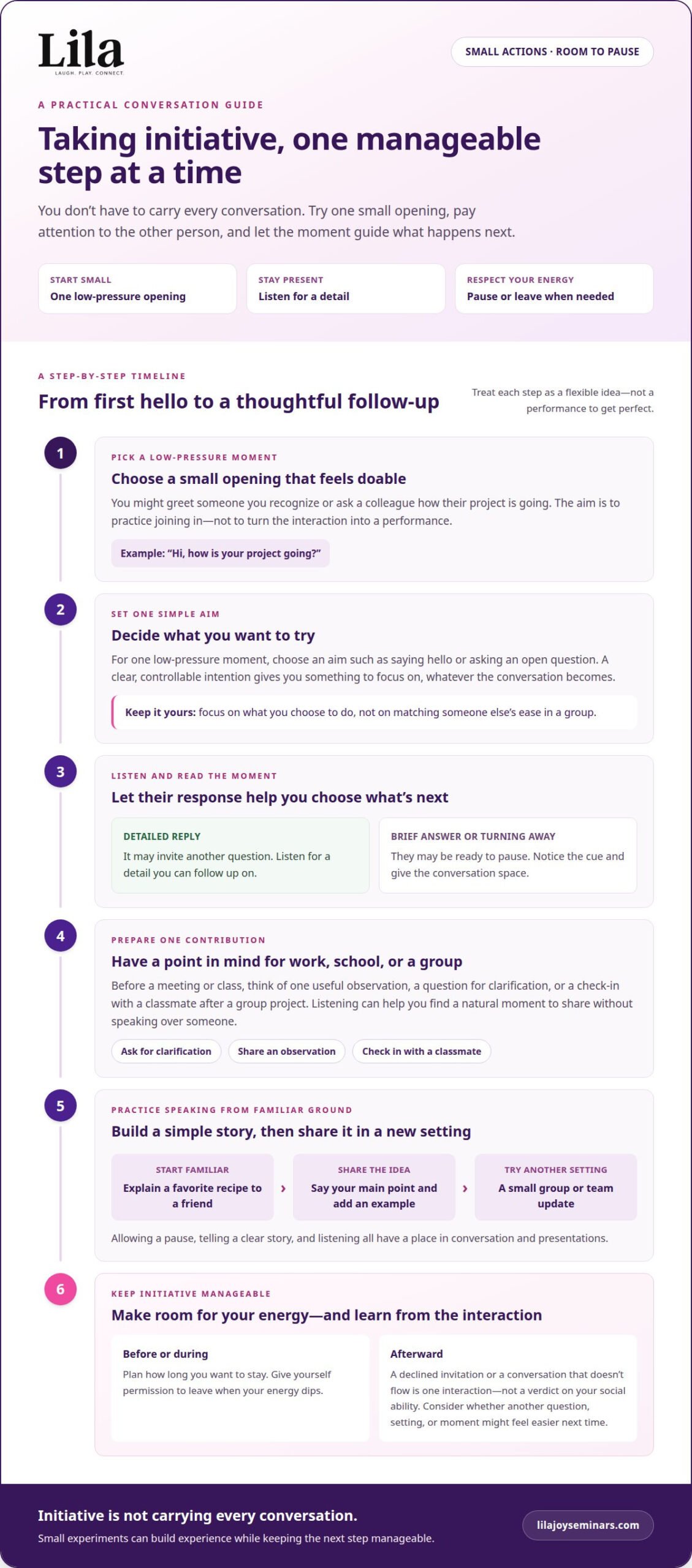
Taking initiative doesn’t mean carrying every conversation. Try one small opening: ask a colleague how their project is going, or greet someone you recognize. Then listen for a detail you can follow up on. These manageable actions let you practice social skills without turning an interaction into a performance.
For a practical exercise, choose one low-pressure moment and set a simple aim, such as saying hello or asking an open question. Notice the other person’s cues: a detailed reply may invite another question, while brief answers or turning away can signal they’re ready to pause. Either way, you’ve practiced responding to the situation, not just planning what to say next.
At work or school, prepare one contribution before a meeting or class. You might ask for clarification, share a useful observation, or check in with a classmate after a group project. Having a specific point in mind can make it easier to join in, while listening helps you choose a natural moment rather than speaking over someone.
To practice speaking in front of others, start with a familiar topic, such as explaining a favorite recipe to a friend. Say your main point aloud, then share an example to support it. Later, try the same idea with a small group or during a team update. Conversation and presentations both draw on clear storytelling, attentive listening, and allowing a pause without rushing to fill it.
Plan how long you want to stay at an event, and give yourself permission to leave when your energy dips. If someone declines an invitation or a conversation doesn’t flow, treat it as one interaction, not a verdict on your social ability. Consider what you learned: perhaps a different question, setting, or moment would feel easier next time. Small experiments build experience while keeping initiative manageable.
4. Building rapport and moving beyond small talk
Rapport grows through small exchanges that show you’re listening, not through a perfect story. If someone says they spent Saturday painting, ask what they enjoyed painting. Their answer gives you a fresh thread to follow, such as a favorite color, a class, or a room they’re decorating. A specific follow-up feels more personal than quickly switching to another safe question.
Try a simple conversational rhythm: notice a detail, ask about it, then share a little of your own experience. If a neighbor mentions a new café, ask what they ordered, then say you enjoy finding quiet places to read. That small piece of self-disclosure gives the other person something to respond to. It also keeps the conversation from feeling like an interview where one person asks every question and shares nothing.
Move just beyond your comfort zone at a manageable pace. At a book-club gathering, you might share what drew you to the novel, then ask another reader which character stood out. If they respond with enthusiasm, stay with that topic. If they give a brief answer, let the exchange settle or shift gently. The aim isn’t to uncover someone’s whole life in one conversation. It’s to notice where interest is mutual.
Meaningful relationships often take shape through repeated, ordinary moments: remembering a colleague’s garden project, asking how it went, and sharing a small update of your own. These details show care without requiring a dramatic confession or constant talking. Let pauses happen, too. A quiet moment can give both people space to think, rather than signaling that you’ve failed. The takeaway is simple: follow one genuine detail, offer one honest detail of your own, and see whether the other person meets you there.
Listening can make social interactions feel more engaged by showing people you’re interested in them. Giving someone your attention helps convey that interest and supports a more meaningful exchange.
Lila
Lila is an ongoing live online improv membership for adults who want a playful way to practice connecting with others. Through interactive improv games and group reflection, you can practice listening closely, responding in the moment, and adding your ideas to a group exchange. You can take part at your own pace in a warm, supportive setting. The classes are a personal-growth practice, not therapy or treatment for social anxiety.
New students can try one free online improv class, with no credit card required. It’s a low-pressure way to experience the group format and see whether it suits you. Try a free class with Lila and see how it feels.
Let your next step feel like your own
Confidence doesn’t need a grand entrance. It can begin with one choice that feels a little more open than yesterday: joining a conversation, asking a thoughtful question, or letting someone see a bit more of who you are. Building confidence for introverts isn’t about changing your nature. It’s about finding ways to connect that leave room for it.
You can take that step gently. Notice what feels inviting, give yourself time to settle in, and let curiosity guide the exchange. Some days, a small hello will be enough. Another day, you may feel ready to stay in the conversation a little longer. Both count as taking part in your own way.
If you’d like a playful space to explore connection with others, try a free online class with Lila. Start with curiosity, not pressure, and see what feels right for you.
Frequently Asked Questions
What are gradual exposure steps for overcoming social anxiety?
Build a gentle ladder of social situations, starting with one that feels manageable rather than overwhelming. For example, attend a familiar gathering briefly, then try introducing yourself to someone new at a community event. Repeat each step until it feels more familiar before choosing a bigger stretch. This is a way to practice participation, not a substitute for professional support or treatment for social anxiety.
How can introverts set boundaries without feeling guilty?
State your limit kindly and clearly, without giving a long explanation. You might say, “I can join for dinner, but I’ll head home afterward,” or, “I can’t take that on this week.” A boundary communicates what works for you; it doesn’t reject the person asking. If guilt shows up, pause before changing your answer and remember that making time for rest can help you show up more willingly later.
How can introverts build friendships and professional networks comfortably?
Look for settings where conversation has a shared purpose, such as a volunteer project, a professional workshop, or a hobby group. A common activity makes an opening feel more natural than approaching someone without context. After meeting someone you’d like to know better, send a brief note mentioning what you discussed and suggest a simple next step, such as exchanging ideas over coffee or attending another event together.