


Social awkwardness isn’t a verdict on who you are. If you’re wondering how to be less socially awkward, start with small, low-pressure steps: notice what’s happening around you, ask a simple question, and allow yourself to pause. Feeling unsure in one conversation doesn’t mean you’ll feel that way everywhere.
It makes sense if small talk sometimes feels like a test, or if you replay a conversation afterward and wonder what you should have said. You don’t need to become the loudest person in the room or come up with the perfect line. A little practice, self-compassion, and attention to the other person can help everyday interactions feel more natural.
This article explores what social awkwardness can mean, why it varies from one situation to another, and practical ways to feel more at ease. You’ll find gentle ideas for starting conversations, easing tension in your body, and finding opportunities to connect through activities and shared interests.
Key Takeaways
- Use simple questions and gentle self-talk to make everyday conversations feel less like a performance.
- Choose an activity you enjoy as a natural way to meet people and share a common focus.
- Notice tension in your face and body, then soften it with a relaxed posture and comfortable gestures.
- Awkwardness can depend on the situation; understanding what feels difficult for you can help you choose a manageable next step.
1. Small talk, mindfulness, and self-compassion
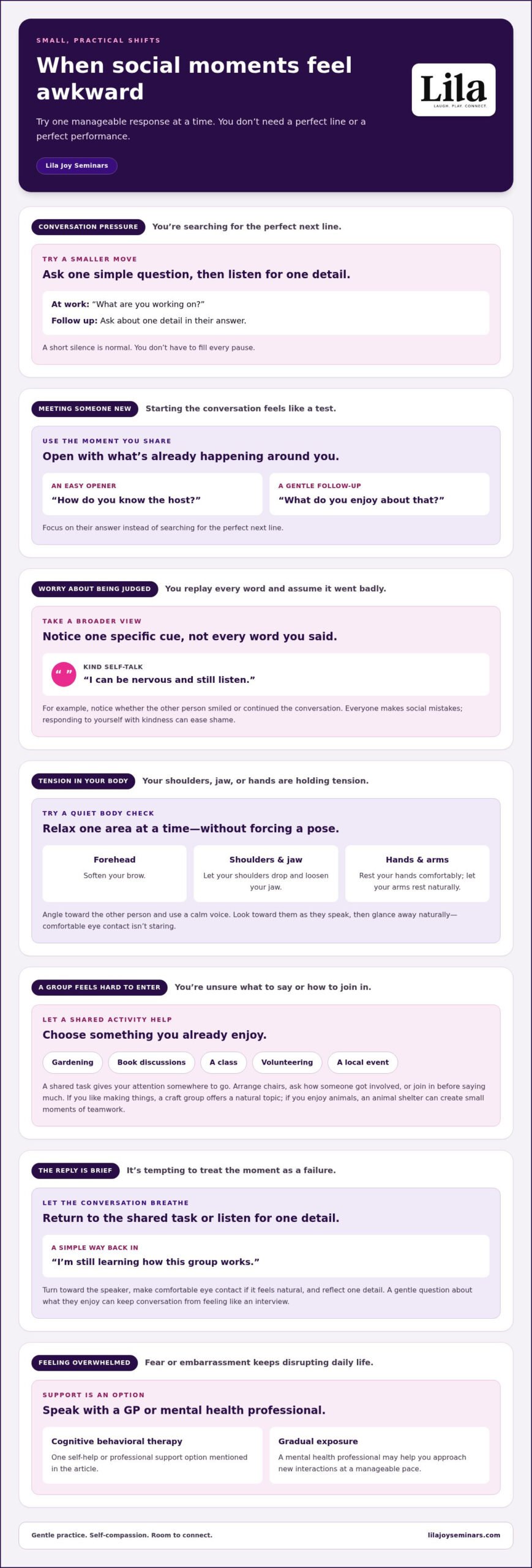
A practical way to be less socially awkward is to choose one small action: ask a question, notice your breathing, or stay present through a pause. In a brief interaction, ask a colleague, “What are you working on?” and listen for one detail to follow up on. If you feel awkward, notice the feeling in your body without rushing to push it away. Take a belly breath and let your abdomen move outward as you inhale.
To start a conversation with someone new, try an everyday opener such as, “How do you know the host?” Then build on their answer with a gentle follow-up: “What do you enjoy about that?” Focusing on one detail helps you stay in the moment instead of searching for the perfect next line. A short silence is normal; you don’t have to fill every pause.
If fear of being judged takes over, take a broader view before deciding the interaction went badly. Notice a specific detail, such as whether the other person smiled or continued the conversation, instead of replaying every word. Try calming self-talk: “I can be nervous and still listen.” Everyone makes social mistakes. Responding to yourself with kindness can ease shame and support confidence.
For self-help, practise a simple affirmation before a gathering, such as, “I can be curious, not perfect.” Walking, calming music, reading, or breath work may also help you settle. If social situations feel overwhelming or fear of embarrassment keeps disrupting daily life, speak with a GP or mental health professional. Cognitive behavioral therapy is one option; a mental health professional may also use gradual exposure to help you approach new interactions at a manageable pace.
2. Joining activities and community groups
A shared activity gives a conversation a natural starting point. Choose a community group, volunteer role, or class connected to something you already enjoy, such as gardening, book discussions, or helping at a local event. A shared task gives your attention somewhere to go besides your own awkward feelings. You can talk while arranging chairs, ask how someone got involved, or simply join in before saying much.
Start with a setting that draws on a strength you already have. If you like making things, a craft group offers a natural topic; if you enjoy animals, volunteering at an animal shelter can create small moments of teamwork. The goal isn’t to impress everyone or become close right away. It’s to make social interaction part of something meaningful to you, allowing learning and connection to grow side by side.
During conversation, practise active listening instead of planning what to say next. Turn toward the speaker, make comfortable eye contact if it feels natural, and nod to show you’re following. Then reflect one detail: “So you started painting after moving here?” A gentle question about what they enjoy can keep the conversation from feeling like an interview. Listen for what matters to them, not just for your next opening.
If a reply is brief, let the conversation breathe instead of treating it as a failure. You might say, “I’m still learning how this group works,” or ask someone to show you how they’re doing a shared task. These simple words make it easier to rejoin because there’s a familiar activity to return to. With practice, noticing another person’s interests and responding warmly can make interactions feel more positive and less like a test.
3. Relaxing facial and body tension
Before joining a conversation, notice where your body is holding tension. Are your shoulders raised, jaw clenched, or hands gripping a cup? Let your shoulders drop, loosen your jaw, and rest your hands comfortably. These small adjustments can make it easier to stay present instead of monitoring every movement. If anxiety makes your face feel tight, soften your brow rather than forcing a smile.
Open body language can signal interest without turning social skills into a performance. Angle your body toward someone, keep your arms comfortably uncrossed, and use a calm voice. You don’t need to copy every gesture or hold a fixed pose. A relaxed stance, a natural nod, and a friendly expression can show you’re open to conversation while still feeling like yourself.
Eye contact can help communicate attention, but comfortable eye contact doesn’t mean staring. Look toward the other person as they speak, then glance away naturally while thinking or responding. If looking directly at someone feels intense, focus briefly near their eyes or face. Notice their cues, too: a distant expression or turning away may suggest they’re ready to pause or leave.
Try a quiet body check before talking with friends or meeting someone new: relax your forehead, release your shoulders, and let your arms rest naturally. During the interaction, notice if tension returns and gently adjust one area. This isn’t about perfect posture; it’s a way to feel more comfortable in your body. Practising these simple skills in low-pressure conversations can help you find gestures that feel genuine, even when you’re anxious.
4. Signs and possible causes of social awkwardness
Social awkwardness can show up as uncertainty about when to speak, difficulty reading cues, or replaying a conversation afterward. For example, you might miss a hint that someone is ready to leave or worry that a pause means you said something wrong. These moments can feel uncomfortable, but one interaction doesn’t define how you’ll act in every situation.
Notice where and with whom the feeling appears. Someone may feel awkward at a crowded gathering but relaxed with close friends, or find workplace conversations easier than meeting new people. Expectations and social cues can vary between cultures, too. Introversion is different: an introverted person may prefer time alone and still feel at ease in social situations.
When might social awkwardness be a sign of social anxiety or another condition? Consider how much fear and avoidance affect daily life. Social anxiety may involve persistent worry about being scrutinized, humiliated, or embarrassed, leading someone to avoid interactions at school, work, or social events. Social awkwardness alone doesn’t establish a diagnosis or prove there’s another condition.
To understand your own pattern, note the situation, what you feared might happen, and what actually happened. For instance, after a conversation, record whether the other person kept talking or said goodbye; a quick head nod can sometimes signal they’re finished. If fear repeatedly limits everyday activities, talk with a GP or mental health professional. Learning how to be less socially awkward can begin with noticing which situations feel difficult, rather than judging yourself as awkward everywhere.
Let the next conversation be a small beginning
You don’t have to transform your personality to feel more at ease with people. Choose one gentle experiment for your next conversation: stay curious for one more exchange, pause before judging how it went, or join an activity where talking can grow around a shared interest. Then notice what felt a little easier. That’s useful information, not a test you need to pass.
Learning how to be less socially awkward can mean making room for your own pace while staying open to connection. Some days, a hello is enough. Other days, you may feel ready to keep talking or try something new. Both are worthwhile steps.
If you’d like a playful place to practise spontaneity and connection with others, try a free live online improv class with Lila. You can take the next step when it feels right for you. There’s no need to be polished; just begin where you are.
Frequently Asked Questions
What does it mean to be socially awkward?
Being socially awkward usually means finding some social exchanges harder to navigate, not being incapable of connection. You might speak quickly when nervous, struggle to enter a group conversation, or wonder afterward whether your response came across as intended. The experience depends on the setting and the people involved. It describes difficulty in certain moments, not your whole personality or your ability to build relationships.
What about awkward workplace conversations?
At work, make the purpose of the conversation clear and use direct, considerate language. If a task is confusing, try, “Could you walk me through the part I should prioritize?” Before giving presentation feedback, decide what you want to say and offer a useful next step. If a colleague regularly talks over you, calmly name what’s happening and ask to finish your thought.
What can I do now?
Choose one small action you can take today, such as sending a friendly follow-up after a conversation or accepting an invitation that feels manageable. Keep the goal specific: reconnect with one person rather than trying to feel completely confident. Afterward, write down one thing you learned about the situation. This gives you a useful reference for next time instead of relying only on a worried first impression.
What makes someone awkward?
There isn’t one cause. You might feel unsure because a setting is unfamiliar, the conversation moves quickly, or its unspoken expectations are hard to read. Stress can also make it harder to find words or notice other people’s responses. Culture and context shape what feels natural, too. Someone who seems awkward in one group may feel at ease with familiar people or around a shared activity.
What are good questions to ask to avoid awkward silence?
Ask questions that invite a story, then share a little of your own. Try, “What brought you here today?” or “What have you been enjoying lately?” At a gathering, you might ask, “Have you tried anything good from the snacks?” If an answer is brief, let the pause rest or offer a related thought of your own. Conversation can flow naturally without becoming a string of questions.
How can I improve active listening and body language?
Practise responding to the meaning of what someone said instead of just waiting for your turn. Briefly paraphrase their point, then leave space for them to correct or add to it. Keep your voice at a comfortable volume and let your expression respond naturally. Rather than copying someone’s movements, notice whether they seem engaged and adjust your pace or distance with care.