


What if feeling more playful didn’t mean becoming the funniest or most spontaneous person in the room? If you’re wondering how to feel more playful as an adult, it can be hard to make space for fun when the day is already full of responsibilities. The thought of looking awkward or having to entertain someone can make play feel like one more thing to get right.
You don’t have to be silly on cue or impress anyone. Playfulness can begin with a small moment of curiosity, a shared laugh, or trying something simply because it interests you. This article offers gentle, low-pressure ways to bring more lightness into ordinary days, without asking you to pretend to be someone you’re not.
You’ll find simple ideas to try on your own or with others, plus a look at guided group improv. Lila’s live online improv classes use interactive games and group reflection to make room for shared play. No improv experience is needed. Start wherever you feel comfortable.
Key Takeaways
- Learn how to feel more playful as an adult by treating playfulness as curiosity and enjoyment, not a demand to be funny or silly.
- Explore solo, shared, creative, or movement-based play, and notice which feels most comfortable for you.
- Use a gentle progression: notice an opening, choose something that interests you, try it briefly, then reflect without judging yourself.
- Explore guided group improv as one way to play with others in a supportive setting, without needing prior experience.
- Find out what Lila’s live online classes involve: Zoom sessions of one to two hours, with interactive games and group reflection.
What Does It Mean to Feel More Playful as an Adult?
Wanting more lightness doesn’t mean you’re ungrateful for your life or need to change your personality. Adult days can be full of plans, errands, work, and care for other people. In the middle of all that, it’s natural to miss doing something simply because it catches your interest. You don’t need a free afternoon or a big new hobby to begin noticing those moments.
Playfulness is a curious, open way of enjoying an experience, not a requirement to be funny or outgoing. It can be quiet or shared, creative or active, planned or brief. You might pause to notice the shape of a cloud, make up a small story about a passing dog, or take a different route just to see what’s there. These moments don’t need an audience or a particular result.
There’s no single adult version of play to copy. A useful overview of the concept of play describes its varied forms and presence across life stages. For you, a playful moment might mean following a question, experimenting with a recipe, or enjoying a conversation that takes an unexpected turn. The point isn’t to do more. It’s to meet some part of the day with a little more interest.
Can you be playful without being silly?
Absolutely. Playfulness doesn’t require jokes, costumes, games, or anyone watching. If those things appeal to you, they can be part of it, but they aren’t the entry fee. You might notice an unusual shop window, choose a different walking route, or see how many shades of green you can spot on the way home. None of those has to feel right for you. Follow what sparks even a small amount of interest.
That distinction can help if you’ve been searching for how to feel more playful as an adult while worrying you’ll have to act like someone else. You can be thoughtful, reserved, and still playful. There’s no need to make a moment amusing for someone else. A private smile or a small experiment counts, even if nobody knows it happened.
Why can playfulness feel harder in adult life?
Schedules and responsibilities often leave little room for unstructured time. Many of us also learn to prioritize being capable, sensible, and focused. After a while, an activity without a clear purpose can feel hard to justify, even when it sounds appealing. You might catch yourself asking whether it’s worth the time or whether you’re doing it “right.”
Self-consciousness can add another layer. Perhaps you imagine looking awkward or wonder what others will think. That hesitation isn’t a flaw; it’s a familiar response when you’re unsure what’s expected. You don’t have to push past it all at once. Start with a moment that feels comfortable enough to explore, whether that means trying something alone or sharing a small laugh with someone you trust.
How Playfulness Can Bring More Curiosity Into Ordinary Days
Playfulness doesn’t have to become another item on your to-do list. It can be a way of meeting something you’re already doing. Instead of asking, “How can I fit in more fun?” you might gently wonder, “Is there anything here I haven’t noticed?” There’s no need to make every routine enjoyable or turn lightness into a new personal goal. A moment of interest is enough.
A small playful choice can turn a familiar task into a moment of discovery, without changing the task itself. The walk is still a walk. The dishes still need doing. But your attention gets a little room to wander, and the moment may feel less automatic.
Playfulness is a way of approaching the moment
Imagine taking your usual walk and noticing which windows have plants, or wondering where a side street leads. You haven’t added an activity; you’ve brought fresh attention to the one already happening. While doing a household task, you might listen for a favorite song or try a different order. In conversation, you could follow an unexpected question instead of steering straight back to the usual topic.
These small shifts aren’t tricks for making chores exciting. Some days, a chore is just a chore. The invitation is to notice when curiosity appears and give it a little space, if that feels welcome. You might find yourself more engaged with the details around you, or share a moment of amusement with someone nearby. There’s no required outcome to measure.
Small moments count, even when life is busy
A playful moment can last a few seconds: spotting a funny-shaped cloud, humming while you make lunch, or sending a friend a question you’re genuinely curious about. It can be solitary or shared, quiet or energetic. And if you don’t feel like playing today, that’s fine too. You don’t need to reach a daily quota or turn every spare minute into an opportunity.
To find a small opening, notice where your attention naturally goes. Maybe you linger over a color, get curious about a sound, or enjoy an unexpected turn in a conversation. You can follow that thread briefly or let it pass. Both are choices. If you’re curious about bringing more openness to everyday moments, explore small steps toward everyday spontaneity as an idea to carry into familiar routines.
Over time, noticing these openings can make ordinary life feel a little less scripted. Not because every day becomes carefree, but because you’ve allowed yourself to respond to what catches your interest. For a shared way to explore playful curiosity, Lila’s live online improv classes use interactive games and group reflection in a guided setting.
Which Kind of Playfulness Feels Right for You?
Play doesn’t have to be a group activity, a performance, or a test of how funny you are. A useful starting point is something that feels interesting enough to try and comfortable enough to enjoy. Your energy, surroundings, and mood can all shape what fits. A quiet idea at home can be just as playful as a lively activity with friends.
Use this comparison as a menu, not a checklist. You can adapt any idea to suit your space and energy, or skip it if it doesn’t appeal.
| Kind of play | Setting | Energy | Low-pressure example |
|---|---|---|---|
| Solo | Private or on your own | Low | Arrange a few objects in an amusing pattern, then put them back. |
| Shared | With one person or a group | Low to lively | Ask a friend to help invent a name for an oddly shaped snack. |
| Creative | Wherever you have a little space | Quiet or focused | Make a tiny collage from paper scraps, with no finished result in mind. |
| Movement-based | At home or outdoors | Gentle to energetic | Put on one song and move in whatever way feels comfortable. |
Solo play, shared play, and creative play
Solo play gives you privacy to follow an interest without explaining it. Shared play can be as simple as trading silly names for household objects with someone you trust. Creative play might mean sketching a made-up creature or arranging colors on a page. Make the idea smaller if you’re tired, or give it more room if you feel curious. There’s no required version.
Movement can be playful, too, without becoming exercise or a display. Swaying to music, stretching into a shape that feels new, or taking a few light steps around your room may be enough. You don’t need to enjoy every type. Think of these options as different doors, not levels to work through.
What if play feels awkward at first?
A little uncertainty is ordinary when you try something unfamiliar. You might feel self-conscious or wonder whether you’re doing it properly. There’s no audience to satisfy. If it feels easier, begin privately, keep the moment brief, or invite someone whose company feels comfortable. You can stop whenever you like; even testing an idea for a moment tells you something about what suits you.
If you’re considering how to feel more playful as an adult, let interest and comfort guide your choice, rather than how an activity might look to someone else. Ask yourself: Does this sound pleasant, intriguing, or simply easy to try? Choose the option that gets even a small yes. If none does today, wait for another moment. Playfulness doesn’t need to prove anything, and the right kind can change with your mood.
How to Make More Room for Playfulness in Everyday Life
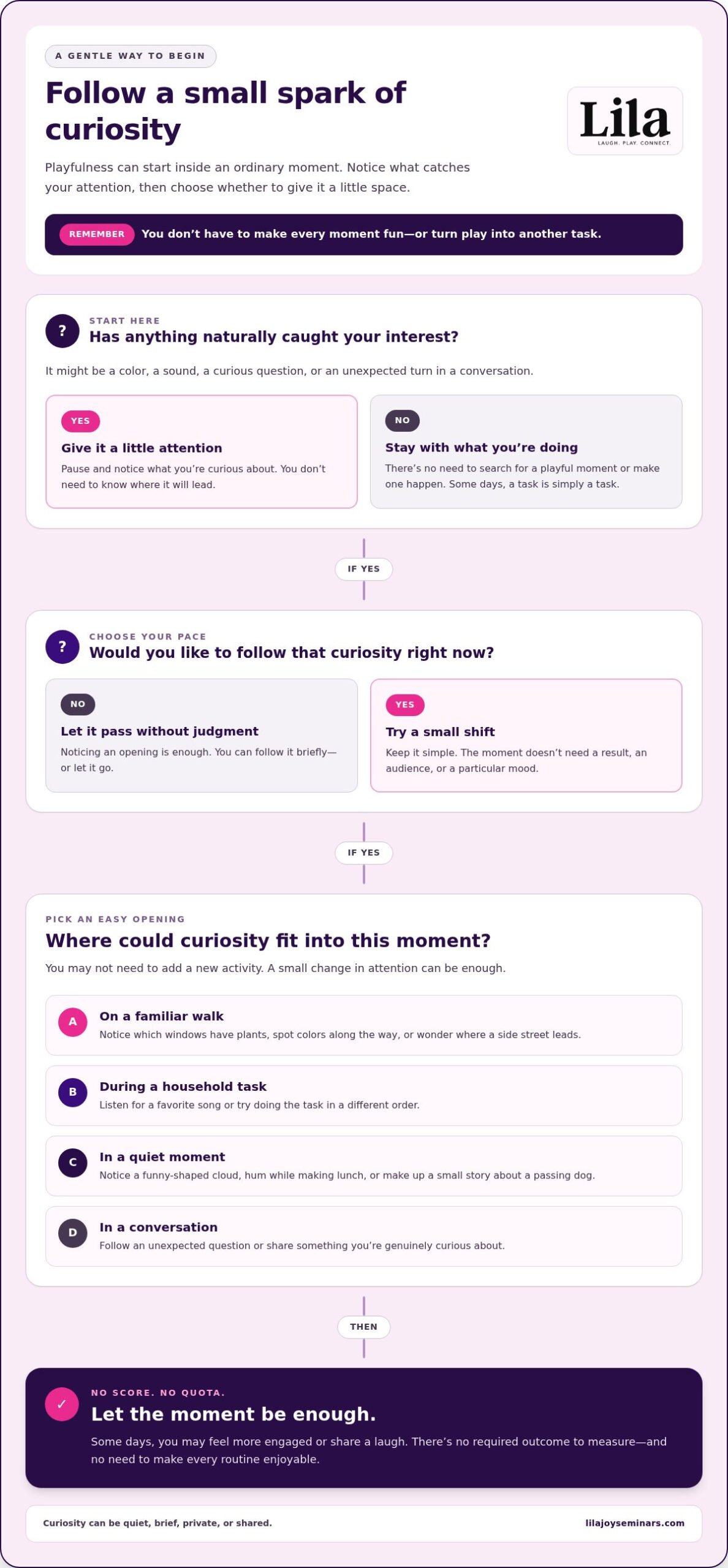
Playfulness doesn’t need its own appointment in your calendar. It can begin with noticing what already draws your attention, then making a small choice to follow that interest. Keep the process loose. This isn’t a routine to complete or another way to judge how well you use your time.
Notice what interests you, choose one small invitation, try it briefly, then reflect without judging. You can move through these steps in a spare moment, while doing something familiar, or not at all on a day when you’d rather rest.
Start by noticing what already makes you curious
Think of a recent moment when you felt absorbed, amused, or interested. Maybe you paused to watch light move across a wall, enjoyed a phrase in a conversation, or wondered what was around the next corner. You don’t have to write this down or explain why it caught your attention. Simply notice what holds your gaze, makes you smile, or invites a question.
You can also let your surroundings offer a quiet prompt. Is there a sound you hadn’t noticed? A familiar object that looks different from another angle? An ordinary choice you’re curious to change? This first step asks for attention, not a plan. You’re gathering possibilities, not setting a goal or promising yourself you’ll act on every one.
Choose one small invitation and let it be enough
Pick something that feels comfortable to try right now. Take a different path through a familiar room, make up a new use for an object, or change the order of a routine. If you enjoy making things, doodle while waiting for water to boil or arrange a few items in an unexpected way. No special supplies, spending, or reserved block of time is needed.
Let the idea stay small. You might try it for a moment, discover it isn’t enjoyable, and stop. You might adapt it or return to what you were doing. That’s not a failed attempt; it’s useful information about what feels right today. For a structured set of prompts to try, see simple improv exercises for everyday ease.
Afterward, reflect gently, without grading the experience. Did anything catch your interest? Did you feel at ease, or would you rather try something quieter next time? You don’t need to make a habit of tracking these moments. A passing thought is enough to help you notice what you might welcome again.
If you’re exploring how to feel more playful as an adult with other people, a guided setting can offer a shared starting point. Lila’s live online improv classes include live Zoom sessions, interactive games, and group reflection. No previous improv experience is required.
Explore Playfulness With a Supportive Online Improv Group
Trying something playful with other adults can feel easier when there’s a shared activity to begin with. You don’t have to arrive with jokes, clever ideas, or a big personality. A guided improv group offers a way to explore curiosity alongside others. It isn’t the only way to invite more lightness into your life; solo activities and small everyday experiments count, too.
What a guided improv setting can offer
In Lila’s live online improv classes, adults meet on Zoom for one to two hours. Classes include interactive improv games and group reflection. The games give people a shared starting point, while reflection offers room to notice what came up and hear others’ perspectives. You can take part without needing to make every moment funny or polished.
The classes are designed as a supportive, low-pressure space to explore personal growth, confidence, and communication. It isn’t performance training. The focus is on trying ideas and connecting with other people, rather than preparing to impress an audience. Each participant may experience a group setting differently. You can approach it at your own pace and let the activities be an opportunity to explore, not a test you have to pass.
If you’ve wondered how to feel more playful as an adult but feel uncertain about joining in, a shared activity can take some of the pressure off. You don’t have to generate a perfect idea before you arrive. You can respond to what’s happening in the moment, listen, and see what interests you. Sometimes the most comfortable first step is simply being part of a group where everyone is exploring together.
A small next step if you want to try it with others
No acting or improv experience is required to join Lila’s classes. You don’t need to identify as outgoing, quick-witted, or naturally spontaneous, either. The format gives you a chance to explore through guided activities, without needing to arrive with a plan for how you should feel.
Your first class is free, giving you a chance to experience the group before deciding whether you’d like to continue. Lila’s live online improv classes offer a guided way to explore play with other adults, alongside the small, comfortable ways of playing that already fit your life.
Let Curiosity Lead to Your Next Small Step
You don’t have to become a different person to welcome more play into your life. Let your next step be small enough to feel comfortable and interesting enough to draw you in. Maybe you follow a passing curiosity on your own, or perhaps you’d like to explore playfulness with other adults. Either choice is a good place to begin.
If shared, guided play sounds inviting, a free first class with Lila is a chance to experience it for yourself. You don’t need to arrive with experience or a plan for how you should feel. You can simply come curious and notice what the experience is like for you.
Learning how to feel more playful as an adult isn’t about being cheerful on demand. It’s about giving yourself permission to meet a moment with a little openness, in a way that feels like you. Start gently. Let curiosity set the pace, and trust that even a small beginning can make room for more lightness.
Try your first live online improv class with Lila for free.
Frequently Asked Questions
Can adults learn to be more playful?
Yes, adults can make more room for playfulness by noticing what sparks interest and choosing to follow it now and then. You don’t need to change your personality or adopt a new hobby. If you’re wondering how to feel more playful as an adult, start by giving yourself permission to explore without expecting a particular result. Even a small shift in how you approach a familiar moment can be a useful beginning.
Is it normal to feel awkward when trying to be playful?
Yes, feeling awkward is common when you’re trying something unfamiliar or worrying about how it appears to others. You might feel unsure about what to say or laugh a little nervously. That doesn’t mean you’re doing it wrong. Try choosing something with little audience or pressure, then notice whether the awkwardness eases, stays, or tells you this activity isn’t for you. You’re allowed to change your mind.
How can I be playful if I am shy or introverted?
You can explore playfulness in ways that suit a quieter temperament. Try making a private observation, choosing a new arrangement for something on your desk, or asking one trusted person a curious question. You don’t have to lead a group or keep a conversation lively. If you’re with others, listening closely and building on someone else’s thought can be a gentle way to join in.
What are simple ways to feel more playful during a busy day?
Look for a moment that’s already available instead of searching for extra time. While waiting for a page to load, invent a name for the next file you need to open, or choose a color to notice during a familiar commute. Keep it brief and optional. If the day feels too full, there’s no need to squeeze play in. A missed opportunity isn’t a setback.
Do I need to be funny to enjoy improv?
No, improv isn’t about arriving with a supply of jokes or making other people laugh on demand. You can listen, respond to what’s offered, and let a simple idea unfold. A quiet contribution can be enough. If you’re new to improv, you don’t need to prepare clever lines in advance. Curiosity and willingness to take part matter more than trying to be the funniest person there.
Can improv help adults feel more playful?
Improv can give adults a shared structure for exploring spontaneity, listening, and responding to others. That may feel like a helpful setting if you’d rather not invent an activity alone, though each person’s experience is different and no particular outcome is guaranteed. Lila offers adult-focused online improv classes built around interactive activities and reflection, with no prior improv experience required.
How can I make time for playfulness without adding another obligation?
Don’t schedule play as another task to complete. Instead, leave a little room for choice inside something you’re already doing. You might take a pause before answering a routine question, or let a conversation wander briefly when it feels enjoyable. There’s no need to repeat the same activity or track how often you do it. Let playfulness be an invitation, not a promise you have to keep.