


What if you didn’t need the perfect words to speak up? You might have a thought in the middle of a conversation, then quietly edit it until the moment has passed. If you’re wondering how to speak up more without overthinking, that pause can feel frustrating, especially when you’re also worrying about sounding awkward or being misunderstood.
It makes sense to want time to get your words right. But you don’t have to become louder, quicker, or more polished to contribute. A question, a brief response, or one specific detail you noticed can be enough to join in, even if it comes out a little imperfectly.
This gentle checklist will help you share thoughts sooner, stay with the conversation instead of rehearsing your next sentence, and feel more at ease in everyday exchanges. You’ll find ways to lower the pressure, choose manageable contributions, and use curiosity to find an opening. No perfect script or personality change required, just a little practice showing up as you are.
Key Takeaways
- Notice when you’re editing a thought instead of following the conversation, without treating every pause as a problem.
- Explore how to speak up more without overthinking by choosing a small contribution, such as a question, observation, or brief agreement.
- Use a flexible before, during, and after checklist to make joining in feel more manageable.
- Practise in familiar, low-pressure conversations where you can try sharing a thought without needing perfect words.
- Discover how playful improv exercises can help you listen, respond, and make room for ideas as they come.
Why speaking up can feel harder when you are overthinking
The conversation is moving along, and you have something to add. You shape the sentence in your head, swap out a word, then wonder if your point is quite right. By the time you’re ready, someone has changed the subject. That can feel disappointing, but it doesn’t mean your thought was unimportant or that you have nothing worthwhile to say.
Here, overthinking means repeatedly evaluating a possible contribution before deciding whether to share it. You might weigh its relevance, wording, timing, and likely reception all at once. For a general description of the pattern, see What is Overthinking? In ordinary conversation, that mental review can take longer than the opening you were waiting for.
A thoughtful pause helps you choose your words; endless self-editing keeps moving the finish line. You can care about what you say without reviewing every sentence until it feels completely safe. A comment can be considerate and still be spontaneous, simple, or a little unfinished.
What the inner editing loop can sound like
Perhaps you hear a question and think, “Is this relevant?” Then: “Will this sound strange?” A moment later: “Should I wait?” Each question might seem small, but trying to predict every reaction can delay an easy response. You may be checking the topic, your tone, and other people’s faces before deciding what you actually want to say.
This happens to people for different reasons, and a quiet moment by itself isn’t a sign that anything is wrong. Sometimes you’re listening, thinking, or simply comfortable letting someone else speak. Notice the loop when you want to join in but repeatedly talk yourself out of it.
Why speaking up does not require becoming louder
Speaking up isn’t the same as taking over. You don’t have to tell a long story, jump into every silence, or become the most talkative person in the room. One clear sentence can be enough: “I noticed that too,” “What happened next?” or “I see it a little differently.” A small contribution is still participation.
If you’re exploring how to speak up more without overthinking, the aim isn’t to replace your personality with a louder one. Quietness and thoughtfulness can stay. You’re making a little more room to share, ask, or respond at a pace that feels manageable. Some moments will feel easier than others, and that’s okay. You’re not trying to say everything, only to let a thought out before editing it away.
How to notice the moment overthinking starts taking over
A useful first step is spotting what’s happening without turning it into another thing to get right. Going quiet doesn’t automatically mean you’re overthinking. You might be listening closely, gathering your thoughts, or simply have nothing to add. The clue is often where your attention is: are you following the conversation, or judging how your next response might sound?
Common signs you are editing instead of listening
You may notice you’re rehearsing a reply while the other person is still speaking. Perhaps a natural phrase comes to mind, then you silently replace it with something more polished or impressive. You might wait until you’re certain your comment will land well. These signs don’t prove anything is wrong; they’re clues that your attention has shifted from the conversation to editing yourself.
Try this quick check when you realize you’ve gone quiet:
- Am I listening to what’s being said, or preparing a perfect response?
- Am I changing my words because they need clarity, or because I’m trying to predict every reaction?
- Would I like to respond, or would I rather keep listening right now?
You don’t have to answer all three. Even one honest answer can help you choose what to do next. You might return your attention to the speaker, ask a question when there’s a natural opening, or decide not to contribute this time. The point is to notice the choice, not force yourself to speak.
A kinder check-in for the moment you go quiet
Ask yourself, “Am I listening, or am I preparing a perfect response?” Then name what you notice privately: There’s the editing loop, or I’m waiting to feel completely sure. Keep the tone neutral. You don’t need to scold yourself, fix the feeling, or speak just to prove you can.
You can notice a thought without having to obey it. The thought “I might sound awkward” can be present while you still listen, ask a question, or let the moment pass. Naming it gives you space to decide what feels right. It’s an idea that also appears in practical guidance on speaking up without overthinking.
The goal isn’t to monitor every word more closely. That can turn awareness into another round of self-editing. Instead, use the check-in as a soft reset: notice where your attention went, then bring it back to the person speaking. From there, decide whether to respond now, wait for a natural opening, or keep listening.
If responding in the moment feels easier to practise through play, Lila Joy Seminars’ live online improv seminar uses interactive games and group reflection to explore spontaneity and communication. No prior improv experience is needed. The seminar offers one way to practise sharing an idea without planning every word first.
Choose a small way to join the conversation
You don’t need a finished speech to take part. Often, an opening is already in the conversation: something someone mentioned, a detail you noticed, or a point you genuinely agree with. A simple shape for your response can help you share the thought before you edit it into something that doesn’t sound like you.
Three gentle ways to enter a conversation
Think of these as options, not rules. Choose what fits the moment. A question keeps someone else talking; an observation adds a detail of your own; agreement helps you connect without introducing a new topic. To choose, ask yourself whether you’re curious about something, have a detail to add, or genuinely share the point being made.
| Situation | Low-pressure option | Sample opening |
|---|---|---|
| You noticed a detail in what someone shared | Add one short observation | “That sounds like it took a lot of patience.” |
| You’re interested but unsure what to add | Ask a genuine follow-up question | “What happened after that?” |
| A point resonates with you | Agree briefly and say why | “I agree, especially what you said about making time to rest.” |
Each opening gives the other person something easy to respond to. Keep it to one sentence and let the conversation carry on from there. You don’t need the most original thought to be part of the conversation. A small, sincere response can be enough.
What to say when your thought arrives late
Sometimes the right words show up after the group has moved on. You can bring them back if the topic still feels relevant. Try, “I was thinking about what you said earlier,” or “I wanted to come back to your point about…” These openers reconnect your thought to the conversation without requiring a long explanation for the pause.
You don’t need to apologize for taking a moment or explain everything you were thinking. Name the thread you’re returning to, then add your response. If the conversation has moved too far along, you can save the thought for another time. Either choice is fine; the aim is to give yourself an option, not a new rule.
If you’re practising how to speak up more without overthinking, try one of these openings in a familiar conversation. Ask a follow-up when you’re curious, share an observation when it comes naturally, or say briefly why you agree. There’s no need to use every approach or make your contribution especially clever. Let it be simple, relevant, and yours.
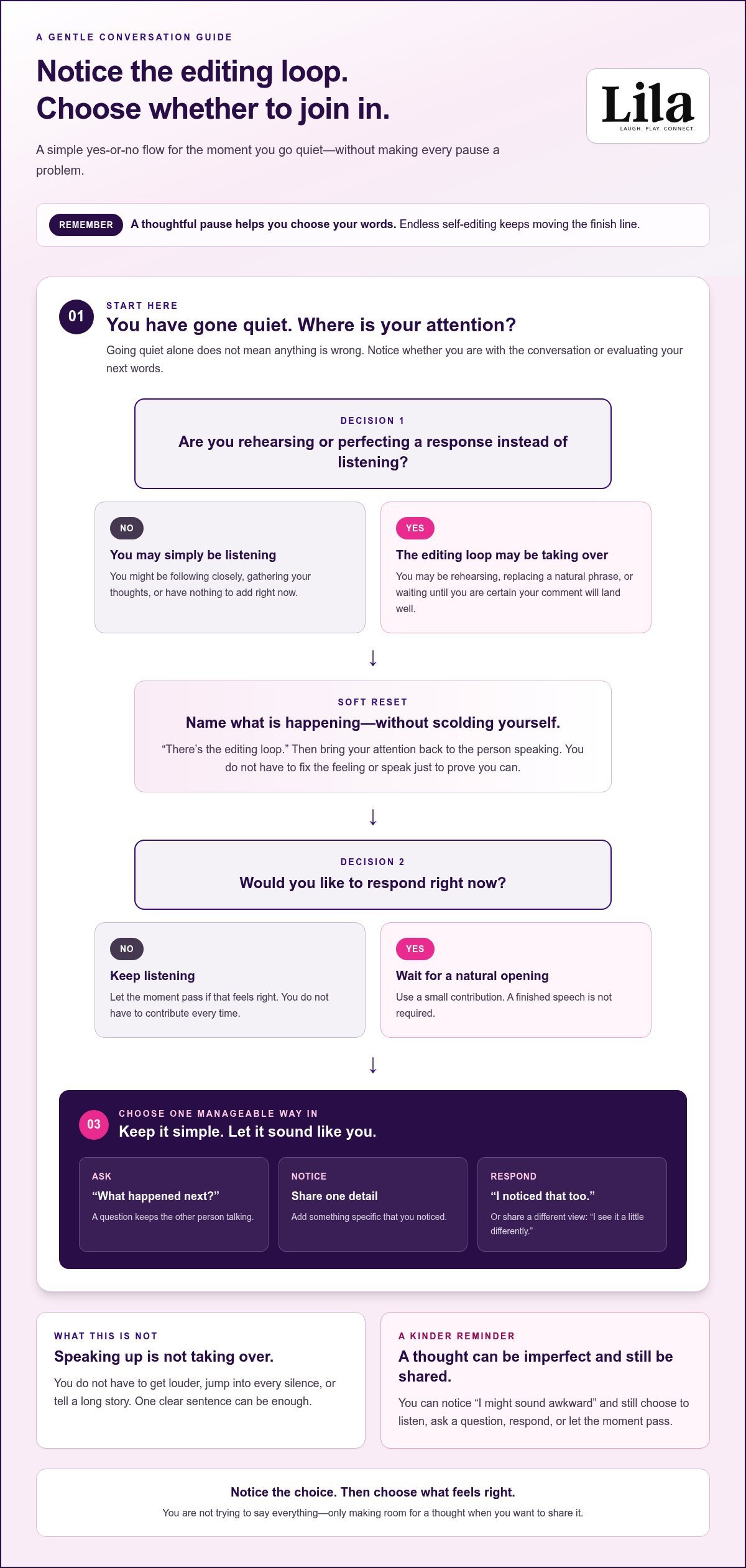
A practical checklist for speaking up with less overthinking
A checklist can offer a handrail, not another standard to meet. You don’t need to do every step or get through them in order. Choose one small action that feels possible for your next conversation, then let the rest wait. The point is to make room for a contribution, not to keep score of every time you speak.
Before and during the conversation
Before you join in, set a modest intention. Keep it small enough to remember without rehearsing a whole speech. Once the conversation starts, listen for a natural opening, such as a pause after someone finishes a thought or a detail you’d like to ask about.
- Choose one intention. Decide whether you’d like to ask a question or share an observation, and leave room for the conversation to unfold differently. For example: “I’ll ask about one detail I’m curious about.”
- Listen for an opening. Follow what the person is saying rather than preparing several possible replies in advance. For example: “I’ll listen for a moment when a question fits naturally.”
- Start with one sentence. Offer the first clear thought that comes to mind, then pause and let the other person respond. For example: “That sounds like a big change. How has it been so far?”
- Adapt if the moment shifts. Your intention is optional; if the topic moves on or you’d rather keep listening, you can let it go. For example: “I’ll save my question for another opening.”
One brief sentence is enough to begin. You don’t have to explain every part of your thinking or keep talking to prove your point matters. The conversation can meet you halfway.
Afterward, reflect without replaying every word
When the conversation ends, you might feel tempted to review each phrase and imagine how it sounded. Try a gentler kind of reflection instead. Keep it brief, and remember that one interaction doesn’t tell you how every future conversation will go.
- Record one thing you tried. Focus on the action, not whether it sounded impressive. For example: “I asked one follow-up question.”
- Notice what helped or felt tricky. Treat what you learn as a small observation, not a grade. For example: “It felt easier to speak after I listened for a natural pause.”
- Let the moment end. If a sentence came out awkwardly, you can acknowledge that and move on without replaying it all evening. For example: “That felt a little clumsy, and the conversation is over now.”
Try one checklist action at a time. You might practise a question in a familiar conversation, then choose a different step another day. For playful practice listening and responding in the moment, explore Lila Joy Seminars’ live online improv seminar, an eight-week experience for adults with no prior improv experience required.
Practise speaking up in a low-pressure way
Speaking up can feel more manageable when you practise in conversations that already feel familiar. You don’t need to start with a meeting full of new people or a subject you know little about. Try a small contribution with a friend, family member, or trusted colleague, where you can focus on being present rather than getting every word just right.
Build practice into everyday moments
Choose one manageable action and try it in different conversations. You could share a small preference, ask a follow-up question, or offer a simple observation. Repeating one kind of contribution can make it feel more familiar without asking you to make a dramatic change or speak in every situation.
For example, you might say, “I’d rather meet somewhere quiet,” when choosing a place to eat. In another conversation, you could ask, “What did you like most about it?” There’s no need to turn these moments into a test. Afterward, notice whether you joined in and felt connected, not whether your wording was especially clever. If a moment feels awkward, let it be one moment, not a verdict on how you’ll do next time.
How playful group practice can support spontaneity
Playful exercises offer another way to try responding as ideas arrive. In an improv game, you listen to what someone offers, respond, and add an idea of your own. The focus is on meeting the moment together, not preparing a perfect line in advance. Group reflection also gives you a chance to notice what it felt like to listen, contribute, and stay curious.
Lila Joy Seminars offers an eight-week live online improv seminar for adults, with weekly Zoom sessions lasting about two hours. Sessions include interactive improv games and group reflection, supporting practice with spontaneity, communication, and connection. It’s personal-growth practice, not a promise that you’ll stop overthinking or feel confident in every conversation. No previous improv experience is needed.
If you’re exploring how to speak up more without overthinking, begin with one small action in a familiar conversation. Or, if a playful group setting sounds like a comfortable next step, you can explore Lila’s live online improv seminar. The first session is free, so you can experience the practice and see how it feels without needing to arrive with the perfect words.
Let one small contribution be enough
You don’t have to wait until speaking feels effortless. The next time a thought comes to you, see if you can offer a small piece of it: a question, a preference, or a simple response. It may feel a little new at first. That’s okay. You’re making space for yourself in the conversation, not trying to become someone else.
Learning how to speak up more without overthinking can begin with a single moment of trying. If you’d like a playful place to practise responding as ideas come, Lila Joy Seminars offers an eight-week live online improv seminar for adults. Sessions meet weekly on Zoom and include interactive games and group reflection. No prior improv experience is required, and your first session is free.
Try the first live Zoom seminar session free if that feels like a welcoming next step. Or start with one small thought in a familiar conversation. Either way, you can move at your own pace. Your words don’t need to be perfect to be worth sharing.
Frequently Asked Questions
Is it normal to think of what to say only after a conversation ends?
Yes, it’s common to think of a response later, especially if you were concentrating on the conversation or felt unsure in the moment. Your mind may find the words once the pressure has passed. If the thought still feels useful, you could follow up with a short message or bring it up next time. A delayed response doesn’t mean you failed to participate.
Can I speak up more without becoming an extrovert?
Yes. Speaking up is about sharing when you want to, not changing your social energy or becoming the center of attention. If you’re wondering how to speak up more without overthinking, choose an approach that suits you, such as contributing once in a small meeting or sharing an opinion with someone you trust. You can still prefer quiet settings, thoughtful pauses, and plenty of time to recharge.
How can I share an opinion when I am worried someone will disagree?
Try stating your view as your perspective, rather than presenting it as something everyone must accept. For example: “I see it a little differently because the shorter option seems easier to manage.” You can also invite another view with, “How does that look from your side?” Disagreement may feel uncomfortable, but it doesn’t automatically mean you expressed yourself badly or that the conversation has gone wrong.
What if I interrupt someone by speaking up?
If you realize you’ve spoken over someone, pause and give the floor back: “Sorry, I cut you off. Go ahead.” Then listen to what they were saying. A brief repair is usually clearer than a long explanation or repeated apologies. If you’re unsure whether they’ve finished, wait for a natural break or ask, “Were you still adding something?” These small courtesies can help keep the exchange considerate.
Does taking a pause make me seem awkward or unsure?
Not necessarily. A pause can simply show that you’re thinking, especially if you’re responding to a thoughtful question or choosing your words with care. If silence feels uncomfortable, you can make the pause feel more conversational with a simple phrase like, “Let me think for a second.” You don’t need to fill every quiet moment. Other people may be giving you space to answer.
Can practising small talk help me feel more comfortable contributing?
It can give you a low-stakes chance to get used to starting and continuing brief exchanges. For example, you might comment on a shared setting, ask someone how their project is going, or follow up on something they mentioned before. Keep the aim simple: learn one thing about the other person or share one small detail. Small talk doesn’t need to be dazzling to create a friendly opening.
When might it help to seek support for persistent fear around speaking?
Consider seeking support if fear around speaking is persistent, causes substantial distress, or leads you to avoid important parts of work, study, relationships, or everyday life. A qualified mental health professional can help you explore what’s happening and discuss suitable support. You don’t need to wait until things feel unbearable, and asking for help isn’t a sign of weakness. Practical conversation practice may still be useful, but it isn’t a substitute for care when you need it.