


What if the way to stop being boring in conversations is to stop rehearsing them? Learning how to stop being boring in conversations can begin with a simple shift: notice what’s happening, get curious about the person in front of you, and respond to what they actually say. You don’t need a perfect story or a quick comeback.
If talking to strangers feels dull, it doesn’t mean you’re dull. A conversation can feel flat when you’re busy searching for the right thing to say, or haven’t yet found a detail that sparks your interest. An awkward pause is a place to begin, not proof that you’ve failed.
Here, you’ll explore ways to find interest in ordinary moments, connect with people whose personalities differ from yours, and understand why strangers can be harder to talk with. You’ll also see how a little improvisation can help you follow a conversation as it unfolds, without turning every exchange into a performance.
Key Takeaways
- Find fresh conversation material by noticing small details in everyday moments and following what genuinely catches your attention.
- Use open questions and attentive listening to make room for different personalities and conversational styles.
- Balance curiosity with small personal shares so the exchange feels mutual, not like an interview.
- Let the other person’s words guide your next response instead of trying to rehearse the perfect thing to say.
1. Finding interest in ordinary experiences
Learning how to stop being boring in conversations often starts with noticing what you usually pass by. On your next walk, pick one detail: a bakery’s morning queue, a neighbor’s bright umbrella, or the sound of a busker. Ask yourself what might be happening beyond that first impression. Curiosity gives ordinary moments a reason to stay with you.
People also reveal small stories when they describe work, family, or weekend plans. Listen for the detail that carries feeling, then ask a follow-up: “What did you enjoy most?” If someone says they’re restoring an old chair, you might ask how they chose the color. Their answer could open up a story about patience, taste, or a relationship they value.
To gather experiences to share, try one or two new activities per month. Choose something simple, such as visiting a neighborhood market or trying a new recipe. You don’t need an impressive story. A burnt pie, a helpful stranger, or a surprising song can open a conversation because it gives the other person something specific to respond to.
Common ground often appears in small preferences, not matching biographies. If a stranger mentions a long commute, ask what they listen to on the way. A shared love of podcasts may lead to favorite topics, while different tastes can still make for an easy exchange. Follow what interests both of you instead of forcing agreement.
How can you tell whether someone is interested or wants to end a conversation? According to the Centers for Medicare & Medicaid Services, nonverbal communication can signal interest, so notice whether the person faces you and responds to what you say. One cue can be ambiguous. If their replies keep shrinking, offer an easy exit: “I’ll let you get back to your day.”
2. Handling conversations with people who have different personalities
A quiet person and a fast talker may enjoy different conversational rhythms. Instead of expecting someone to respond like you, listen for what matters to them. If a coworker gives brief answers about a new project, ask which part they’re figuring out first. That invites detail without demanding a long story or expecting them to match your pace.
Listen to learn, not to prepare your next line. The Centers for Disease Control and Prevention describes active listening as letting someone share thoughts and feelings without interruption, then repeating what you heard in your own words. For example, “So the move felt exciting, but leaving your friends was hard?” gives them room to clarify or add more.
When talking with someone you don’t know well, use the shared setting as a small bridge. At a gathering, ask, “How do you know the host?” Then follow their answer with a related question, such as what they’ve enjoyed about the evening. This moves from small talk toward personal details without making the exchange feel like an interview.
You can show curiosity and enthusiasm by responding to one specific detail, then asking a genuine follow-up. If someone mentions learning to cook, try, “What’s the best thing you’ve made so far?” Add a thought of your own, such as a dish you’d like to try. That small contribution makes the exchange feel mutual, not like a list of questions.
Personal stories can also replace routine small talk. Share a brief moment with a clear point, such as getting lost on the way to a concert and discovering a favorite café. If shyness makes conversation difficult, choose one question, listen to the answer, and share one related detail. You don’t need to tell everything. A simple “I’ve had a similar moment” gives the other person something to build on.
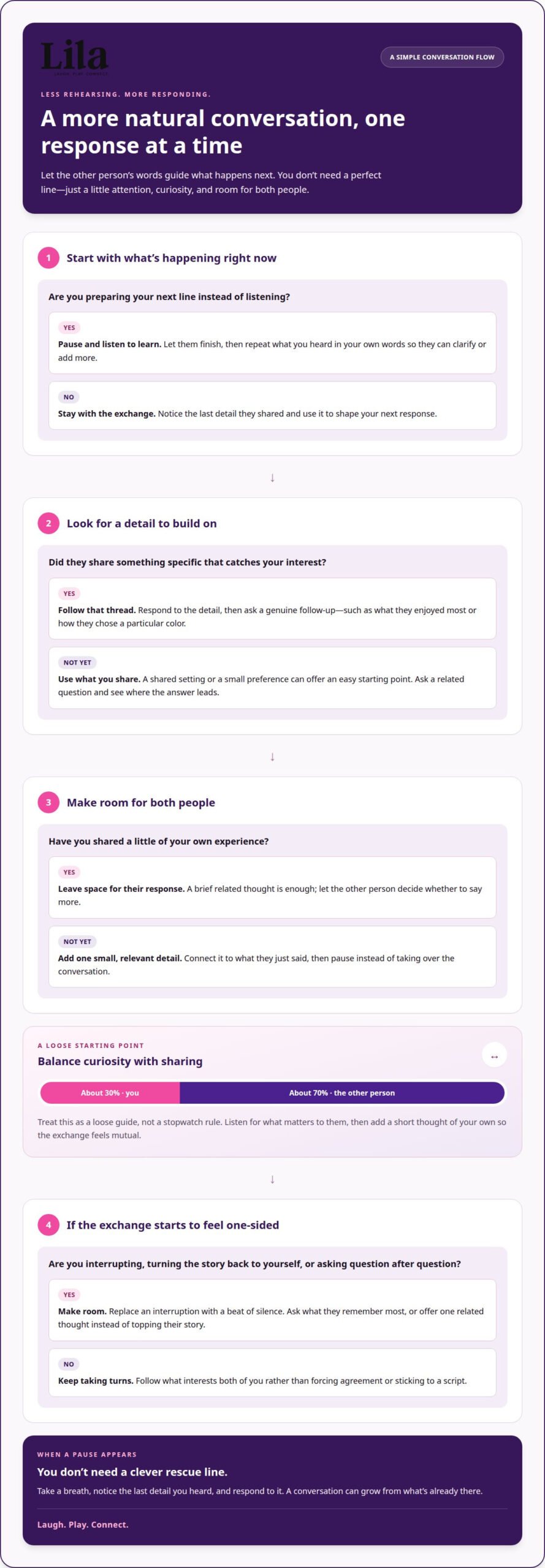
Balancing self-disclosure and curiosity about others
A person can seem boring when an exchange feels one-sided, distant, or stuck on one topic. That impression describes the conversation, not someone’s whole personality. For example, answering “fine” to every question gives the other person little to build on.
Try a loose balance: aim for about 30% of your input and 70% of the other person’s. Treat that as a starting point, not a stopwatch rule. If someone shares a story about moving, listen for the detail that matters, then add a short thought of your own. “I moved once and missed my old neighborhood” offers a little of yourself without taking over.
Sharing something personal can make a conversation feel warmer, especially when it connects to what the other person just said. You don’t need to share your deepest secret. If a friend mentions feeling unsure about a new job, you might say, “I felt that way before my first presentation.” Then pause and let them decide whether to say more.
To avoid habits that make people disengage, notice whether you interrupt, turn every story back to yourself, or ask question after question. Replace a quick interruption with a beat of silence. Instead of topping someone’s travel story with a bigger one, ask what they remember most. These small choices make room for both people.
An awkward pause doesn’t require a clever rescue line. Take a breath, notice what you’re thinking, and respond to the last detail you heard. If someone says they’re learning guitar, ask what song they’re working on, then share a song you enjoy. Curiosity and self-disclosure can take turns naturally, without making either person carry the whole exchange.
4. Improvising instead of rehearsing conversations
Rehearsing every sentence can pull your attention away from the person speaking. Try treating conversation like a small improv scene: notice what they offer, respond to that detail, and add something of your own. If a neighbor says the elevator stopped between floors, respond to the surprise, then share a brief moment when your plans went sideways. The next line grows from what’s already there.
This doesn’t mean saying whatever comes to mind. It means letting go of a polished script and staying with the exchange. For example, if someone mentions an early train, ask what brought them into town. If they say they’re visiting a museum, follow that thread instead of switching to a prepared topic. Each reply gives you fresh material.
When your mind goes blank, use a simple pattern: repeat one meaningful detail, add a genuine reaction, then leave room for their response. “A tiny bookshop behind the station? That sounds lovely. Did you find anything unexpected?” feels more connected than a memorized joke. Sharing a real reaction can be easier than searching for the perfect line.
Improv skills grow through small, low-stakes changes. At lunch, respond to a comment with a curious question instead of planning your next story. At a family gathering, build on a surprising detail rather than steering back to familiar topics. The aim isn’t to entertain everyone. It’s to notice, respond, and stay open to where the conversation goes.
Live improv classes can offer a playful place to practice responding in the moment. If you’d like to try one, your first online class is free, and no credit card is needed.
Lila
Lila offers live online improv classes for adults who want to practice responding in the moment. These aren’t acting or performance training: the interactive games and group reflection focus on listening, sharing, and building on what someone else offers. Classes run live on Zoom and last one to two hours. You can take part without arriving with a polished story or a clever reply.
If you’d like a gentle place to explore this kind of practice, try a free class with Lila.
Let your next conversation unfold
You don’t have to become a different person to feel more at ease with people. Let the next conversation be an experiment, not a test. Notice what draws your attention, follow one unexpected detail, and allow your reply to be simple. A pause doesn’t need to be filled with something impressive. It can give you a moment to hear what’s actually being said.
If you’re still wondering how to stop being boring in conversations, try shifting the goal from impressing someone to meeting them where they are. Small, genuine responses can make room for a more natural exchange, even when the topic or personality feels unfamiliar.
If you’d like a playful place to practice responding in the moment, try a free online class with Lila. Let curiosity lead, one conversation at a time.
Frequently Asked Questions
Why Are You Always Bored When Talking to Strangers?
You may feel bored because a stranger’s context is unfamiliar, so their first answers don’t yet connect to anything meaningful for you. Instead of judging the whole exchange quickly, listen for a detail that surprises you or differs from your experience. A person’s unusual route to work, favorite local spot, or reason for attending an event can give the conversation a fresh direction.
How can I become a better listener and ask more engaging follow-up questions?
Listen for the part of someone’s answer that carries a choice, feeling, or change. If a coworker says they switched teams, ask what prompted the move instead of jumping to your own work story. A useful follow-up grows from their words, not a prepared list. If you’re unsure what to ask, briefly reflect the detail you heard and let them correct or expand on it.
What are good open-ended questions to keep a conversation going?
Ask questions that invite a personal answer without demanding private information. You might say, “What surprised you about that neighborhood?” or “How did you get interested in that kind of music?” At a shared event, try, “What brought you here today?” These questions allow for a short reply or a longer story, and the answers give you natural clues for what to ask next.
How can I share stories without rambling or dominating the conversation?
Keep your story centered on one moment and one point. For example, describe the mix-up that sent you to the wrong café, then share what made the detour memorable. Skip side details that don’t help explain the moment. Afterward, pause and notice whether the other person responds or offers a related experience. Their reaction helps you decide whether to add context or hand the conversation back.
How can I make small talk more interesting and natural?
Give a routine topic a personal angle. Instead of only saying a meeting ran late, mention what you did with the unexpected wait or ask how the other person spent it. You can also connect a familiar subject to a preference: “Do you like quiet weekends, or do you prefer having plans?” A small, honest detail makes everyday talk feel less like exchanging automatic lines.
What should I do when a conversation runs out of things to say?
First, decide whether you want to continue or end the exchange. If you’d like to keep talking, shift gently to something nearby, such as the place you’re in, a shared activity, or what’s coming up next. If the other person seems ready to leave, let the conversation close kindly: “It was lovely talking with you. Enjoy the rest of your evening.” A quiet ending is perfectly ordinary.