


Thinking on your feet in meetings isn’t a talent reserved for the quickest person in the room. It means pausing, identifying the point of a question, and responding clearly, even when you haven’t planned what to say.
If your mind goes blank when someone puts you on the spot, it doesn’t mean you’re bad at meetings. A surprise question can catch anyone off guard. You don’t need a perfect answer or a dazzling comeback. A little preparation and a simple structure can help you respond more easily.
This guide explains what thinking on your feet means and how to think on your feet in meetings without rushing or overthinking. You’ll learn how to prepare for questions you dread, use a brief pause to gather your thoughts, and shape an answer with a clear point and useful context. You’ll also find ways to practise in low-pressure moments, so speaking up can feel more natural over time.
Key Takeaways
- Prepare a few key points for likely questions, including the one you’d least like to hear.
- Pause, identify what the question is asking, then answer directly with a reason or next step.
- Practise speaking about familiar topics in low-pressure settings to get more comfortable responding without notes.
- Focus on being present and clear, not on producing a perfect or instant answer.
Preparing for likely high-pressure questions
Before a meeting where you may be called on, spend about ten minutes preparing. A short plan gives you something to draw on when a difficult question comes up.
-
Map likely questions to your priorities
Name two or three meeting priorities, then note your view on each. Spend two minutes writing down the question you most dread, such as, “Why is this project behind?” List the concern, the facts you can share, and anything you still need to learn. This gives you useful talking points without requiring you to memorize a script.
-
Consider the Questioner’s Point of View
Consider what the questioner needs to decide, understand, or raise. A teammate asking, “Can we still launch Friday?” may be concerned about a missed deadline, not looking for a flawless defense. Think about what they already know and what context may be missing. Don’t assume a sharp tone means hostility. Identify the practical concern before choosing your answer.
-
Repeat the Question to Gain Thinking Time
Restate the key part of a question in your own words. If someone asks, “What’s causing the delay?” you might say, “You’re asking what’s holding up the timeline?” This gives you a moment to gather your thoughts and lets the questioner correct a misunderstanding. Don’t repeat the whole question mechanically. Focus on its main point.
-
Practise Responding to Surprise Questions
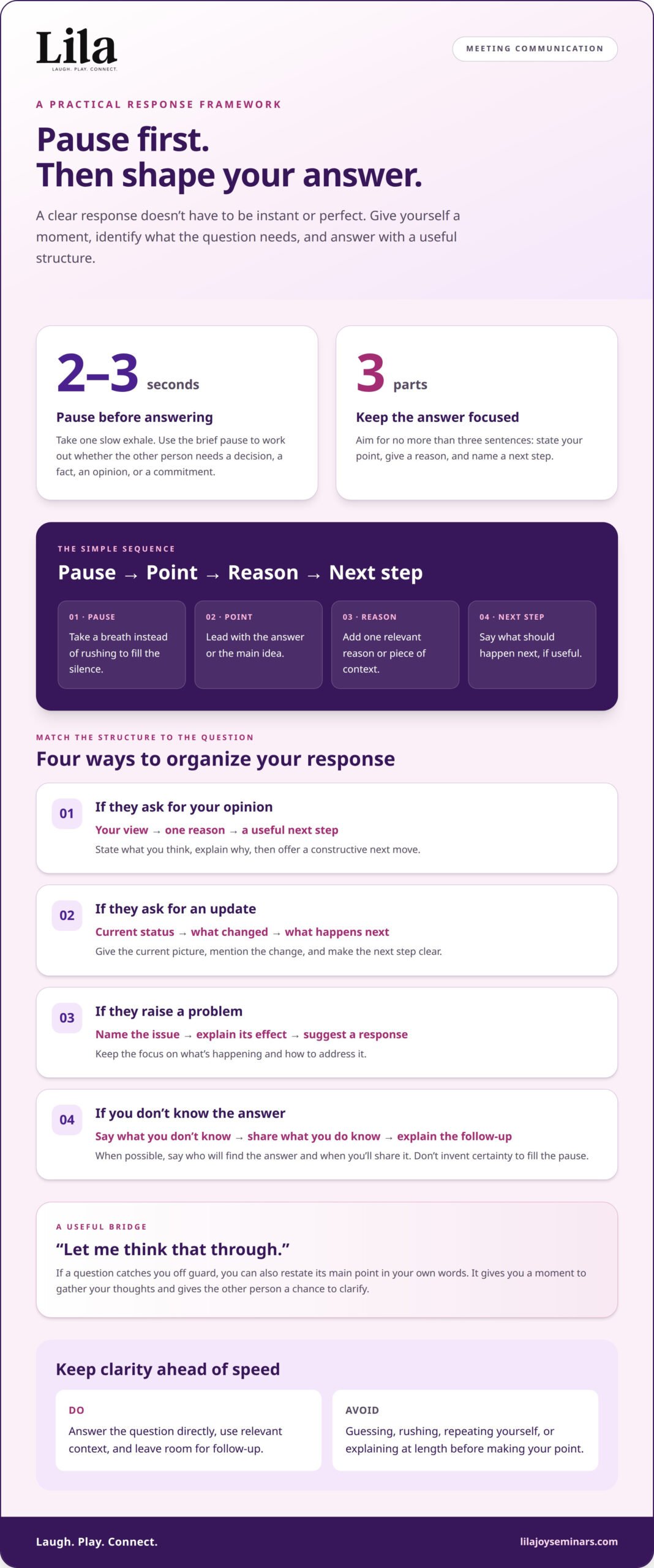
Practise with questions you haven’t prepared for, using a work topic you know well. Try, “What might change this plan?” or “What would you recommend next?” Answer in no more than three sentences: state your point, give a reason, and name a next step. Notice where you hesitate, then try the question again with a calmer, more direct response.
What structures help you answer on the spot?
A useful response starts with a pause and follows a clear structure. Avoid rushing, guessing, or explaining at length before answering. Those habits can obscure your point.
-
Pause Before You Answer
Take one slow exhale before speaking, especially when a question catches you by surprise. A pause of two or three seconds gives you time to identify what the other person needs: a decision, a fact, an opinion, or a commitment. Don’t fill every silence with “um” or extra detail. If you need a bridge, say, “Let me think that through.”
-
Choose a Structure for Your Answer
Match your response to the question. For an opinion, state your view, give one reason, then offer a useful next step. For an update, share the current status, what changed, and what happens next. For a problem, name the issue, explain its effect, and suggest a response. For example: “The test is delayed because one result needs review. I’ll share the revised timeline after that check.”
-
Respond When You Do Not Know
Say plainly what you don’t know, then distinguish it from what you do know. You might say, “I don’t have the latest figure, but the report shows demand is rising. I’ll check the current number and follow up tomorrow.” If you can, say who will find the answer and when you’ll share it. Don’t invent certainty just to fill the pause.
-
Keep Your Answer Concise
Lead with your answer, then give one reason and a next step. If a question has two parts, signal both: “There are two pieces here. The timeline is unchanged; the budget needs review.” Avoid repeating yourself, wandering into unrelated context, or assuming you must solve every part of a complex question immediately. A short, relevant answer leaves room for follow-up.
Can quick-thinking skills be learned?
Yes. Practise speaking without notes in low-stakes situations, then add gentle time limits. Try these exercises with familiar topics before using them in meetings.
-
Practise in Low-Stakes Settings
Choose a familiar subject, such as your weekend plans or a project you know well. Speak about it without notes, focusing on one clear idea and its reason. You’re practising finding words as you go, not trying to sound polished. If you lose your train of thought, pause and start again with a simpler point.
For a playful variation, explain your subject as if speaking to an imaginary 12-year-old. Use everyday words and one example, such as describing a budget as a plan for where money goes. This helps you notice when an explanation gets tangled. Keep the practice private or try it with a trusted friend, so the stakes stay comfortable.
-
Speak Out Loud Under Time Limits
Set a timer and begin answering a familiar question within three seconds. Keep your first response to 30 seconds. For example, answer, “What makes this project useful?” with your main point, one reason, and a supporting detail. Speaking aloud helps you hear whether the idea is clear, rather than only rehearsing it silently.
Try a five-minute daily routine: pick a topic, speak for under 30 seconds, then explain it again in 15 seconds. Use the shorter turn to find the essential point, not to race through every detail. You might describe a recent decision, what shaped it, and what you learned. Change the topic each day, and notice which prompts make you pause.
These exercises can help you get more comfortable speaking without a script. Keep the timer gentle. The goal is to practise finding and expressing a thought, not to deliver a perfect answer on demand.
The meaning of thinking on your feet
- Think of quick thinking as responding usefully, not speaking first. In a planning meeting, someone may ask whether a launch date still makes sense. You don’t need an instant, polished speech. You need to understand what the decision depends on and offer a relevant thought. A clear answer that names a concern can help more than a fast reply that misses the point. Aim to move the conversation forward, not win a race.
- Listen for the thread connecting people’s comments. If a teammate raises a delivery risk after the group discusses timing, link your response to both: “The date still looks possible, but delivery is the piece we need to resolve.” This shows you’re responding to the conversation rather than reciting a prepared line. Notice the topic, the decision under discussion, and what each comment adds. These details give you a useful starting point.
- Choose one helpful contribution instead of trying to cover everything. When a broad question opens up a complicated topic, focus on the part you can address clearly. For example, if asked how to improve a handoff, you might suggest clarifying who owns the next step. You don’t need a perfect connection or a complete solution. A focused observation, useful example, or thoughtful alternative gives others something concrete to build on.
- Make room for an unfinished thought. In a discussion about customer feedback, you might say, “One pattern I’m noticing is confusion at sign-up.” Then explain what led you to that thought or invite the group to consider it. Thinking on your feet includes shaping an idea as you speak while staying attentive to others’ responses. The aim is a clear, relevant exchange, not an impressive performance or a flawless answer.
Lila Joy Classes
Lila Joy Seminars offers live online improv classes where adults can practise responding in the moment through playful group exercises. If you understand answer structures but find it difficult to speak spontaneously, this shared practice gives you space to try ideas, listen, and build on what others say. There’s no pressure to be funny or perform. The focus is on taking part and seeing where a thought leads.
New students can try a free first online class with no credit card required. It’s a low-pressure next step if you’d like to practise thinking aloud with others in a supportive setting. Try a free class with Lila.
Bring one clear thought to your next meeting
At your next meeting, try choosing one useful contribution before you speak. It could be a question that opens up a new angle or a brief observation that helps the group consider its options. Approaching how to think on your feet in meetings this way can make participation feel more like a conversation and less like a test.
If you’d like a supportive place to explore spontaneous conversation with others, Lila offers live online improv classes for adults. Join at your own pace and see whether this playful practice suits you. Try a free first class with Lila and bring a little more play into your conversations.
Frequently Asked Questions
What Does “Thinking on Your Feet” Mean?
It means responding usefully when a conversation takes an unexpected turn instead of relying on a prepared script. For example, if a meeting shifts from a planned launch to a customer complaint, acknowledge the new issue and share a relevant observation. The skill is less about speed than staying engaged, choosing a useful point, and making your meaning easy to follow.
How Do You Prepare for Something You Can’t Prepare For?
You can’t predict every question, but you can prepare flexible talking points. Before a meeting, note the decisions at stake, the people affected, and the facts that may shape those decisions. For a budget discussion, know which costs are fixed and which can change. These reference points help you respond to unfamiliar questions without rehearsing every possible exchange.
How Can I Stop Freezing During Meetings?
If your mind goes blank, focus on something concrete before you speak. Feel both feet on the floor, loosen your shoulders, and take a slow exhale. Then choose a simple opening, such as, “I’m thinking about the timing.” You don’t need to produce a complete answer at once. A first sentence can help you find the next thought.
How Do I Think Faster When Someone Asks Me a Question?
Instead of trying to make your mind move faster, give it a clear task. Listen for the key noun or decision in the question, then connect it to something already discussed. If someone asks about staffing after a deadline change, respond to that link: “The revised date means we’ll need to revisit coverage.” Making the connection gives you a starting point without requiring a clever response.
What Do You Say When You Genuinely Don’t Know?
Be direct about what’s missing, then say what you can do next. For instance: “I don’t have the latest supplier update, so I can’t confirm the delivery date. I’ll check with the project lead and send the answer after the meeting.” This makes clear what’s missing, who will follow up, and how the conversation can move forward.
What Should You Do in the First Three Seconds?
Use that brief moment to settle, not to search for a perfect sentence. Take one slow exhale and decide what kind of response the question needs: a fact, a view, or a choice. If the wording is unclear, ask, “Are you asking about the current plan or a change to it?” A quick clarification can help you avoid answering the wrong question.