


What if your first improv class asked you to listen and respond, not prove you’re funny? If you’ve searched for improv classes no experience needed, you might still worry you’ll be pushed to perform, fall behind, or feel out of place in a group. Those concerns are understandable. A beginner class should make it clear what taking part involves and give you room to try simple exercises alongside other newcomers.
You don’t need quick wit or an acting background. You do need a willingness to be present and explore. This article explains what “no experience needed” means, what happens in a first improv class, and what to check when comparing class formats. Lila Joy Seminars, for example, offers an eight-week live online improv seminar on Zoom, with weekly sessions of about two hours. The first session is free, so you can experience the format before deciding whether it suits you.
Key Takeaways
- With improv classes no experience needed, you can start without being funny or prepared. Beginner sessions guide you through listening and responding.
- Simple prompts give you something specific to respond to, so you can focus on the exchange instead of planning the perfect line.
- Compare the class purpose and participation expectations. Stage-based comedy training and online personal-growth improv serve different goals.
- Before choosing, name your goal and check the format, session length, experience requirements, and what taking part involves.
- Consider whether a live online seminar feels manageable, then review its details to see if they match what you want.
What “No Experience Needed” Means in an Improv Class
It’s understandable to wonder whether you’ll freeze, say something awkward, or be expected to make everyone laugh. A beginner improv class shouldn’t require polished jokes or a ready-made stage persona. At its heart, beginner improv is guided practice in noticing what another person offers and responding to it. You’re learning with others, not auditioning for their approval.
Improv has different styles and purposes. Some classes focus on comedy for the stage; others use playful exercises to explore communication and connection. Improvisational theatre covers a range of forms, so the word “improv” alone doesn’t tell you what a particular class involves. Read the description and ask what participants are expected to do.
Do you need acting experience or a naturally funny personality?
No. A true beginner class doesn’t assume you’ve acted, studied comedy, or memorized lines. You might be invited to respond to a prompt, take part in a short exchange, or try an activity with a partner. The goal is to participate and pay attention, not to carry the room or entertain everyone. Activities vary, so look for a class that explains its approach clearly.
What does “beginner-friendly” actually tell you?
Look for details about who the class is for, how activities are introduced, and whether the focus is personal exploration or stage performance. A welcoming facilitator and gradual exercises can make it easier to try something new, though no label can guarantee you’ll feel confident right away. “No experience needed” means you can join without prior skills, not that every moment will feel effortless.
An entry-level improv class teaches newcomers how to take part; audition-based training expects you to demonstrate skills before or during entry. That distinction can help you identify a gentle introduction versus a more performance-focused setting.
So, improv classes no experience needed should make room for beginners to learn as they go. You don’t have to be quick, loud, or naturally funny. You do need to know what participation looks like in that specific class and whether its purpose matches what you hope to explore.
How Beginner Improv Builds Comfort Through Listening and Response
Once you’re in the room, you may wonder, “What am I actually supposed to say?” Beginner exercises often start with a simple prompt or a partner’s offer, rather than asking you to invent a whole scene or deliver a clever line. That small starting point gives you something to notice. You can respond to what’s there instead of trying to plan the perfect answer in advance.
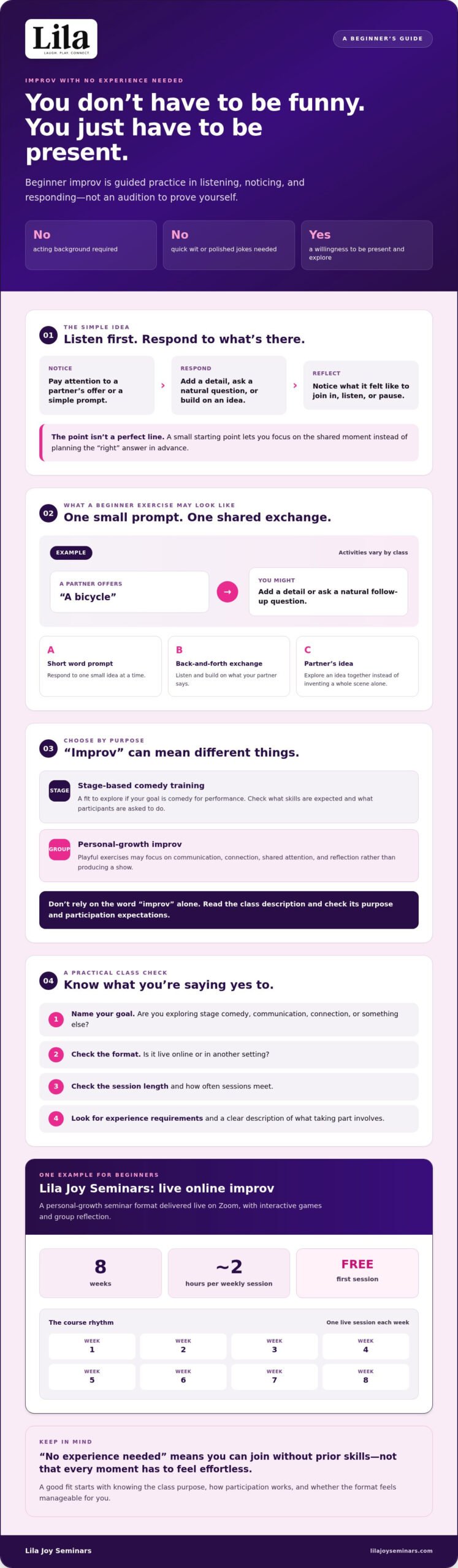
Beginner improv is repeated practice in listening, noticing, and responding to what someone else offers. For example, a partner might name an ordinary object. You could add a detail about it or ask a natural follow-up question. The goal isn’t to create a polished scene. It’s to stay with the shared moment and see where it goes.
What do beginners practise in simple improv games?
Depending on the class, activities might include a short word prompt, a simple back-and-forth exchange, or building on a partner’s idea. These are examples, not a standard syllabus. A short prompt can feel more manageable than inventing an entire scene because you only need to respond to one small thing at a time.
There’s no score for being the most entertaining person in the group. You’re practising shared attention and play. In Lila Joy Seminars’ live online seminar, interactive games and group reflection are part of the format. Reflection gives you a chance to notice what it felt like to join in, listen, or pause. It’s an opportunity to consider the experience, not receive a grade on your performance.
How can those practices connect with everyday conversations?
Everyday conversations don’t come with a script either. A colleague may mention a new project. Instead of rehearsing the perfect reply while they speak, you can listen for what matters to them and ask a genuine question. That shift from planning to noticing is something improv exercises invite you to practise.
It doesn’t mean every conversation will suddenly feel easy, or that a class can promise a particular result. It offers a place to practise responding in the moment with other people and reflect on how that felt. For some, improv classes no experience needed are appealing beyond a stage or comedy goal: the focus can be on connection and communication, not producing a show.
If you’d like to see how this kind of guided practice is presented, you can read about the live online improv seminar from Lila Joy Seminars.
Online or Stage-Based Improv: Which Beginner Class Fits You?
“Beginner improv” can describe very different experiences. One class may help you explore scenes with an eye toward performing; another may use improv games as live group practice in communication and connection. Neither format is automatically better. Consider what you want to practise, where you’d feel comfortable participating, and whether performing is part of the course.
Choose by the experience and goals you want, not by the word “improv” alone. Use these questions to compare options:
- Purpose: Is the focus stage performance, personal exploration, or another goal?
- Setting: Do you meet in a venue or join a live group online?
- Participation: Are you practising scenes, taking part in group exercises, or both?
- Performance: Does the course include a show, or does participation take place within the sessions?
When might a stage-based class be the right fit?
If you’re curious about performing, a stage-oriented class may be a natural place to explore improv. Some courses describe stage comfort as part of the experience, but that isn’t a promise about every class. Before enrolling, check the stated goals, whether prior experience is expected, where sessions take place, and whether a performance is included. These details help you judge whether the format matches your interest.
When might a live online class feel more approachable?
A live online group may suit you if you want real-time interaction without travelling to an in-person venue. It differs from a self-paced recorded course because participants meet together and take part live. Online formats vary, so check how the group participates and what the sessions are designed to explore.
For adults interested in guided personal-growth practice, Lila Joy Seminars offers an eight-week seminar that meets weekly on Zoom for about two hours. No previous acting or improv experience is required. This is a live online format, not stage-based performance training. Compare it with other options by looking at the purpose, setting, participation expectations, and whether a show is part of the course.
If you’re exploring improv classes no experience needed, you don’t have to decide which format is right for everyone. Start with your reason for joining. If you want to practise for performance, look closely at stage-focused course details. If you prefer a live group centred on personal growth, check for an online seminar that explains its purpose and what taking part involves.
How to Choose a Beginner Improv Class That Feels Right
Once you know what you hope to get from improv, choosing a class can feel less like a leap into the unknown. You don’t need to find the “best” format for everyone. You need enough clear information to decide whether a particular group suits your goals, schedule, and comfort level.
Try this sequence:
- Name your goal. Are you curious about performance, personal growth, communication, or playful group practice?
- Check the format. Find out whether sessions are live or recorded, online or in person, and who the class is designed for.
- Read the expectations. Look for prerequisites, how often the group meets, session length, and what participation involves.
- Ask what’s still unclear. If the description doesn’t say whether there’s a performance or how activities work, contact the organizer before registering.
What should you check before registering?
Look for clear details rather than relying on a “beginner-friendly” label alone. Does the class welcome adults or another specific group? Does it state whether prior experience is needed? Check the schedule and session duration, then read how the facilitator describes the activities. Most of all, make sure the purpose is clear: a course for stage performance may have different expectations from one focused on personal growth.
Worried that joining means you’ll be pushed onstage? Don’t guess from the word “improv.” Look for references to a show, stage work, or performance goals. If the description doesn’t answer your question, ask directly: “Is a performance part of this course?” A straightforward answer can help you decide whether the experience fits.
What if you are still nervous about joining?
Feeling unsure doesn’t mean you’re not suited to a beginner group. It may simply mean you’d like more information first. Ask how participants take part, whether the class is intended for newcomers, and what happens during a typical session. You can gather information and take time to consider it. Choosing a class should feel informed, not like a test of how far you can push past discomfort.
For example, Lila Joy Seminars offers adults an eight-week live online improv seminar on Zoom, meeting weekly for about two hours. No prior acting or improv experience is required, and the first session is free. If this format matches what you’re looking for, explore the live online improv seminar and check its current details before deciding.
When comparing improv classes no experience needed, look for clear expectations, a stated purpose, and a format you can picture yourself joining. You don’t have to talk yourself into a class that feels wrong. Keep looking until the details make sense to you.
Trying Lila Joy Seminars: A Live Online Option for Beginners
After comparing class goals and formats, you may be looking for a live group that treats improv as a way to explore communication and connection rather than training for stage performance. Lila Joy Seminars offers adults an eight-week live online improv seminar on Zoom. It meets weekly, with each session lasting about two hours. No prior acting or improv experience is required.
What the Lila seminar includes
The seminar uses interactive improv games and group reflection as part of a guided personal-growth practice. Games give participants a shared way to take part, while reflection offers room to notice and consider the experience. The work is intended to support confidence, spontaneity, connection, and communication. Individual experiences and results can vary.
This is a live group, not a self-paced recorded course. Participants meet on Zoom at a regular weekly time, so consider whether that rhythm and format suit your schedule. Some improv classes no experience needed focus on preparing for stage performance; this seminar is centered on personal growth rather than acting credentials or putting on a show.
How to decide whether to try the first session
Before choosing, ask yourself a few questions. Does meeting weekly feel manageable? Would joining a group online from home feel comfortable enough to explore? Are you looking for guided practice in spontaneity and communication rather than performance training? Your answers can help you decide whether the seminar’s purpose and format fit what you want.
You don’t need to feel completely sure before learning more. The first session is free, so you can get a feel for the live online format before deciding whether to continue. Check current dates and enrollment details as you explore. If this sounds like the beginner experience you’re looking for, Explore the Lila Joy Seminars and reserve your free first session.
Take a Gentle First Step Into Improv
Starting improv doesn’t mean arriving with jokes, acting experience, or instant confidence. A beginner class offers guided practice in listening and responding, while different formats serve different goals. Before choosing, check what participation involves, whether the focus is performance or personal growth, and whether the schedule and setting feel manageable for you.
If you’re exploring improv classes no experience needed and want a live online option, Lila Joy Seminars offers adults an eight-week seminar on Zoom. Sessions meet weekly for about two hours, and no prior acting or improv experience is required. Interactive games and group reflection support practice in confidence, spontaneity, connection, and communication, without promising the same experience or results for everyone.
The first session is free, so you can get a feel for the format before deciding whether it suits you. Explore the Lila Joy Seminars and reserve your free first session. You can begin simply, one curious step at a time.
Frequently Asked Questions
Can I take an improv class with no acting experience?
Yes, many beginner improv classes are designed for people without acting experience. You don’t need stage credits, scripts, or comedy knowledge to start. Look for a class that clearly welcomes beginners and explains its purpose and participation expectations. For example, Lila Joy Seminars’ adult seminar requires no prior acting or improv experience and focuses on personal growth through live online improv, rather than acting or performance training.
Do you have to be funny to take an improv class?
No, being funny isn’t a requirement. Beginner improv is often about listening to another person and responding to what they offer, not making a room laugh or delivering a clever line. Activities differ between classes, so read the description to understand what participation involves. A class focused on personal growth may have different aims from one designed to practise comedy for a stage.
What happens in an improv class for beginners?
Beginner classes may use simple prompts, interactive games, partner activities, or group reflection. The exact exercises vary, but you generally don’t need to prepare a full scene in advance. Instead, you practise paying attention and responding to someone else’s idea. Check the class description for its specific activities and purpose. In Lila Joy Seminars’ live online seminar, interactive improv games and group reflection are part of the format.
Is online improv class suitable for someone with no experience?
Yes, a live online class can suit a beginner if its description welcomes newcomers and explains how participants take part. Online doesn’t have to mean learning alone: a live Zoom group meets together, unlike a self-paced recorded course. Consider whether joining from home feels comfortable and whether the session schedule works for you. Lila Joy Seminars’ live online seminar is for adults and requires no prior improv experience.
Will I have to perform in front of an audience in a beginner improv class?
Not necessarily. Some beginner courses are stage-focused, while others use improv for personal growth and don’t describe an audience performance as part of the format. Don’t assume based on the word “improv” alone. Read the course information for references to a show, stage work, or performance goals. If you’re unsure, ask the organizer directly whether performing for an audience is included or expected.
How do I choose an improv class if I feel nervous about starting?
Start by naming what you hope to explore, then check the format, course purpose, prerequisites, session length, and participation expectations. Feeling nervous is understandable; you don’t have to force a decision before you have enough information. Ask the organizer whether beginners are welcome and what a typical session involves. Clear answers can help you decide whether the setting feels manageable and right for you.
How long is the Lila Joy Seminars improv program?
The Lila Joy Seminars program runs for eight weeks, with one live Zoom session each week. Sessions last about two hours and are designed for adults. No prior acting or improv experience is required. The first session is free, which may help you get a sense of the format before deciding whether it suits you. Check the seminar information for current dates and enrollment details.