


What if personal growth could begin with noticing what’s happening, rather than trying to become a more confident or polished version of yourself? Improv for personal growth isn’t about being funny, quick-witted, or ready to perform. It’s a way to practice curiosity, flexibility, and connection in small moments, then carry that practice into everyday life.
If self-development advice sometimes feels abstract or overly serious, you’re not alone. And if the thought of joining an improv group brings up worries about what to say, that makes sense too. You don’t need acting experience or a supply of clever ideas. You can start by listening, responding, and seeing what happens when you let a moment unfold.
This guide explores everyday capacities you can practice through improv, along with gentle ways to reflect and try a different response. You’ll also get a clearer sense of what may, and may not, change beyond a class, and whether learning with others feels right for you. Lila’s live online improv classes offer a supportive space to try improv games and reflect as a group. Your first class is free.
Key Takeaways
- Improv for personal growth is a playful way to practice responding to what’s happening with curiosity and attention.
- Try a simple rhythm in everyday conversations: notice what’s offered, listen, and respond to the detail in front of you.
- Improv offers opportunities to practice flexibility and connection, but personal outcomes differ and aren’t guaranteed.
- Use a change of plan or an unfinished thought as a low-pressure moment to try a new response, then reflect on how it felt.
- Shared games and reflection can help you notice your responses in a supportive group setting.
What Does Improv for Personal Growth Actually Mean?
You may want to feel more present in conversation, less thrown by a change of plan, or more connected to the people around you. That doesn’t mean you need a dramatic reinvention. Being quiet, careful, or someone who likes time to think isn’t a flaw to correct. Improv for personal growth can offer a playful space to notice how you respond and explore what else might be possible.
In an improv activity, people respond to what others say or do, building from the shared moment rather than following a prepared script. The forms of improvisational theatre vary, but responding to what’s happening is central to the practice. Improv for personal growth is playful practice in noticing and responding to what’s happening with other people. It creates opportunities to explore, not guaranteed personal outcomes.
Personal growth is practice, not a personality makeover
Growth here doesn’t mean becoming louder, more outgoing, or endlessly agreeable. It can mean noticing a familiar reaction and giving yourself room to try another one. Perhaps someone shares an idea and you usually start planning what to say next. You might experiment with pausing, listening through their thought, and responding to what they actually said.
The point isn’t to judge your usual response or make every interaction feel different. It’s to become curious about your choices. You might discover that you prefer a quiet moment before speaking, and keep it. Or you might find that adding one small thought feels comfortable. Either way, you’re gathering experience, not taking a test.
Improv is not a test of talent or comic timing
You don’t need to arrive with jokes, acting experience, or lightning-fast replies. Participants work with shared ideas as they emerge, rather than preparing polished scenes in advance. A response can be simple: noticing a detail, asking a sincere question, or adding one thought to what someone else has offered. There’s no need to turn every moment into a punchline.
If you’re wondering whether humor is required, Do You Have to Be Funny to Do Improv? The Truth takes a closer look at that concern. For now, think of improv less as showing what you can do and more as making space to notice what’s already happening.
That shift can make the idea feel more approachable. You aren’t trying to earn a new personality or guarantee a particular result. You’re practicing small responses with other people, then noticing which ones feel natural, surprising, or worth trying again. The learning lives in that cycle of attention and exploration.
How Improv Practice Can Build Everyday Flexibility
Flexibility doesn’t have to mean having the perfect reply ready. In improv, you practice a simple rhythm: notice what’s happening, respond to it, and stay open to what comes next. That rhythm can be useful in ordinary exchanges, especially when your mind is busy preparing what to say instead of taking in the moment.
Listening and accepting an offer
An improv offer is any word, idea, action, or detail another person brings into an exchange. Acceptance means acknowledging that contribution before adding something of your own. It doesn’t mean agreeing with every idea or ignoring your needs.
Imagine a friend says, “I’ve been thinking about taking a pottery class.” You might be ready with advice or a story of your own. Instead, pause and respond to what they actually shared: “What got you interested in pottery?” You’ve noticed their offer and made room for them to continue. If you disagree with something, you can still acknowledge what you heard before expressing your view.
This kind of listening is active, but it doesn’t need to be elaborate. Notice a detail, ask a genuine question, or reflect a feeling you heard. The Harvard Gazette’s discussion of improv skills describes how listening, teamwork, and adaptability can carry into social and professional settings. In everyday life, those capacities begin with small choices to pay attention and respond.
Making room for the unexpected
Plans shift. Someone brings up a new topic. A conversation takes a turn you didn’t see coming. Improv practice invites you to notice the new detail and consider a next step, rather than treating the change as a mistake that must be erased. You might ask a question, suggest an adjustment, or take a breath while you work out what fits.
That doesn’t mean you need to control every moment less or say yes to everything. Flexibility can include a clear “I can’t do that,” followed by another option that works for you. In an improv activity, a missed word or unexpected response can become something to work with; it isn’t proof that you’ve failed. The same perspective can help you recover from an awkward pause or a conversation that didn’t go as planned.
These responses take practice. You might first notice only afterward that you were rehearsing a reply or resisting a change. That noticing still gives you something to work with next time. If you’d like a guided place to explore this rhythm with others, live online improv classes offer time for shared improv activities and reflection.
What Improv Can, and Cannot, Offer Personal Growth
Improv can give you a place to practice responding with attention and openness. What you take from that practice will depend on you, your circumstances, and how the experience feels. One person may enjoy trying an unfamiliar response; another may mainly notice what feels comfortable or not quite right. Both are useful observations. The value isn’t measured by how much you change.
Improv classes at Lila offer supportive practice and reflection, not a guaranteed personal-growth result. Think of them as an opportunity to explore ways of listening, expressing yourself, and meeting a moment, not a promise that those skills will automatically carry into every part of life.
Possible areas of practice, without promises
In an improv activity, you might practice being present with a shared idea, listening for a detail, expressing a thought, or trying a response you wouldn’t usually choose. Afterward, consider: What did I notice? What felt easy or unfamiliar? Is there anything I’d like to try in an everyday situation?
Those questions keep the focus on noticing rather than grading yourself. A participant might find that sharing an idea feels comfortable in one setting but not another. Someone else may enjoy listening more than speaking. The same activity can land differently for different people, and there’s no single sign that you’re “doing growth” correctly.
| Practice opportunity | Possible everyday relevance | What it does not guarantee |
|---|---|---|
| Presence | Noticing what’s happening before choosing how to respond | Feeling calm or focused in every situation |
| Listening | Paying attention to another person’s words or ideas | Always understanding or agreeing with them |
| Self-expression | Trying out a thought in a shared activity | Becoming more outspoken or comfortable everywhere |
| An unfamiliar response | Exploring another way to meet a changing moment | Knowing what to do whenever plans change |
Personal development is different from clinical care
A group improv class uses shared activities and reflection as a space for exploration. It isn’t therapy, diagnosis, or clinical treatment, and it shouldn’t be treated as a substitute for care. The purpose is to practice and notice, not to assess or treat a health concern.
If you’re looking for help with a mental-health concern, a qualified clinical professional is the appropriate source of support. You can still be curious about improv as a separate learning experience, while keeping its scope clear. That distinction makes it easier to consider improv for personal growth without expecting a class to solve something it isn’t designed to address.
How to Bring Improv-Inspired Reflection Into Everyday Life
You don’t need to turn daily life into a stage or make every conversation an exercise. Improv for personal growth can be as small as catching one familiar reaction and trying a gentle alternative. Choose an ordinary moment, not your hardest one. A brief pause in a conversation or a change of plan can be enough to notice how you meet what’s in front of you.
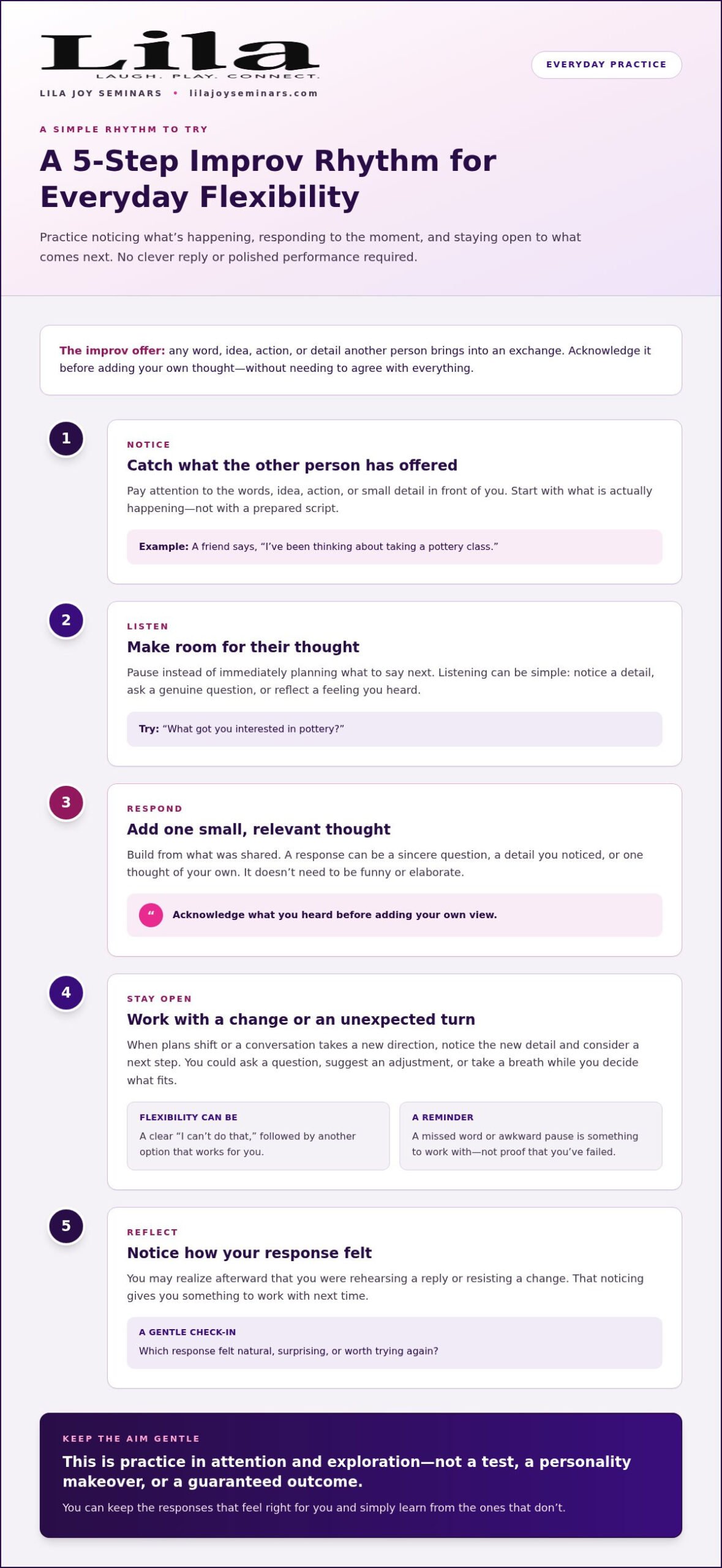
A five-step reflection practice
Try this sequence when you feel rushed, rehearsed, or unsure. You can do it quietly, without explaining the practice to anyone or needing a particular response from them.
- Notice the moment. Recognize that you’re planning your reply, feeling uncertain, or reacting to a change.
- Listen. Take in the other person’s words, or the new detail in the situation, before deciding what to do.
- Accept one detail. Acknowledge something real that’s been said or changed. This doesn’t mean you have to agree.
- Respond simply. Offer a genuine question, share one thought, or suggest a next step that feels right.
- Reflect afterward. Notice what happened without scoring yourself or deciding whether you did it perfectly.
For example, if a plan changes at the last minute, you might notice your disappointment, hear the alternative, then say what works for you. Or, when sharing an unfinished thought, you could offer one piece of it rather than waiting until you’ve found the perfect words. What felt easier, surprising, or worth trying again? Let the answer be information, not a grade.
Keep the practice kind and realistic
Some moments will feel natural; others may feel awkward or leave you unsure. That doesn’t mean the practice failed. Awkwardness can show you that a response was unfamiliar, the timing felt off, or the situation wasn’t a good fit for experimenting. You can respect that information and choose a smaller step next time.
If one small experiment feels comfortable, you might repeat it in a similar situation. There’s no need to turn it into a rule for every conversation. And if concern about other people’s reactions makes it hard to share a thought, How to Stop Caring What Others Think: Gentle Steps for Everyday Life explores that experience further.
If you’d like to practice with shared activities and reflection, join a live online improv class as a guided way to explore this kind of learning with others.
Take One Small Step Toward More Curiosity
You don’t have to know exactly what you’ll discover before you begin. Let your next step be small: notice a moment when you usually rush to respond, then give yourself a little room to listen. There’s no need to get it right. Even a response that feels awkward can show you what you want to try, or what feels true for you.
That’s a gentle way to approach improv for personal growth: with curiosity rather than a demand to change. You can keep what feels useful and leave the rest. Your voice doesn’t need to be louder or more polished to be worth hearing. Sometimes it simply needs a little space.
If you’d like to explore that kind of practice with others, try a free live online improv class with Lila. Bring your curiosity and take the next step at your own pace.
Frequently Asked Questions
Can improv help with personal growth if I am naturally quiet?
Yes. Being quiet doesn’t prevent you from exploring improv for personal growth. You might take time to observe, then contribute when something feels ready to share. For example, you could add one detail to a group idea or ask a question that helps someone continue. The aim isn’t to speak more than feels right. It’s to notice your choices and discover whether any new response feels worth trying.
Is improv for personal growth the same as therapy?
No. Improv is a learning activity, not therapy or clinical care. It can give you a chance to explore how you respond in a group, but it doesn’t diagnose or treat mental-health concerns. If you’re seeking care for a personal or mental-health concern, a qualified clinical professional can help you understand appropriate support. You can approach improv as a separate experience, without expecting it to take the place of that care.
Do I need to be funny or have acting experience to try improv for personal growth?
No. You don’t need to be funny, perform, or have an acting background to take part. A simple contribution, such as naming a detail you noticed or responding to someone’s idea, can be enough. If you’re new, focus on following the activity rather than trying to invent something impressive. The experience is about exploring interaction, not proving that you have a particular talent.
How long does it take to notice personal growth from improv?
There isn’t a set timeline, and you may not notice a clear change right away. Sometimes the first thing you notice is a small moment: you asked a question instead of changing the subject, or realized afterward that you felt at ease sharing an idea. Other experiences may feel less meaningful. Reflecting occasionally on what you noticed can help you recognize patterns without expecting a particular result.
What if I freeze or do not know what to say during an improv exercise?
Freezing can happen, and it doesn’t mean you’ve failed. Take a breath, notice what someone else has contributed, or offer a simple response like “I’m not sure yet.” You can also listen for a moment and join when you’re ready. If the pause feels uncomfortable, remember that you don’t have to fill every silence with a clever line. One small response is plenty.
Can online improv help me explore personal growth?
Yes. A live online setting can bring people together to share an activity and respond to one another, even when they’re joining from different places. You can explore how it feels to contribute, listen, or pause in a group without traveling to a classroom. Online won’t suit everyone, but it can be a useful format if joining from home feels more approachable. Your own experience is the best guide.