


Better conversations often begin with less planning, not more. You can improve communication skills with improv by practicing how to listen closely, build on someone else’s ideas, and respond when a conversation takes an unexpected turn. These habits can make small talk, presentations, and everyday exchanges feel more natural.
If you sometimes rehearse what to say while the other person is still speaking, you’re not alone. Improv isn’t about being the funniest person in the room or having a perfect answer ready. It offers a playful way to pay attention, share an idea, and let a conversation unfold without trying to control every moment. You can start to improve communication skills with improv simply by staying curious about what someone says.
This article explains how improv exercises can strengthen listening, idea-sharing, adaptability, and confidence in social situations. You’ll also see how these skills can help with small talk and presentations, and why accepting an imperfect response can make it easier to speak up. These are practical ways to improve communication skills with improv in everyday conversations.
Key Takeaways
- Listen for what someone is actually saying instead of preparing your reply while they speak.
- Build on another person’s idea with a simple contribution that keeps the exchange moving.
- Practice staying flexible when a conversation takes an unexpected turn, rather than clinging to a prepared response.
- Use brief, relevant comments to make room for others in small talk and presentations.
- Let go of the need to sound perfect; a genuine, imperfect response can help you join in with more ease.
Listening closely during communication
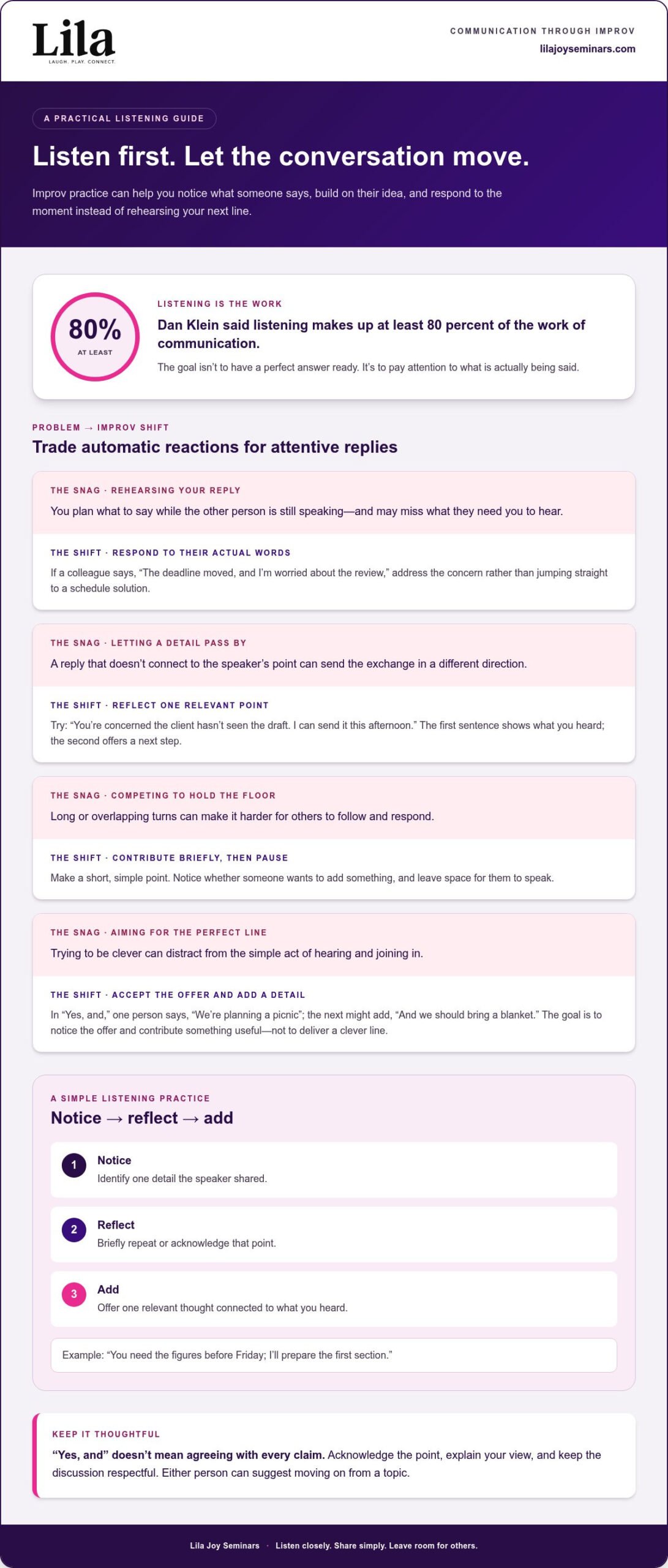
Improv makes listening an active part of conversation: you respond to what you hear, not the reply you prepared in advance. Dan Klein said listening makes up at least 80 percent of the work of communication.
Focused Listening in Conversation
Focused listening means giving your attention to the speaker’s words instead of planning your next sentence. A response based on what someone actually said is more likely to fit the moment. If a colleague says, “The deadline moved, and I’m worried about the review,” you can address the concern rather than jumping straight to a schedule solution.
In an improv scene, missing a partner’s detail can send the exchange in a different direction. Everyday conversation works similarly: notice a key phrase, stay open to new information, and let it shape your response. That small pause can help you listen to understand, rather than simply wait for your turn.
Active Listening and Turn-Taking
Active listening involves concentrating on, understanding, responding to, and remembering what another person says. In conversation, you can repeat one relevant point before adding your own thought. For example: “You’re concerned the client hasn’t seen the draft. I can send it this afternoon.” The first sentence shows what you heard; the second offers a next step.
Turn-taking also makes it easier for others to follow and respond. Improv partners practise making short, simple contributions instead of competing to hold the floor. Try the same approach in a meeting: pause after making a point, notice whether someone wants to add something, and leave space for them to speak.
Listening Exercises and Confidence
Improv exercises improve listening and confidence by giving you repeated, low-pressure chances to hear a partner’s idea and respond in the moment. In “Yes, and,” each person accepts the idea offered and adds a detail. Virginia Tech communication experts describe the exercise as a way to practise active listening and quick thinking.
For instance, if your partner says, “We’re planning a picnic,” you might add, “And we should bring a blanket.” The goal isn’t a clever line. It’s to notice the offer and contribute something the other person can use. Short turns make an exchange easier to follow, and practice can make speaking feel more comfortable.
These skills can help in professional conversations, but improv techniques call for judgment. “Yes, and” doesn’t mean agreeing with every claim or ignoring a concern. If a colleague raises a risk you don’t share, acknowledge the point, explain your view, and keep the discussion respectful. Either person can also suggest moving on from a topic.
Try this listening practice in an everyday exchange: identify one detail the speaker shared, reflect it briefly, then add one relevant thought. In a planning meeting, for example, “You need the figures before Friday; I’ll prepare the first section” connects your response to the request. That’s how improv can build communication skills through attention, clear turns, and useful replies.
Accepting and building on other people’s ideas
Improv turns a conversation into a shared exchange: each person contributes, then leaves room for the next idea. When you look to improve communication skills with improv, you learn that every participant plays a vital role in keeping the dialogue flowing naturally.
Building Shared Experiences
Improv builds shared experiences as people create a story or scene together, one contribution at a time. Interactions become collaborative, rather than feeling like separate attempts to impress. If one person says, “We’ve found a map,” another might add, “And it leads to a garden.” Both ideas now belong to the same imagined moment.
The same pattern can shape everyday exchanges. In a team discussion, someone might suggest a quiet space for focused work. You could add a practical detail, such as using an unused meeting room. Your contribution shows you’ve engaged with their thinking and helps the group explore the idea together.
The “Yes, And” Approach
“Yes, and” is an improv approach that accepts another person’s offer and adds a new detail. The “yes” acknowledges what they brought into the exchange; the “and” gives the conversation somewhere to go. In a planning discussion, if a colleague suggests a shared checklist, you might build on the idea by proposing a section for deadlines.
Acceptance doesn’t mean agreeing with every opinion or treating every suggestion as workable. It means recognizing the idea before responding. You might say, “I see why that schedule could help,” then raise a concern about timing. This keeps the interaction respectful while making room for clear, honest thinking.
During an improv exercise, participants practise making an offer: adding a detail their partner can use. An offer can be a place, action, or object. For example, “The train is leaving” gives a partner several ways to continue. The aim is to support the shared scene, not take it over with a more elaborate idea.
Rapport and Trust
Building on someone’s contribution can support rapport because it signals attention and cooperation. When talking with a new teammate, you might respond to their suggestion with a related question or a small addition. This shows how their idea affects the discussion, rather than letting it disappear without acknowledgment.
Turn-taking can also help build trust. If one person offers an idea and another develops it, both help shape the outcome. In a group exercise, each participant has a chance to contribute to the same scene. Sharing responsibility can make it easier to speak up without carrying the whole exchange alone.
Try this approach in a low-stakes interaction, such as choosing a lunch spot with a friend. Acknowledge their suggestion, then add one useful thought: “That café sounds good, and it’s close to the park.” If you disagree, recognize the idea first and offer an alternative. This keeps the exchange open without pretending every suggestion works, a concept often explored in Lila’s improv classes.
Adapting plans and responding in the moment
Improv gives you practice adjusting when a conversation moves away from your plan. Instead of forcing a prepared line, notice the new information, respond to it, and choose a useful next step. If a meeting shifts from project timing to a customer concern, acknowledge the concern before returning to the schedule.
A practical technique is to repeat one relevant point in your own words, then respond to it. For example, a teammate says, “The draft is ready, but the images are missing.” You might answer, “The text is complete, and we still need images.” This keeps your reply focused on the issue instead of assuming the draft is fully finished.
Repeating a key detail can also reveal a misunderstanding. Imagine a friend says they can’t meet Friday because they’re traveling, and you respond, “So Friday is difficult, but another day could work?” That brief reflection gives them room to clarify. It also helps you adapt your suggestion to their situation instead of continuing with a plan that no longer fits.
Improv exercises often introduce a change without warning, asking participants to keep a scene moving as new information appears. A scene might begin at a café, then a partner adds that the café is closing. You could accept the change and suggest finding another place. The exercise isn’t about guessing what comes next; it’s about staying attentive to what happens.
Medical improv adapts improvisational theatre and role-play for communication and teamwork in medical practice. In training, a student might speak with an actor-patient who raises an unexpected concern. The student needs to hear the concern, address it, and communicate clearly instead of sticking rigidly to a prepared exchange. Medical improvisation can help students respond to unexpected events, address patient concerns, and communicate more confidently.
This kind of practice also shows why flexibility needs care. In a workplace conversation, changing direction doesn’t mean ignoring a deadline or making a decision without relevant information. If a colleague raises a safety or scheduling concern, pause, clarify what has changed, and explain the next step you can take. Improv supports responsiveness, not careless agreement.
For an everyday conversation, try this sequence: notice the new detail, reflect its meaning, then respond with one relevant question or option. If a friend says their plans changed because of rain, you could ask whether they’d prefer an indoor activity. If someone challenges your proposal in a meeting, summarize their concern before explaining your reasoning. These simple techniques help you adjust while keeping the exchange clear and considerate.
Using improv for small talk and work presentations
Improv can make everyday exchanges more responsive, whether you’re meeting someone new or sharing an idea at work. The useful shift is simple: notice what’s happening, then contribute something relevant.
Improv for Small Talk
Using improv in small talk means treating a brief exchange as a shared conversation, not a test with a perfect answer. That can help when you’re unsure how to begin. A simple observation or compliment, such as “That’s a lovely necklace,” gives the other person something easy to respond to.
If they mention the necklace came from a local market, you could ask what else they found there. Their answer offers a natural next thread. Keep your contribution short, then notice whether they want to continue, change the subject, or end the exchange.
Beginners can practise at home with a willing friend. Choose an ordinary prompt, such as a favorite meal, and take turns adding one related detail. If your friend says, “I made soup last night,” you might ask what kind or share a brief food memory. This low-key practice helps you respond without planning an entire conversation in advance.
There isn’t one best improv class for everyone in the United States. Look for interactive practice that fits your goals, such as everyday conversation, workplace exchanges, or comfort speaking with others.
Presentations and Face-to-Face Communication
Improv can support presentations by helping you stay connected to listeners instead of relying only on a fixed script. In a work presentation, explain one point, pause, and notice the audience’s response. If someone asks about a detail, answer the question before returning to your next planned point.
Improv training differs from a public speaking or communication course in its emphasis on spontaneous interaction. A presentation course may focus more directly on organizing and delivering prepared material; improv uses exercises that ask you to respond to a partner’s contribution. The approaches can serve different needs.
At school, a student working on a group project can use the same flexibility. If a classmate proposes a poster and another suggests a short demonstration, the student can help connect those ideas rather than sticking rigidly to one plan. At work, that responsiveness can make face-to-face discussions more collaborative.
There’s no fixed timeline for noticing changes from improv practice. Progress depends on how regularly you practise and whether you use those skills in real conversations, such as asking a follow-up question at lunch or adjusting a presentation after audience feedback.
Reducing social anxiety through improv
Pausing before speaking, worrying about sounding awkward, or feeling the urge to stay silent can make social moments feel effortful. Improv offers a way to practise responding with another person, without needing to make every line clever or polished.
One useful shift is accepting imperfection. If you’re introduced to a new colleague and your mind goes blank, try a simple response: “It’s nice to meet you. How do you know the team?” The aim isn’t to impress them. It’s to enter the conversation with one genuine sentence.
Improv games for adults give you a chance to practise that kind of response. With a partner, you might take turns adding one line to a shared story. If your partner says, “We found a key,” you can add, “It opens the garden gate.” A small contribution is enough. Each turn gives you a moment to speak, hear a response, and continue.
Discomfort can be part of learning a new communication habit. During a group exercise, you may hesitate before sharing an idea or feel unsure about where a scene is going. Rather than waiting for the perfect line, try one simple detail. A partner can respond, and the exchange moves forward without requiring you to carry the whole moment.
This practice can also help you notice what happens when you shift attention away from self-judgment. In a conversation at lunch, for example, focus on the other person’s answer and ask one related question. You don’t need to plan the next three topics. Responding to the detail they just shared gives you a clear place to begin.
Keep the practice gentle and specific. Before a gathering, choose one small aim, such as greeting someone or asking about their weekend. Afterward, recall one moment that went well, such as listening through an answer or sharing a short thought. This gives you something concrete to notice instead of judging the whole interaction as a success or failure.
Improv is communication practice, not therapy or a clinical treatment for social anxiety. If a group exercise feels like too much, you can start with a trusted partner and a simple prompt, then decide whether to continue. The useful skill is participating at a pace that lets you stay present and make a real contribution.
If you’d like guided practice with playful exercises and other adults, explore live online improv practice.
Let Your Next Conversation Be a Small Experiment
You don’t need to change your whole personality to feel more at ease with other people. Choose one small experiment for your next conversation: ask a follow-up question, share a thought before you’ve polished it, or pause long enough to notice what the other person is offering. Then let the moment teach you what feels natural.
That kind of practice can be quiet and gradual. A greeting, a curious question, or one honest contribution is enough to begin. If you’d rather explore these skills with a group, Lila offers a live online improv membership, and your first class is free. It provides a guided setting for adults who want to practise spontaneity and connection through interactive improv games.
If you’re ready to explore how to improve communication skills with improv, try a free class with Lila. You can take the next step at your own pace. One small, genuine response can open the door to a more connected conversation.
Frequently Asked Questions
What problems were addressed?
This article covers common communication challenges: losing track of what someone said, hesitating to share an idea, or feeling unsure when plans change. It also considers awkward small talk, workplace presentations, and self-consciousness in social situations. For example, if a meeting takes an unexpected turn, improv principles can help you respond to the new concern instead of forcing your prepared remarks.
How does improv help improve communication skills?
People can improve communication skills with improv by practising responses to what another person says, rather than relying only on prepared replies. In a simple partner exercise, one person offers a detail and the other adds a relevant response. This builds habits you can use outside the exercise: noticing key information, sharing a clear thought, and adjusting when a conversation shifts direction.
What is the “Yes, and” technique in improv, and how does it help conversations?
“Yes, and” means acknowledging another person’s contribution and adding something that keeps the exchange moving. If a coworker suggests a shared calendar, you could say, “That could help, and we can mark project deadlines there.” It shows you heard the idea and makes room for collaboration. It doesn’t require agreeing with every suggestion; you can recognize a point and still raise a concern.
How does improv improve public speaking and thinking on your feet?
Improv can help you improve communication skills by giving you chances to speak without knowing exactly what another person will say next. In a presentation, that can help you handle a question or audience comment without losing your place. For instance, briefly restate the question, answer its main point, then return to your next topic. Clear preparation still matters for important presentations.
How can teams use improv to improve workplace communication?
Teams can use short improv activities to practise collaboration before applying those habits to real work. For example, colleagues can build a shared story by adding one sentence each, then reflect on which contributions helped the group continue. In a project discussion, team members can acknowledge an idea, add a practical detail, or respectfully explain a concern. These activities create space to practise inclusive, responsive exchanges.