


Online improv can be worth it for more than laughs: it offers a playful way to practice listening, responding, and connecting with other people. If you’re wondering whether online improv is worth it, the clearest answer is yes when you want low-pressure social practice and mental engagement, rather than a substitute for every part of in-person improv. The experience is different, but it can still make room for genuine interaction.
It’s understandable to wonder whether a screen leaves enough room for connection. You don’t need to be quick, witty, or experienced. Online exercises can use close-up expressions, slower exchanges, and shared storytelling, giving you a chance to notice what others offer and build on it. This article explores how those moments may carry into everyday conversation, what playful mental exercise can look like, and how virtual classes differ from meeting in person. You’ll also see how live online classes can bring people together through games, laughter, and spontaneity.
Key Takeaways
- Notice how listening closely and responding to others can make everyday conversations feel more natural.
- See why virtual improv exercises may use slower exchanges, clear cues, and expressive close-ups.
- Explore how playful storytelling can invite creativity, spontaneity, and mental engagement without a script.
- Consider whether live online classes suit your hopes for shared practice and social connection.
Can improv help me with my daily conversations and social skills?
Improv gives you a simple practice space for the parts of conversation that can feel effortful: listening, responding, and staying present. In a class game, a partner might say, “I brought a very unusual lunch.” You can acknowledge that offer and add a curious detail, rather than searching for the perfect reply. Repeating this kind of exchange lets you try out communication skills through play, not a polished performance.
That practice can carry into everyday moments. If a friend shares a story, for example, listen for one detail and ask a follow-up question about it. Improv asks you to notice what someone else contributes before adding your own idea. Participants may feel more confident and better able to think on their feet, though that doesn’t mean every conversation will suddenly feel easy.
Public speaking can feel less daunting when you’ve practiced speaking without scripting every sentence. Imagine being asked to explain a familiar object, such as a coffee mug, in a few spontaneous lines. You can focus on one clear idea, notice your audience’s response, and continue from there. Improv exercises can help you get used to speaking while your thoughts are still forming. They’re not a replacement for specialized public-speaking instruction or acting training.
For confidence, a useful shift is from “I must be impressive” to “I can respond to what’s here.” In a partner exercise, try three small moves: listen to the whole offer, accept its basic idea, then add one detail. If your partner says, “We’re waiting for a train,” you might add, “And it’s carrying a piano.” That shared idea gives both people something to build on. The same attention can help you stay engaged in a meeting or casual chat, even when you don’t have a clever line ready.
Adapting improv exercises for virtual settings
Beginner online improv classes typically cover listening, reacting, basic game structures, and how to build a scene. A course may also explain technical clues, such as when to speak and how to make an offer clear on screen.
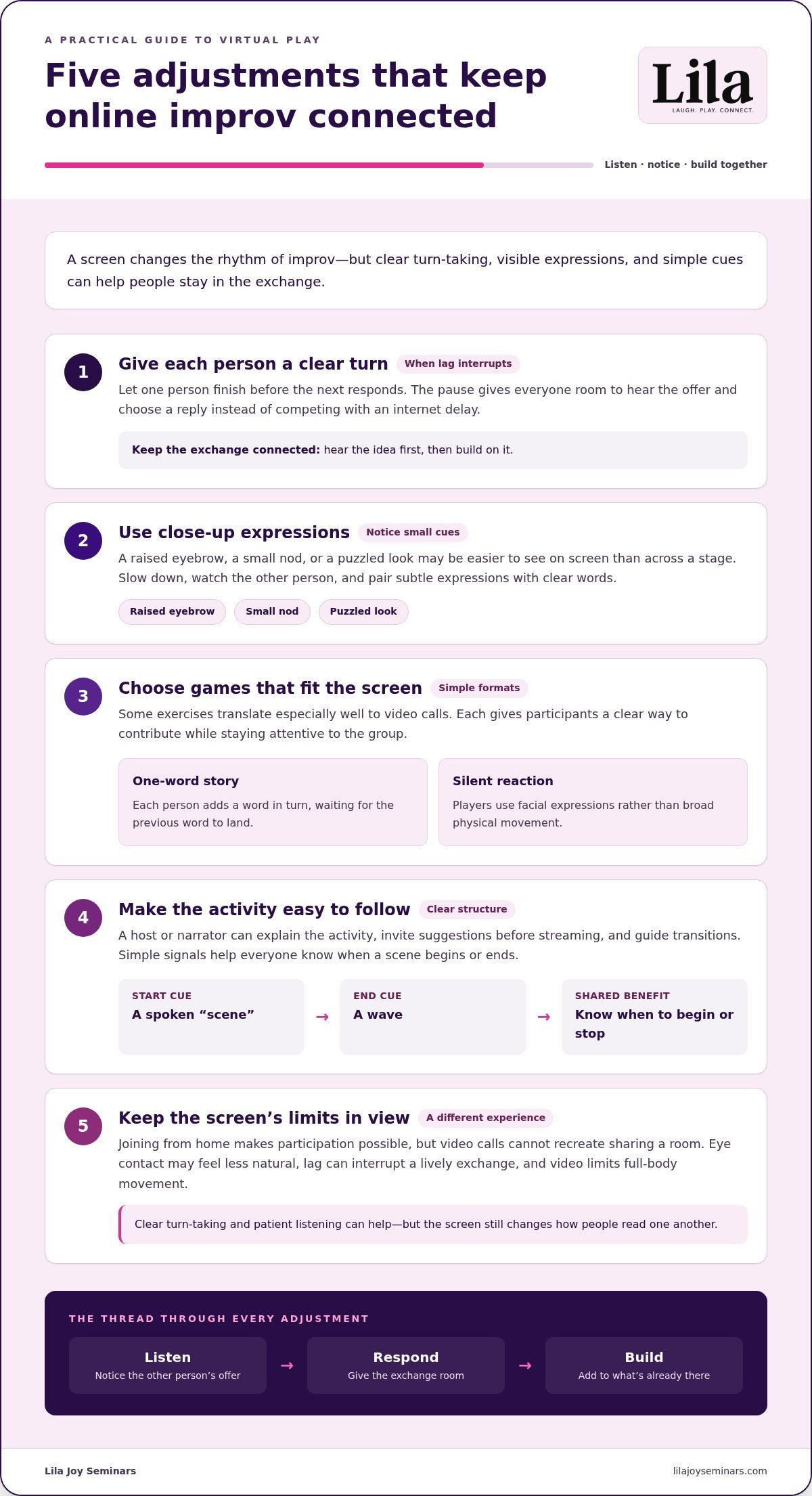
Virtual rooms can change the rhythm of familiar exercises. Internet lag may cause interruptions, and technical issues can disrupt games that depend on quick, overlapping replies. A simple adjustment is to let one person finish before the next responds. That pause gives everyone room to hear the idea and choose a response, rather than competing with a delay.
Close-up video changes how people communicate, too. A raised eyebrow, a small nod, or a puzzled look may be easier to see on screen than across a stage. In a two-person exercise, subtle expressions can accompany clear words. Slowing down, watching the other person, and building on their contribution helps keep the exchange connected.
Some exercises work especially well on screen. In a one-word story, each person adds a word in turn, waiting for the previous word to land. In a silent reaction game, players can use facial expressions rather than broad physical movement. Joining from home makes participation possible, though video calls can’t recreate the experience of sharing a room.
Online shows and group exercises can also benefit from simple structure. A host or narrator can explain the activity, invite suggestions before streaming, and guide transitions. Clear cues, such as a spoken “scene” or a wave to signal an ending, help players know when to begin or stop. These choices make it easier to follow along, even when a screen freezes or a participant misses a moment.
If you’d like guided practice with exercises shaped for Zoom, explore live online improv as one way to experience the format.
Adult play and mental exercise
Improv gives adults a playful reason to follow a thought somewhere unexpected. A facilitator might offer “a library on the moon,” then invite everyone to add a story detail. One person imagines floating books; another invents a librarian who guides them home. The exercise brings creativity and spontaneity together, with no need to prepare a polished story.
Shared storytelling asks you to notice what came just before your turn. If a partner says, “The garden gate opened by itself,” you can add a sound, a visitor, or a reason. You choose from the details already in the scene, then give the next person something to build on. Listening keeps the story connected, while an unexpected idea gives your imagination room to move.
Short games can make mental effort feel less like a task. In a word-association round, one person says “rain,” and the next responds with the first related word that comes to mind. A group might turn those words into a shared story, shifting attention between listening, remembering details, and contributing. Online, participants can join from separate rooms, with clear turn-taking and attention to the group helping the exercise flow.
Improv can be playful without becoming a test of quick thinking or a clinical treatment. You can pause, offer a small detail, and let an idea grow at an easy pace. For example, if the prompt is “a very serious picnic,” you might add a tiny paper crown or an overly formal invitation. The fun comes from exploring the idea together, not finding the cleverest answer. Adults can create, adapt, and play without needing a finished plan.
Social connection through online improv
Online improv can build connection through shared attention, not just jokes. In a group activity, one person offers a setting, another adds an idea, and everyone helps shape the moment. Creating something together gives participants a reason to listen and respond, even when each person joins from home.
There are trade-offs. Compared with meeting in person, online sessions can make eye contact feel less natural, and internet lag can interrupt a lively exchange. Video also limits full-body movement and the feeling of sharing a room. Clear turn-taking and patient listening help, but the screen changes how people read one another.
When choosing an online improv course, look for live interaction, clear guidance, and exercises that welcome beginners. A useful class explains how activities work, leaves room for each person to participate, and makes the social purpose clear. To judge whether an instructor and format feel reputable, look for a transparent course description and a structured, interactive session rather than relying on promises of instant confidence.
In the United States, price depends on class format, duration, group size, and instruction, and is given after a quote request. Community-led online practice groups can offer free informal play, while an instructor-led class provides guided exercises and feedback.
Choose based on the kind of connection you want: informal group play or regular guided practice. Lila’s live online improv classes offer interactive games in a shared Zoom setting for adults who want to practice together.
Make Room for a Little More Play
You don’t have to wait until you feel confident to try something new. Confidence may follow the experience of showing up, listening, and taking part, even in a small way. If you’re deciding whether online improv is worth it, consider what you’d like more of: playful moments, shared creativity, or a fresh way to connect with people.
There’s no need to arrive with a clever idea or a polished version of yourself. Start with curiosity and see how it feels to create alongside others. A live group can offer a welcoming place to explore at your own pace.
If you’d like to take a closer look at a guided online experience, try a free class with Lila. You can choose your next step gently, and let play begin with one simple moment of participation.
Frequently Asked Questions
Are Online Improv Classes Worth It?
Yes, online improv is worth it if you want guided opportunities to respond in real time and create with other people. Its value depends on what you’re looking for: screen-based play and conversation practice, or physical stage work. After a session, notice whether you felt engaged in the activities and welcome to contribute. That’s a more useful measure than expecting every class to change how you socialize.
Can I join even if I’ve never taken an improv class?
Yes. You can join Lila’s live online improv classes without previous acting or improv experience. In a first exercise, you might simply add one detail to a partner’s idea, such as naming what a character brought to a picnic. Listening comes before inventing anything clever. You can take part at a manageable pace and grow more comfortable through practice.
Will I become one of those people who thinks everything can be solved by improv?
No. Improv is a playful practice, not a universal answer or a substitute for practical judgment. If a coworker is worried about a deadline, for example, listening and asking what support would help may matter more than adding a playful twist. You can enjoy improv games while choosing direct, serious communication when the moment calls for it.
Will I need any special software or technical skills?
No special improv software or technical skills are needed. Lila’s sessions take place on Zoom, and you’ll need a basic internet connection. Before joining, open the meeting link, check that your audio works, and learn how to mute or unmute. These simple steps can make the first few minutes less distracting, leaving more attention for the group.
Will it still be fun even though it’s online?
Yes, an online session can still be enjoyable because surprise comes from how people respond to one another. A group might invent an imaginary café, with each person adding a menu item or an unexpected customer. A frozen screen or delay can interrupt the flow, but the facilitator can adapt the activity and keep the shared play going.
What are the benefits of taking online improv classes?
Online improv offers structured opportunities for adults to practice listening, creativity, spontaneity, and communication with others. A story game, for instance, asks you to build on someone else’s detail rather than plan your whole response in advance. Shared activities also give people a reason to interact. Notice which skills each exercise invites you to use, then reflect on the experience afterward.