


What if the goal isn’t to find the perfect comeback, but to feel more present when a conversation catches you off guard? If you’ve ever replayed an exchange later and thought of exactly what you wish you’d said, you’re not alone. Learning how to stop thinking of the perfect comeback too late doesn’t mean becoming the quickest or funniest person in the room.
That delayed flash of insight has a name: “staircase wit,” a phrase linked to the philosopher Denis Diderot, who described thinking of a reply only after leaving the moment. It doesn’t mean you’re awkward or lacking in wit. Surprise, tension, and the pressure to say the right thing can make it harder to respond naturally.
This article explains why better replies often arrive afterward and offers practical ways to pause, listen, and choose a response that fits. You’ll practise letting go of the perfect line and making room for words that feel usable and true to you. We’ll also explore how playful improv can offer a low-pressure way to practise being present with other people, without needing to perform or be funny.
Key Takeaways
- Replaying a conversation can offer perspective, but it doesn’t prove you should have known what to say in the moment.
- Witty isn’t the only way to respond well. A calm question, honest answer, pause, or boundary may fit the moment better.
- To practise how to stop thinking of the perfect comeback too late, notice the urge to impress, pause, listen, and choose one honest next response.
- Try small, optional practice moments in everyday chats so responding feels less like a performance and more like a conversation.
- Supportive improv games invite you to listen and respond to what’s happening, with connection, not polished comebacks, as the focus.
Why the Perfect Comeback Comes to Mind Too Late
You finish a conversation, take a breath, and suddenly find the words you wanted. Maybe they’re a lighter reply to a friend’s teasing comment, a clearer point you could have made in a meeting, or a firm sentence you couldn’t find during a tense exchange. The situations differ, but the afterthought can feel familiar: “Why didn’t I say that then?”
A delayed reply doesn’t mean you had nothing to offer. It may simply be easier to shape a thought after the exchange has ended and you’re no longer trying to respond in real time. That distinction matters when you’re figuring out how to stop thinking of the perfect comeback too late. The aim isn’t to judge yourself for pausing, but to understand what was happening in the moment.
What does l’esprit de l’escalier mean?
L’esprit de l’escalier is a French phrase often translated as “staircase wit.” It describes thinking of a clever or fitting reply only after the moment to use it has passed. The words may come to you while walking away, getting home, or moving on to something else. You can find a brief description of the phrase in the Wikipedia article on l’esprit de l’escalier.
It’s a name for a familiar experience, not a diagnosis or formal psychological condition. And the reply that arrives later doesn’t have to be witty. Perhaps you realize how you could have answered a casual question more openly, explained your thinking at work, or expressed a boundary during a difficult conversation. What these moments share is their timing: the thought becomes clearer after the exchange has ended.
Why the moment can feel bigger afterward
In the moment, you may be listening, working out what the other person means, and deciding how much you want to say. Later, you can revisit the exchange without having to keep up with it. You can try different wording, soften a sharp edge, or add a detail you couldn’t gather quickly enough before. Hindsight allows for revisions that the original conversation didn’t.
That gap can bring frustration. You might wish you had sounded more confident, been kinder to yourself, or said plainly what mattered. Replaying the exchange can help you notice what you wanted to express. But it can also become a harsh review, where every possible response seems obvious because you already know how the conversation unfolded.
One delayed reply doesn’t tell you how capable or socially comfortable you are. Missing a joke in a relaxed chat isn’t the same as struggling to speak during a meeting or feeling unsure in a tense exchange. Each moment has its own pace and stakes. You’re allowed to take time to find your words, and you don’t have to treat every later thought as evidence that you failed.
Why Your Mind Replays the Conversation Afterward
A conversation moves quickly. You’re listening, reading the other person’s tone, deciding what you think, and choosing how to put it into words, sometimes all at once. Afterward, the pace changes. You can sort through what mattered and revise your wording without someone waiting for an answer.
That extra room can make a response feel obvious in hindsight. But thinking of a better sentence later doesn’t prove it would have changed the conversation. The other person might have reacted differently, or the moment might have passed in much the same way. Reflection can show you what you wanted to say; it can’t tell you for certain what would have happened next.
How pressure and surprise affect what you say
A sudden question in a meeting may leave you choosing between answering right away, asking for more time, or gathering your thoughts. In a tense exchange, you might be weighing whether to explain yourself, set a limit, or let the comment go. A quick chat with unfamiliar people brings its own uncertainty: you may not yet know the group’s tone or how your words will land.
It’s harder to choose among several possible responses when the conversation keeps moving. The same person may feel relaxed and quick with close friends, then go quiet in a new group or during a disagreement. That shift doesn’t mean your social ability has disappeared. The setting, subject, pace, and sense of being judged can all affect how easy it feels to speak.
A pause after a conversation can help a thought take shape because you have room to consider what you meant without needing to answer at once.
Notice the situations that bring on delayed replies
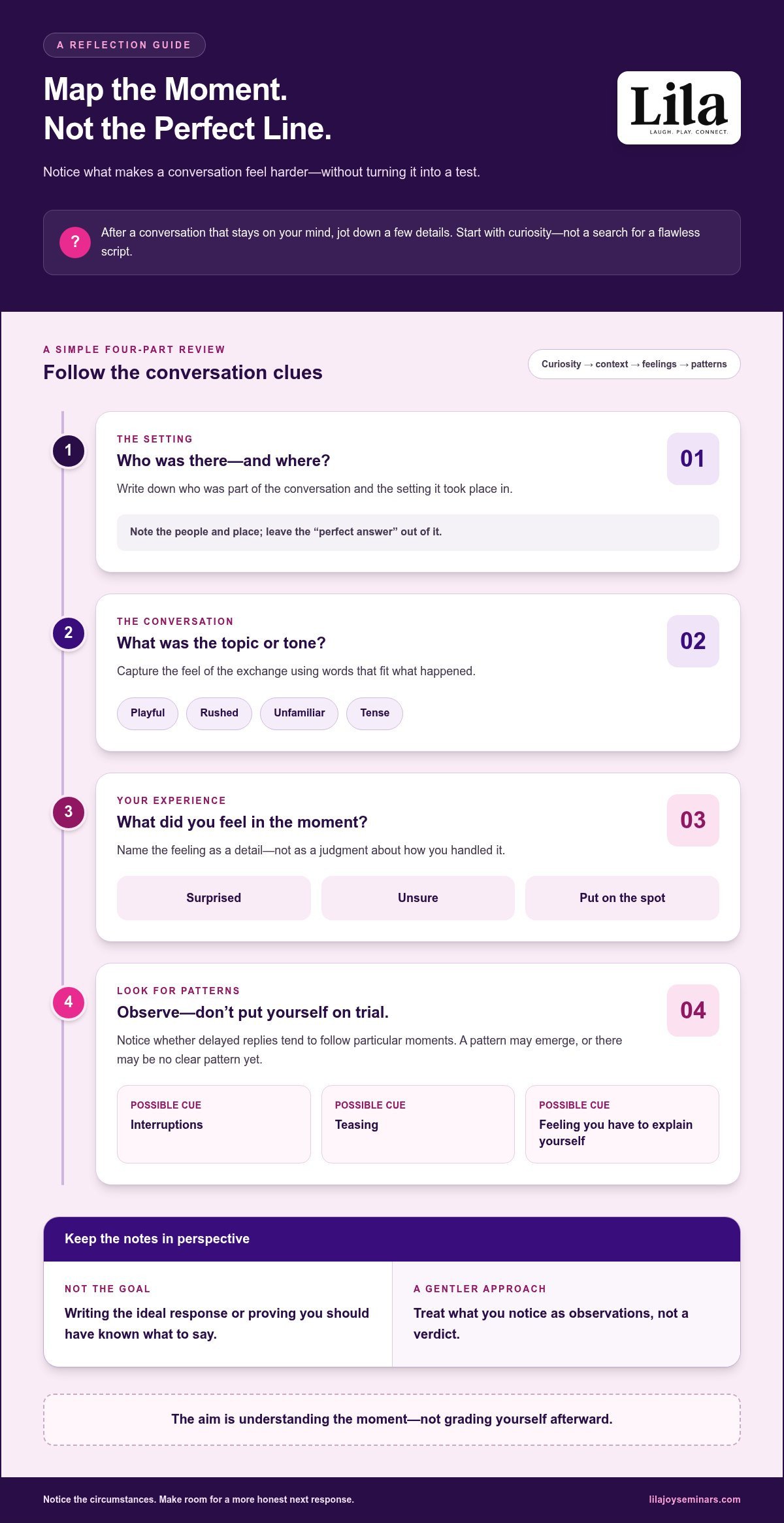
If you want to understand how to stop thinking of the perfect comeback too late, start with curiosity, not a search for a flawless script. After a conversation that stays on your mind, jot down a few details:
- Who was there, and what was the setting?
- What was the topic or tone: playful, rushed, unfamiliar, or tense?
- What did you feel in the moment, such as surprised, unsure, or put on the spot?
You don’t need to write the ideal response. Recording the circumstances can help you notice patterns without turning every conversation into a test. Perhaps delayed replies tend to follow interruptions, teasing, or moments when you feel you have to explain yourself. Or perhaps there’s no clear pattern yet. Either way, treat your notes as observations, not a verdict.
Noticing what makes a moment feel harder can offer a gentle starting point for exploring everyday spontaneity. If you’d like a playful setting to practise responding in the moment, Lila’s live online improv classes use games and group reflection to support confidence, spontaneity, and connection. You don’t need to arrive with a prepared line or a goal of being funny.
A Perfect Comeback Is Not the Only Good Response
A witty line can feel satisfying. It may lighten a playful moment or help you feel less caught off guard. But a quick, clever reply isn’t automatically the clearest or kindest way to communicate. Sometimes the most useful response is a simple question, an honest sentence, or a boundary that makes your meaning clear.
A useful response doesn’t have to be clever or immediate; it only needs to serve what matters in that moment. That might mean keeping a conversation warm, understanding what someone meant, or making it clear that a comment didn’t feel okay. The aim isn’t to win every exchange. It’s to choose a response that feels workable for you.
When a pause or silence can be enough
A brief pause can help you take in what you’ve heard and decide what you want to say. You might take a breath before answering a pointed question, or let a friend’s joke pass without trying to top it. That pause is different from feeling forced to stay quiet because you can’t produce a witty line quickly enough.
Silence can be a choice, but it isn’t always the right choice. If someone is being hurtful, you don’t have to laugh it off or wait for a perfect response. You can speak up, step away, or return to the conversation later. The point isn’t to make silence the answer. It’s to remember that an instant comeback isn’t your only option.
Choose a response that fits the moment
Try asking what the exchange needs from you, rather than how to sound impressive. Different moments call for different kinds of replies. For example:
- Ask for clarity: “What did you mean by that?” can give you a moment to understand before responding.
- Name your reaction: You might say, “I’m not sure how to take that,” or put the feeling into your own words.
- Take time: “Let me think about that” can be enough when you don’t want to answer on the spot.
- Set a boundary: You can say that a subject or comment doesn’t work for you, without turning the exchange into a contest.
- Change direction: If the conversation has run its course, moving to another topic may be a reasonable choice.
These aren’t lines to memorize. Use words that sound like you, and adjust them to the person and situation. If you’re deciding how to stop thinking of the perfect comeback too late, measure success less by speed and more by whether you communicated what you wanted. A calm response can be strong. A question can be direct. And sometimes you may decide that no response is worth giving right then.
How to Practise Responding Without Rehearsing a Perfect Line
You don’t need to prepare a clever answer for every situation. A gentler practice is to notice when you’re trying to impress, make a little room, and respond to what’s actually happening. This can help you stay in the conversation without turning each exchange into a test of quick wit.
A simple in-the-moment pause
When you feel pressure to answer, notice one breath or a small physical cue, like your shoulders tightening. You don’t have to make the feeling go away. Let it remind you to listen for the other person’s point instead of building a reply while they’re still speaking.
Then choose one honest next step. You might answer, ask what they mean, or say you need a moment. The pause may not change how quickly a reply comes to mind, and that’s okay. It gives you a chance to choose whether you want to speak, ask, or wait.
- Notice the urge to impress. Quietly name it: “I’m trying to find the perfect thing to say.”
- Pause briefly. Feel your feet on the floor or take one easy breath.
- Listen for the point. What is the other person asking, sharing, or expressing?
- Choose one honest response. Say what fits, ask a question, or take more time.
A few flexible phrases can make it easier to begin without turning conversation into a memorized script. Try wording that sounds like you:
- “Give me a moment to think about that.”
- “Can you say a little more about what you mean?”
- “I’m not sure what I think yet.”
These are starting points, not lines you have to deliver perfectly. You can change them, leave them aside, or find your own. The aim is to give yourself options, not to rehearse whole conversations in advance.
Practise with small, everyday exchanges
Choose a familiar, low-pressure chat, such as talking with a friend about their weekend or sharing a thought over lunch. Try offering one fresh observation or asking a genuine follow-up question. Skip the exercise on a day when it doesn’t feel right. This isn’t a challenge to prove anything.
Afterward, notice whether you were present and whether you said something that felt true. Try not to score the exchange by how funny, smooth, or impressive you seemed. If you’re curious about a playful way to practise responding to what’s happening, how to feel more playful as an adult, improv games offer a shared structure without requiring prepared jokes.
If you’d like to practise in a supportive group, explore Lila’s live online improv classes. Improv games and group reflection offer adults a low-pressure space to practise listening, spontaneity, and connection. No prior improv experience is needed, and you don’t have to perform or be funny.
How Supportive Improv Can Help You Practise Being Present
Trying to keep a clever line ready can pull your attention away from the person in front of you. Improv offers a different kind of practice. In an interactive game, you listen to what someone else has offered, accept the starting point, and respond to what’s happening now. You’re not searching for a prepared punchline. You’re taking part in a shared moment.
What improv practice offers beyond a memorized comeback
A memorized response depends on the conversation matching the situation you imagined. Real conversations rarely follow a script. Improv exercises invite you to stay flexible: listen, notice what’s been said, and add a response that fits the moment. The point isn’t to be the funniest person in the group. It’s to participate and connect, even if your contribution is simple.
Playful exercises give you room to experiment with this kind of attention without prior improv experience. You might feel unsure at first, and that’s okay. Improv doesn’t promise faster replies or treat anxiety. It offers a shared setting where you can try responding without arriving with a polished line.
A low-pressure way to explore live improv
For adults who feel stuck, a supportive group can make trying something new feel more manageable. Lila offers live online improv classes on Zoom, each lasting one to two hours. The classes use improv games and group reflection to support confidence, spontaneity, and connection. You don’t need previous improv experience, and you don’t need to be funny to take part.
The practice isn’t about winning laughs or proving you can answer quickly. It’s about joining in, noticing other people’s ideas, and exploring what happens when you respond to the moment instead of rehearsing for it. That can be a useful contrast if you’re learning how to stop thinking of the perfect comeback too late, though a class can’t promise a particular result in your everyday conversations.
If you’re curious, you can try your first class free and see how this kind of group practice feels. Treat it as a chance to explore, not another place where you have to perform. You can begin by listening, joining in at your own pace, and letting the next response be enough for that moment.
Let Your Next Conversation Be a Fresh Start
You don’t have to solve every past exchange before you can feel more at ease in the next one. The next time a reply comes slowly, let that be a moment, not a verdict. You can notice what you’re feeling, choose a simple response, or decide to come back to the conversation later.
That’s a gentler way to approach how to stop thinking of the perfect comeback too late: make space for connection instead of measuring yourself by speed. Try one small experiment, such as asking a curious question or sharing a thought before you’ve polished it. You don’t need to get it just right. A real conversation can hold pauses, imperfect wording, and a change of direction.
If you’d like a welcoming place to explore responding in the moment through playful group practice, try a free live online improv class with Lila. Come as you are, without preparing a joke or proving how quick you can be. One ordinary exchange at a time is enough.
Frequently Asked Questions
Why do I think of the perfect comeback hours later?
A reply may come more easily later because you can reflect without also managing the flow of the conversation. If you’re wondering how to stop thinking of the perfect comeback too late, ask what you wanted the other person to understand. Was there a detail to correct, a feeling to share, or a question you didn’t get to ask? That can help you decide whether a follow-up would be useful, instead of treating every afterthought as a missed chance.
Is there a name for thinking of the right thing to say too late?
Yes. L’esprit de l’escalier, often translated as “staircase wit,” describes a clever reply that arrives after the moment has passed. The phrase gives a familiar experience a name, but it isn’t a diagnosis or a measure of how witty you are. You can recognize the pattern without turning the next conversation into a test of whether you can deliver a clever line in time.
Can I stop replaying a conversation after it is over?
You may not be able to stop a replay the moment it starts, but you can choose how to respond to it. Try naming the thought: “I’m reviewing that conversation.” Then ask whether anything needs attention now, such as clarifying a misunderstanding or following up on a promise. If there’s no useful next step, notice one thing around you and return to the task you were doing.
Should I prepare a comeback before a difficult conversation?
You can prepare for a difficult conversation without writing a comeback in your head. Before a meeting about a concern, for example, consider what you hope the other person understands and what you want to ask. A few flexible phrases may help you open the conversation, but leave space for what they actually say. Listening may change what feels useful, and a prepared punchline may not fit at all.
What can I say when I need time to think?
You can say, “I’d like to think about this before I answer,” or, “Can we return to this later today?” If you’re unsure what someone is asking, you might say, “Are you asking for my view or a decision?” Choose words that suit your relationship and the setting. They don’t have to sound polished. A plain, sincere sentence can make your need for time clear.
Does thinking of a comeback late mean I am bad at conversations?
No. A delayed reply on its own doesn’t define your ability to communicate. A better check is whether you were able to take part in a way that mattered to you, even if your words weren’t especially quick. You might have listened carefully, asked a useful question, or returned to the topic later. Those moments count too. Give yourself room to notice what went well, not only what you wish you’d said.