


What if getting out of your head didn’t mean making every thought disappear? If you replay conversations or search for the perfect reply, an improv class to stop overthinking may offer a gentle way to return your attention to what’s happening now. It doesn’t silence your inner commentary. Instead, it gives you something specific to notice and respond to.
It makes sense if improv sounds intimidating. You might picture quick jokes, big personalities, or needing to be naturally funny. You don’t. A simple exercise might involve listening to a partner’s words and adding one thought of your own. The aim isn’t to impress anyone. It’s to notice when you’re self-editing, then practise meeting the moment as it unfolds.
In this guide, you’ll find gentle exercises to try and a practical way to practise without wrestling with every thought. You’ll also learn what a supportive live class can involve. Lila Joy Seminars offers adults an eight-week live online improv seminar with games and group reflection, a guided space to practise responding in the moment without prior improv or acting experience.
Key Takeaways
- Notice when your attention shifts from listening to judging, replaying, or searching for the perfect words.
- An improv class to stop overthinking offers practice responding to what’s happening, not a promise to silence thoughts or treat anxiety.
- Try one small improv-inspired exercise, such as listening for a detail and responding to it. Pause whenever you want.
- Consider whether a supportive live seminar feels like a comfortable place to practise spontaneity and connection with others.
Why overthinking can pull you out of the moment
You may be rehearsing a reply while someone is still talking, replaying a conversation after you leave, or waiting for the perfect words before saying anything. Some reflection is part of everyday life. It can help you understand what happened or decide what you’d like to say next. The strain comes when attention gets caught evaluating every possible response instead of following the conversation in front of you.
Thoughtful reflection helps you learn from a moment; repetitive replay keeps asking you to relive it. This distinction isn’t about judging yourself. It’s a way to notice whether thinking is helping you take part or keeping you at a distance from the conversation.
What overthinking feels like during a conversation
Imagine a friend telling you about a change at work. As they speak, you silently draft several replies: Should you ask a question? Share a similar experience? Say something supportive? Then you start checking your own expression, tone, or timing to see whether you seem interested enough.
That inner editing can make it harder to catch the details your friend is sharing. You might miss the name of a new project or the feeling behind their story because your attention is busy reviewing your own performance. A pause or moment of uncertainty is ordinary, though. It doesn’t mean anything is wrong with you. It may simply be a cue to notice where your attention has gone.
Why the search for perfect words can keep you stuck
Looking for certainty can feel like preparation: if you find exactly the right sentence, perhaps you can avoid misunderstanding or awkwardness. But conversations keep moving while you edit. You might be choosing between “That sounds exciting” and “How do you feel about it?” only to realise the other person has already moved on to the next part of the story.
You don’t need to become instantly witty or fearless. A genuine response can be simple: “What happened next?” or “That sounds like a lot to take in.” It doesn’t have to be the most polished sentence in the room. The broad idea of improvisational theatre is that people respond to what unfolds rather than follow a fully written script. That makes improv a useful lens for noticing the difference between engaging with a moment and trying to control every possible outcome.
If you’re considering an improv class to stop overthinking, set a gentle expectation: a class offers chances to practise listening and responding, not a test of how quickly you can think or how funny you can be. For now, noticing when you’ve drifted into self-editing is a meaningful first step back toward the conversation.
How improv can give your attention a place to land
Overthinking can pull attention toward imagined versions of what might happen next. An improv prompt gives you something simpler to meet: a partner’s words, a detail in the room, or a choice the group is making together. You’re not asked to empty your mind. Thoughts may still come and go. The practice is to notice what’s happening outside the rehearsal loop and respond to one piece of it.
A small prompt gives attention somewhere present to rest, without asking every thought to disappear. The shift can be modest. You might notice a word, listen for a detail, or offer a straightforward response. These are opportunities to practise paying attention, not guaranteed psychological effects, and each person’s experience will differ.
Responding to what is here instead of rehearsing ahead
Say a partner offers the word “rain.” Rather than planning a whole story, you could notice that word and add, “I left my umbrella at home.” Your partner now has something ordinary to build on, perhaps by mentioning a dripping coat or a puddle on the path. The exchange can grow one small contribution at a time.
The point isn’t to invent something clever. It’s to listen for what’s already been offered, then make a choice that connects to it. That gives your attention a simple task: hear, notice, respond. If your mind wanders, return to the next word or shared choice without criticising yourself.
Letting an imperfect response be enough
In a group exercise, a short answer can keep things moving. “It’s cold,” “Let’s go inside,” or even “I’m not sure” can be enough to offer a next step. You don’t have to turn each contribution into a polished line. Improv activities are shared, so another person can respond, add an idea, or gently shift the direction.
A missed cue or an awkward pause is part of an activity, not proof that you’ve failed. You can let the moment continue rather than stopping to grade your response. This won’t make every thought vanish, and one exercise won’t change everyone’s habits. It simply gives you a chance to practise engaging while thoughts are present.
This is one reason an improv class to stop overthinking can be understood as a place to practise presence, rather than a promise of a particular result. A prompt makes the next step more visible, but you can participate at a pace that feels manageable. Listening closely, responding simply, and noticing when attention drifts are all valid parts of the process.
Lila Joy Seminars’ live online seminar uses improv games and group reflection in a supportive, low-pressure setting. The live online improv seminar gives adults a shared setting to practise responding in the moment.
What improv can and cannot do for overthinking
Improv offers a structured chance to notice how you respond when there isn’t a script. In an exercise, you might catch yourself preparing the “right” contribution, then bring your attention back to the shared prompt or another person’s idea. You can practise listening, responding, and allowing a little uncertainty while the activity continues. These are opportunities for practice, not guaranteed changes in how you think or feel.
That distinction matters. An improv class isn’t a shortcut that switches off thoughts, and joining one doesn’t mean you’ll suddenly feel calm in every conversation. It offers a setting to try something different, with other people and a simple activity to focus on. What feels useful, comfortable, or challenging will vary from person to person.
What practice may help you notice
A group prompt can make self-editing easier to spot. Perhaps you notice you’re planning several responses instead of listening to the next contribution. You can then choose to attend to a word, a gesture, or the direction of the exercise. This isn’t about correcting yourself. It’s a chance to recognise the drift and decide whether you want to rejoin the shared activity.
Exercises can give you chances to practise listening closely, responding simply, and staying with a little uncertainty. Those skills might feel relevant outside class, but they don’t automatically transfer to every conversation. The value can be in trying them in the moment, without turning each attempt into a measure of progress.
What an improv class is not a substitute for
An improv seminar is a group learning experience, not therapy or clinical care. It isn’t a treatment for anxiety, a way to eliminate difficult thoughts, or a promise that overthinking will stop. If persistent worry or distress is affecting your life and you’re seeking help, appropriate professional support is the right place to turn. Improv can sit alongside personal interests, but it shouldn’t replace care you need.
You don’t need to be quick with jokes, invent polished scenes, or feel fearless to take part. Improv practice can be gentle and collaborative. Lila Joy Seminars’ eight-week live online seminar is designed for adults, uses improv games and group reflection, and requires no previous improv or acting experience. The emphasis is on exploring and practising together, not proving you’re naturally funny.
If you’re weighing up an improv class to stop overthinking, ask yourself: “Would I like a low-pressure place to practise listening and responding?” You can approach the experience with curiosity while keeping expectations realistic. You don’t have to arrive without thoughts, leave with a transformed mind, or show anyone a polished version of yourself. A small moment of participation is enough for that moment.
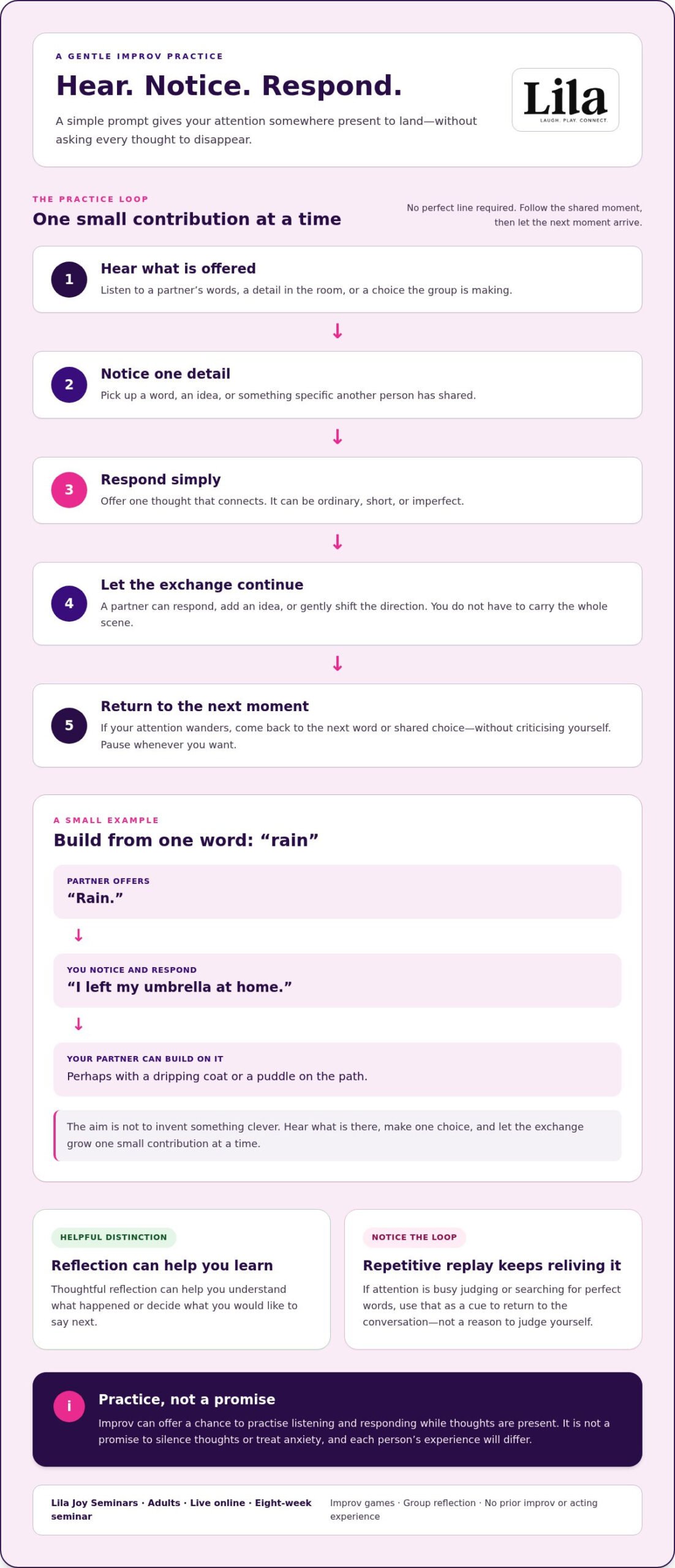
Try these gentle improv-inspired steps when you start overthinking
These brief exercises are invitations, not assignments. Try one by yourself or with someone who’s happy to join in. You can pause, skip a step, or stop whenever you like. No explanation is needed. The aim isn’t to force thoughts away, but to give your attention one small, present detail to meet.
Use a three-part pause: notice, listen, respond
Try this during a relaxed conversation, or adapt it for a quiet moment on your own. Keep each step light. If it doesn’t feel helpful, leave it there.
- Notice. Catch the moment you begin drafting and redrafting the perfect response. You don’t need to change the thought or tell yourself off. Simply recognise, “I’m editing my reply.”
- Listen. Pick one detail from what the other person just said, such as a place, feeling, or activity. On your own, notice a nearby sound or a word on the page in front of you.
- Respond. Offer one simple sentence connected to that detail. “What was that like?” or “I can hear the rain, too” is enough. Let the sentence stand without polishing it several times.
This is a prompt for practice, not a test you pass or fail. If you lose the thread, return to listening or let the conversation move on. Even noticing that you’re self-editing is useful information. You don’t have to produce a perfect response to take part.
Borrow a simple shared-story prompt
If you’re comfortable with a partner, start a story together. One person offers a plain sentence, such as, “A small parcel arrived on the doorstep.” The next person adds one clear detail: “It had a yellow ribbon.” Continue for a few turns if it feels enjoyable. There’s no need for a clever plot, and either of you can pause or stop.
Prefer a quieter version? Write one sentence, then read your partner’s contribution and add a sentence on paper. You can take your time before responding. Or observe as your partner builds the story, noticing one detail without speaking. These variations keep the focus on what’s been shared while leaving room for different comfort levels.
If you’re wondering what joining a group might feel like, read our guide to low-pressure improv classes for adults for more context. Lila Joy Seminars’ online improv seminar provides a live setting for shared prompts and group reflection. The improv class to stop overthinking you choose doesn’t need to make you fearless or funny; it can simply be a place to practise noticing, listening, and responding.
Explore a supportive online improv class at your own pace
Trying an improv class doesn’t have to mean stepping into a spotlight or showing up with a clever idea ready. In Lila Joy Seminars’ eight-week live online improv seminar, adults meet weekly on Zoom for about two hours. Sessions use improv games and group reflection to offer a shared place to explore listening, spontaneity, and connection.
The live format lets you respond to prompts alongside other adults rather than practise alone with a set of instructions. There’s no need to get every response right. You can take part as you are, noticing what feels comfortable and what you might want to try next. People have their own ways of joining in, and there’s no expectation that everyone will feel or progress at the same pace.
What a guided online seminar gives you
A prompt gives the group something to meet together: a word, a small choice, or a shared idea. You can listen to what someone offers and decide how you’d like to respond. Group reflection gives you space to notice what the activity was like, rather than grade yourself on being funny or quick. It’s practice, not a measure of how well you performed.
The seminar may suit you if you’d like a regular place to explore responding in the moment with others. It meets weekly, so you can return to shared activities over time while allowing each session to feel like its own experience. There’s no promise that a particular exercise will change how you think outside class. Its value is the chance to participate, notice, and reflect in a supportive setting.
Decide whether trying a first session feels right
Consider whether a weekly live group practice fits what you’re looking for right now. Would it feel useful to explore simple prompts with other adults? Are you curious about participating without needing to be the funniest person in the room? No prior improv or acting experience is required. The focus is exploration and connection, not polished scenes, quick jokes, or proving yourself.
The first session is free, so you can experience the format before deciding whether you’d like to continue. Come with curiosity rather than a goal to fix yourself. An improv class to stop overthinking can’t promise to silence thoughts or deliver the same outcome for everyone, but a guided seminar offers a shared space to practise listening and responding. Try the first live improv session free.
Take one small step toward being present
You don’t have to wait until your mind feels quiet to try something new. Being present can begin with a small choice: listening for one detail, responding simply, or letting a pause be just a pause. If you’re curious about an improv class to stop overthinking, think of it as a chance to explore, not a promise that every thought will disappear or that you need to become someone different.
Take your time deciding whether a shared, guided activity feels right for you. There’s no need to arrive with a clever idea or prove anything. A little curiosity is enough to begin.
Try the first live improv session free and see how it feels to explore improv with others. Whatever you choose, you can meet the next moment one small step at a time.
Frequently Asked Questions
Can improv help me stop overthinking conversations?
Improv may give you a chance to practise joining an exchange without planning every line, but it can’t guarantee you’ll stop overthinking. You might find it useful to notice what happens when a conversation takes an unexpected turn, then try speaking up without overthinking by responding to what you heard rather than searching for a flawless answer. Afterward, consider what felt manageable, without treating one experience as proof that you should always respond a certain way.
How does improv help you stay present instead of rehearsing what to say?
Improv activities give you a shared focus, such as a group prompt or another person’s contribution. For instance, if someone introduces an unexpected detail in a story, you can respond to that detail instead of planning the ending in advance. Your thoughts might still wander. The activity offers something specific to return to, and practice may help you notice your habits without expecting them to change overnight.
Do you have to be funny to take an improv class for overthinking?
No. Improv doesn’t require you to tell jokes or come up with a brilliant idea on the spot. A plain contribution, such as asking a question or adding an everyday detail, can help an activity continue. If you’re worried about being judged, remember that a beginner class is a place to explore, not a contest. Focus on taking part in a way that feels genuine rather than trying to entertain everyone.
Is an improv class a form of therapy for anxiety or overthinking?
No. An improv class is a learning experience, not therapy or clinical treatment, and it shouldn’t be presented as a cure for anxiety or persistent overthinking. It may offer a setting to practise communication and spontaneity with others, but that is different from receiving mental health care. If worry or distress is affecting your daily life and you’re seeking support, consider speaking with a qualified health professional about appropriate care.
Can I try improv exercises by myself before joining a class?
Yes. Choose an ordinary object nearby and write three different ways it might be useful, letting the ideas be simple rather than clever. Or write a short exchange between two characters who want different things, one sentence at a time. There’s no audience and no need to finish. If the exercise feels uncomfortable or tiring, stop. A small experiment is enough to help you decide whether you enjoy this kind of play.
What happens in a live online improv class for adults?
At Lila Joy Seminars, adults meet weekly on Zoom for about two hours in an eight-week seminar. Sessions include interactive improv games and group reflection in a supportive, low-pressure environment. The activities give participants a shared experience to respond to, while reflection offers a chance to consider what they noticed. No previous improv or acting experience is needed, and the first session is free. It’s a group learning space, not performance training.
Is online improv a good fit if I tend to overthink what others think of me?
It might be worth exploring if a live group activity sounds interesting, even if you feel self-conscious at first. Online sessions let you join from home, though being on Zoom with a group may still feel new or uncertain. You don’t need to decide in advance how comfortable you’ll feel. Consider whether you’re curious about trying a shared activity, and give yourself room to notice your experience without judging it.