


What if learning how to be more spontaneous didn’t mean changing your personality or throwing your plans out the window? Maybe you know the feeling: the perfect reply arrives after the conversation ends, or your routine leaves little room to choose something different. It can seem as if spontaneity belongs to people who are naturally loud, funny, or impulsive. It doesn’t.
If you want to respond with more ease without forcing yourself or acting recklessly, start with small, low-pressure opportunities. You don’t have to become unpredictable. Keep the routines that support you, while making room for curiosity, play, and a moment to consider what you want to say or do.
This article explores why spontaneity can feel difficult, how it differs from impulsivity, and practical ways to practise being present in conversations and everyday plans. Try the small experiments at your own pace, or explore improv as a way to practise responding in the moment with other people. No big personality shift required. Just a little more room to meet what’s happening now.
Key Takeaways
- Think of spontaneity as making a considered choice in the moment, not becoming unpredictable or outgoing.
- Notice when rehearsing what to say pulls your attention away, then gently bring it back to the conversation.
- Learn how to be more spontaneous through small, low-stakes choices that leave your values and boundaries intact.
- Try a brief unscheduled pocket in a familiar routine, and decide what to do when it arrives.
- Explore improv as a way to practise responding with others, where connection matters more than being funny or performing.
What Does It Mean to Be More Spontaneous in Everyday Life?
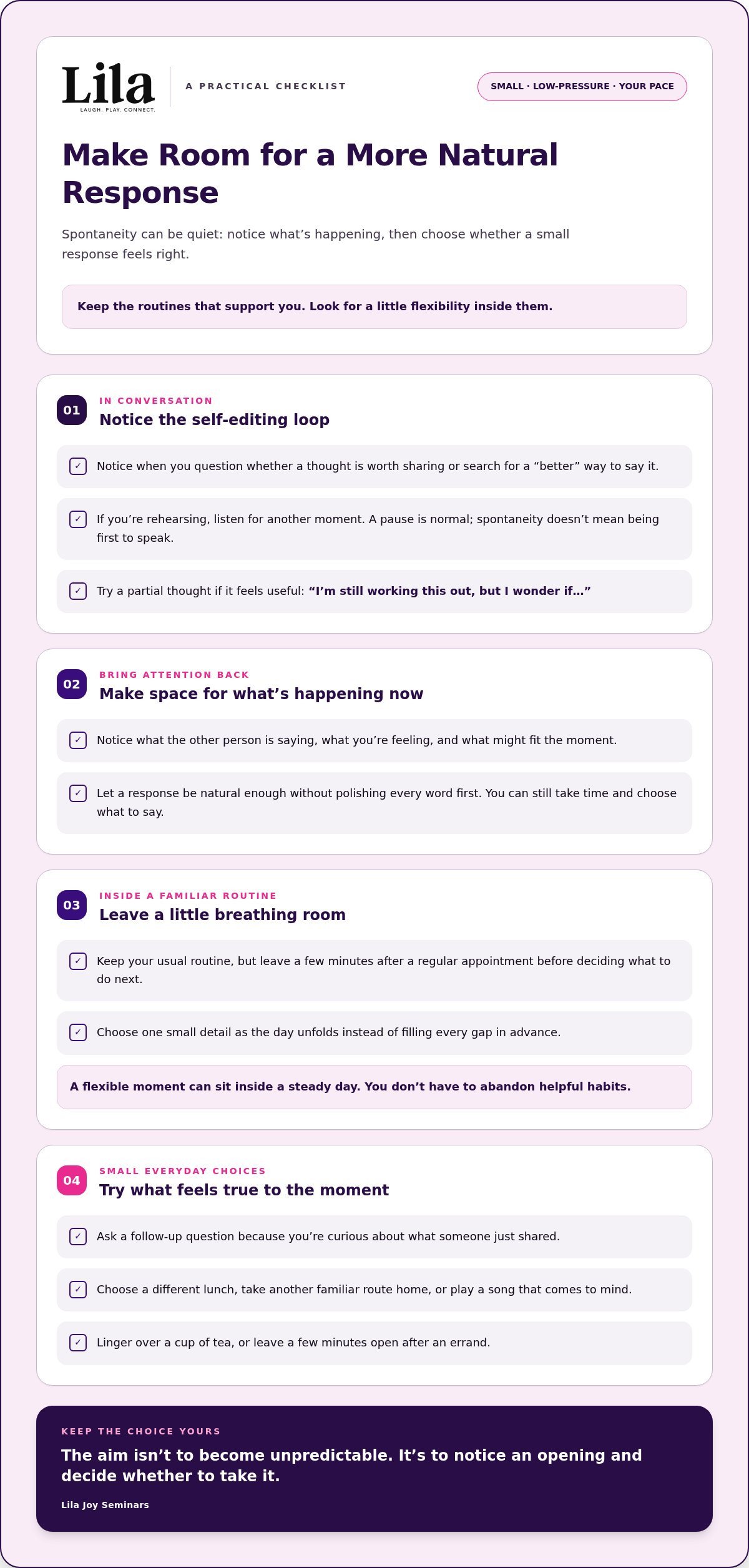
You might wish conversations felt a little less rehearsed, or that your days held more room for small choices. That doesn’t mean you need to become the loudest person in the room, say yes to every invitation, or make dramatic plans at the last minute. You can value structure and still want to feel more responsive to what’s happening around you. Spontaneity can be quiet: notice an opening, then choose whether to take it.
Everyday spontaneity is responding openly to the moment while keeping the freedom to choose what feels right for you. It isn’t the same as acting without thought. A spontaneous choice can be small and considered: asking a question that just occurred to you, suggesting a different walk, or deciding to linger over a cup of tea. The idea connects with the concept of spontaneity, but it doesn’t need to look dramatic or surprising to anyone else.
What does everyday spontaneity look like?
Imagine a friend mentions a new recipe. Instead of moving straight to the next topic, you ask, “What made you want to try it?” The question responds to what’s actually in the conversation. It doesn’t need to be clever. It simply gives your interest some space.
Or perhaps you usually order the same lunch. One day, you choose something else from the menu because it sounds good. You might take a different familiar route home, play a song that comes to mind, or leave a few minutes open after an errand. These are ordinary choices, not tests of courage.
Some moments are brief and thoughtful. Pause, notice what’s happening, and offer a response that feels true enough without polishing every word first. Learning how to be more spontaneous often means paying closer attention to the moment, not inventing a new personality.
Why can spontaneity feel difficult?
Sometimes a thought arrives, then self-editing steps in: Is that an odd question? Should I phrase it differently? By the time you’ve reviewed the options, the conversation may have moved on. If you’ve thought of the perfect reply only after saying goodbye, you’re in familiar company. Hesitating doesn’t mean you’re bad at connecting. You may simply be trying to get the words right.
Preparation can also be comforting. A routine reduces the number of decisions in a day, while knowing what to expect can make plans feel easier to manage. There’s nothing wrong with that. Spontaneity doesn’t ask you to abandon helpful habits or leave every afternoon unplanned.
Instead, think of it as a little flexibility inside the life you already have. Keep your plans and make a small choice within them. You can also take time before answering. The aim isn’t to respond instantly; it’s to notice when you’re editing yourself automatically and consider whether a more natural response feels welcome. Even a quiet “I’m curious, tell me more” can be enough.
Why Overthinking and the Need for Certainty Can Crowd Out Spontaneity
It’s natural to want a little time to find the right words. You might replay a conversation in your head, prepare for a meeting, or feel more at ease when you know what comes next. Those habits can be useful. The difficulty comes when every small interaction feels as if it needs a polished response or a clear plan before you can take part.
Spontaneity depends partly on where your attention is. If you’re busy judging each possible reply, it can be harder to notice what the other person is saying, what you’re feeling, or what might fit the moment. Giving more attention to what’s happening can make it easier to respond in a way that feels natural to you. That doesn’t mean you must stop thinking. It means making a little space between a thought and the urge to edit it away.
How self-editing can interrupt a natural response
The pattern can be subtle: you notice a thought, question whether it’s worth sharing, search for a better way to say it, then realize the conversation has moved on. For example, in a team discussion, you may have an idea about a small change to a shared plan. While you silently test whether it’s clever or complete enough, someone else begins speaking.
There’s no need to force a reply before you’re ready. A pause is normal, and spontaneity doesn’t mean being the first to speak. If you notice yourself rehearsing, listen for another moment or offer a partial thought, such as, “I’m still working this out, but I wonder if…” You may find that useful, or you may not. Either way, you’re allowed to take time and choose what to say.
Why routines can help, and when they leave little room
Routines give shape to a day. They can help you remember what matters, manage responsibilities, and spend less energy deciding every detail. You don’t need to tear up your schedule to make room for a more flexible response. Look instead for a small, low-stakes opening within a familiar pattern.
Perhaps you leave a few minutes after a regular appointment before deciding what to do next, rather than filling every gap in advance. Or you keep your usual morning routine but choose one small detail as the day unfolds. The point isn’t to add another task called “be spontaneous.” It’s to allow a little breathing room where a choice can emerge.
If you’re curious about practising in a shared setting, Lila’s live online improv classes offer a chance to explore responding in the moment with others. You can keep the rest of your day steady. One small open space is enough to begin exploring how to be more spontaneous, at a pace that feels comfortable.
Spontaneity Versus Impulsivity: How to Stay Open Without Ignoring Your Boundaries
Being more spontaneous doesn’t mean agreeing to everything, changing plans without thinking, or ignoring what matters to you. It means staying open to a moment while keeping your judgment in the room. You can welcome an unexpected idea, consider it, and still decide it isn’t right for you.
A useful distinction is the space you leave for a choice. Flexibility lets you notice a new possibility and consider whether it suits your time, energy, and values. Impulsivity skips over relevant consequences. The point isn’t to judge yourself, but to recognize whether you’re choosing with awareness or reacting before you’ve had a chance to check in.
How can you tell flexibility from impulsivity?
Think of a low-stakes invitation: a friend suggests stopping at a bookstore after lunch. A flexible response might be to check your afternoon, then decide to go because you have time and feel curious. An impulsive response might be to agree automatically without considering a commitment you’d already made. Or you might keep your original plan and suggest another day.
The difference isn’t whether you say yes or no. It’s whether your response reflects a choice. You can keep a plan and still be receptive to what’s happening; you can change it after a quick check-in. Either way, spontaneity doesn’t ask you to surrender good judgment.
| Flexible response | Impulsive action | Useful boundary |
|---|---|---|
| You consider a new café, then choose it because you have time. | You agree to go without noticing you’re already running late. | “I have time for a quick stop, but not a long visit.” |
| You try a different lunch from the menu because it sounds appealing. | You order before checking what you actually want. | You stick with your usual choice if that feels right today. |
| You join a casual game if you feel like taking part. | You join because you feel you have to, even though you’d rather watch. | “I’ll sit this one out, but I’d like to watch.” |
How to keep your boundaries while staying open
Before you agree to a change, take a moment to check in: Do I have the time? Do I have the energy? Does this fit a commitment I’ve made? Am I interested, or just worried about disappointing someone? You don’t need to ask yourself every question every time. Even a brief pause can help you distinguish genuine curiosity from automatic agreement.
If you’re unsure, you can say, “Let me think for a moment,” or “Can I get back to you after I check my plans?” A pause isn’t a failure to be spontaneous. It gives you room to respond honestly. If the answer is no, a kind “Thanks for inviting me, I’m going to pass today” is a complete response.
Learning how to be more spontaneous can include staying with your original choice. The aim isn’t to say yes more often; it’s to make room for a considered yes, a comfortable no, or a small change when one feels welcome.
How to Practise Being More Spontaneous With Small Everyday Choices
You don’t have to wait for a free weekend or a bold idea to practise. Start with a choice that feels safe, small, and easy to change. The point isn’t to collect spontaneous moments or prove you can be carefree. It’s to notice where you have room to choose, then explore that room at your own pace.
Start with one low-stakes choice each day
Pick an experiment that fits your day and comfort level. Try one small choice, see how it feels, and move toward something less familiar only if you want to. The progression below is an invitation, not a checklist you need to complete.
- Notice an available choice. Choose a different seat at home, play a song you haven’t heard in a while, or add a little extra time to an activity you already enjoy.
- Let a small curiosity guide you. If a book cover, shop window, or conversation catches your interest, give it a moment. You could browse, ask a simple question, or just notice what drew your attention.
- Try a slightly less familiar option. If it feels comfortable, take a different route through a place you know well or begin a casual conversation with someone you see regularly.
- Pause and reflect, without grading yourself. Did the choice feel pleasant, awkward, or simply ordinary? Noticing what happened is practice, even if you decide you wouldn’t choose it again.
Before editing an idea away, ask, “Is this safe and manageable, and do I actually want to try it?” If the answer is yes, give yourself permission to explore. If not, let the idea pass. Either response is yours to make.
Make a little room for an unexpected moment
A tightly packed schedule can leave little space to follow a passing interest. You don’t need to clear the day. Instead, leave a brief flexible pocket inside a familiar routine, perhaps after lunch or before an evening activity. Keep necessary commitments in place, and let the open minutes remain open until they arrive.
When that pocket comes, notice what you feel drawn to. Maybe you want fresh air, a quiet cup of tea, or a few minutes to look through a nearby market. Choose something safe and manageable, or do nothing in particular. The space is there to offer a choice, not create another obligation.
If you’d like a playful way to practise responding in the moment, try a few improv games to practise spontaneity. Keep the spirit gentle: curiosity matters more than getting it right. For a group experience, Lila’s live online improv classes run on Zoom for one to two hours, and members can join as many as they like. Your first class is free, and no previous improv experience is required.
How Improv Can Help You Explore Spontaneity in a Supportive Group
Practising spontaneity with other people can feel different from trying a new habit on your own. Improv for making friends as an adult offers a playful space to listen, respond, and see what happens without preparing the perfect line. The goal isn’t to be funny, take centre stage, or perform. It’s to explore how you respond in the moment and share an experience with others.
That can make improv one gentle option if you’re wondering how to be more spontaneous. A simple game might invite you to build on someone else’s idea or respond to an unexpected prompt. You don’t need to make the “right” choice. Pay attention, offer what comes to mind, and let the next moment unfold.
What can an adult beginner expect from improv practice?
In Lila’s live online improv classes, adults meet on Zoom for one to two hours. Classes include improv games to practice spontaneity and group reflection. Games create chances to respond to what others say or do, while reflection offers time to notice what the experience was like. No previous improv or acting experience is required.
You don’t have to arrive with a character, a polished story, or a knack for jokes. Improv here is a way to explore connection and responding in the moment, not acting or performance training. If you’re curious about the format and what an adult beginner might explore, you can learn more about online improv classes for adults.
A group setting also gives you the chance to notice how different people respond to the same prompt. You might find that listening closely helps you decide what to contribute, or that a simple response is enough to keep an exchange moving. You can participate without needing to impress anyone.
A gentle next step if you want to explore further
If you’re not sure whether a live class would feel comfortable, your first one is free. It gives you a chance to experience the games and group reflection, then decide whether you’d like to continue. There’s no need to promise yourself a transformation before you begin. You can simply be curious about how it feels.
For more on taking small steps toward greater ease, explore this improv confidence guide. If you’d like to practise spontaneity alongside others, Lila’s live online improv classes welcome adults with no prior experience.
Leave a Little Room for What Comes Next
Being more spontaneous doesn’t require a bold new version of you. It can begin with the willingness to meet one moment as it arrives, even if your response is simple or you’re still finding your words. Keep what steadies you and let curiosity have a small place beside it.
Over the next few days, notice when something catches your attention. You don’t have to act on every idea. Pause long enough to hear it, then choose what feels right for you. That small shift from automatic editing to genuine choice is a meaningful way to explore how to be more spontaneous, without turning ease into another standard to meet.
If you’d like to practise responding in the moment with others, try a live online improv class with Lila. Your first class is free, and no previous improv experience is required.
Frequently Asked Questions
Is spontaneity a skill you can learn?
Yes, you can practise making choices with a little less rehearsal, even if it feels unfamiliar at first. For example, in a team chat, share a relevant thought while it’s still useful instead of waiting until you’ve shaped it perfectly. That’s one small way to explore how to be more spontaneous. Notice the attempt, not just the outcome. You’re building awareness, not trying to become a different person.
Can you be spontaneous if you like planning?
Yes, planning and spontaneity can sit comfortably together. Keep your calendar and to-do list, then leave one part of a weekend afternoon open for whatever feels appealing when it arrives. That doesn’t mean ignoring appointments or responsibilities. It simply lets you make a choice with the information and energy you have that day. A plan can provide structure without deciding every detail in advance.
Why do I feel awkward after doing something spontaneous?
Feeling awkward after an unfamiliar choice is understandable, and it doesn’t prove the choice was wrong. Perhaps you spoke up in a meeting and then replayed your comment on the way home. Rather than reviewing every word, ask what you learned: Did the idea feel relevant? Would you share it again, or adjust how you introduce it? Let the feeling settle before deciding what the moment meant.
Is it okay to say no to a spontaneous invitation?
Yes. A spontaneous invitation doesn’t create an obligation to accept. If a coworker asks you to join a last-minute lunch, check your schedule and how you feel before answering. You might say, “I can’t today, but I’d enjoy catching up another time,” or simply decline kindly. A genuine choice can be a yes, a no, or a suggestion that works better for you.
How can I be more spontaneous at work without seeming unprofessional?
Try brief contributions that fit the conversation and your role. During a project check-in, you could ask, “Have we considered trying the simpler version first?” or offer a related idea when a colleague raises a challenge. You don’t need to speak on every topic or rush to fill silence. Staying attentive to timing, responsibilities, and workplace norms lets you contribute naturally while remaining considerate.
Can being more spontaneous help me feel more connected to other people?
It can create openings for more responsive conversations, though it can’t guarantee how another person will respond. If a friend mentions a new interest, ask what drew them to it instead of moving straight to the next topic. Listen to their answer and let your next question come from what they actually said. Small exchanges like this can feel more present and personal without requiring a big reveal.