


What if spontaneity didn’t depend on finding the perfect thing to say? It can start with small, playful moments of responding to what’s already happening. The right improv games to practice spontaneity give you a simple structure for trying a response without putting you on the spot.
If you’ve thought of the perfect reply only after a conversation moved on, or edited an idea until it disappeared, you’re not alone. You don’t need acting experience, a funny idea, or an audience. Start with a little curiosity and room to try.
In this guide, you’ll find approachable games with clear instructions, including ways to practice on your own, with a partner, or online. Each one gives you a prompt or rule to focus on, so you can respond to what you notice instead of searching for a flawless answer. Start small, keep it light, and let the next response arrive before you polish it.
Key Takeaways
- Spontaneity is responding to what’s happening, not coming up with the cleverest answer.
- Start with simple improv games that help you notice a prompt and build on it.
- Choose a clear rule and familiar prompt, then adapt the game for solo, paired, or group play.
- Keep practice flexible: play a few turns, pause, and notice what felt easy or surprising.
- Lila offers adults live online improv classes with games and group reflection, and your first class is free.
Why improv games can make practicing spontaneity feel easier
You know the pause. Someone says something, you search for the right response, and then the moment moves on. The clever reply appears later, while you’re making tea or walking home. That doesn’t mean you can’t be spontaneous. You may be trying to edit your response before you’ve let yourself have one. Improv games to practice spontaneity offer a gentler place to try: a small structure, a simple prompt, and permission to respond without preparing a perfect answer.
Here, spontaneity means responding to what’s present, not inventing the most original thing in the room. A word, gesture, sound, or everyday idea gives you something to notice. A clear game rule narrows the choices. Instead of wondering what you should say, you can respond to the thing you’ve just heard. That boundary can make trying feel less like a test and more like play.
There’s a useful parallel with the idea of spontaneous order, where a larger pattern can emerge from individual actions without one person planning every step. In a simple improv exchange, each response gives the next person something to work with. You don’t need to know where the conversation will go. You only need to meet the moment in front of you.
The aim isn’t to be funny, fast, or impressive. It’s to notice what arrives and try a response. A game gives you room to do that without treating every pause as a mistake or every idea as a measure of your social skill. These exercises are practice, not a test of how you’ll handle every real-life conversation. For other gentle ways to bring more ease into daily interactions, explore small steps toward everyday spontaneity.
What does spontaneity practice actually mean?
It can be as simple as hearing “rain” and saying the first connected thought that comes to mind: “I like the sound on the roof.” You’re not hunting for a better answer or trying to turn it into a joke. You’re accepting an ordinary idea and adding a little of your own. In a game, that response is enough to keep the exchange moving. In daily life, this kind of noticing can help you stay with what’s happening instead of rehearsing what you might have said.
Do you need to be funny or experienced?
No. A sincere response is plenty to begin. You can pause, offer a plain idea, or stumble over your words and still be part of the game. The point isn’t to make every turn sparkle. It’s to stay curious about what comes next. If a response feels small, let it be small. If you lose your train of thought, take a breath and return to the prompt. Participation matters more than polish.
Four beginner improv games for practicing spontaneous responses
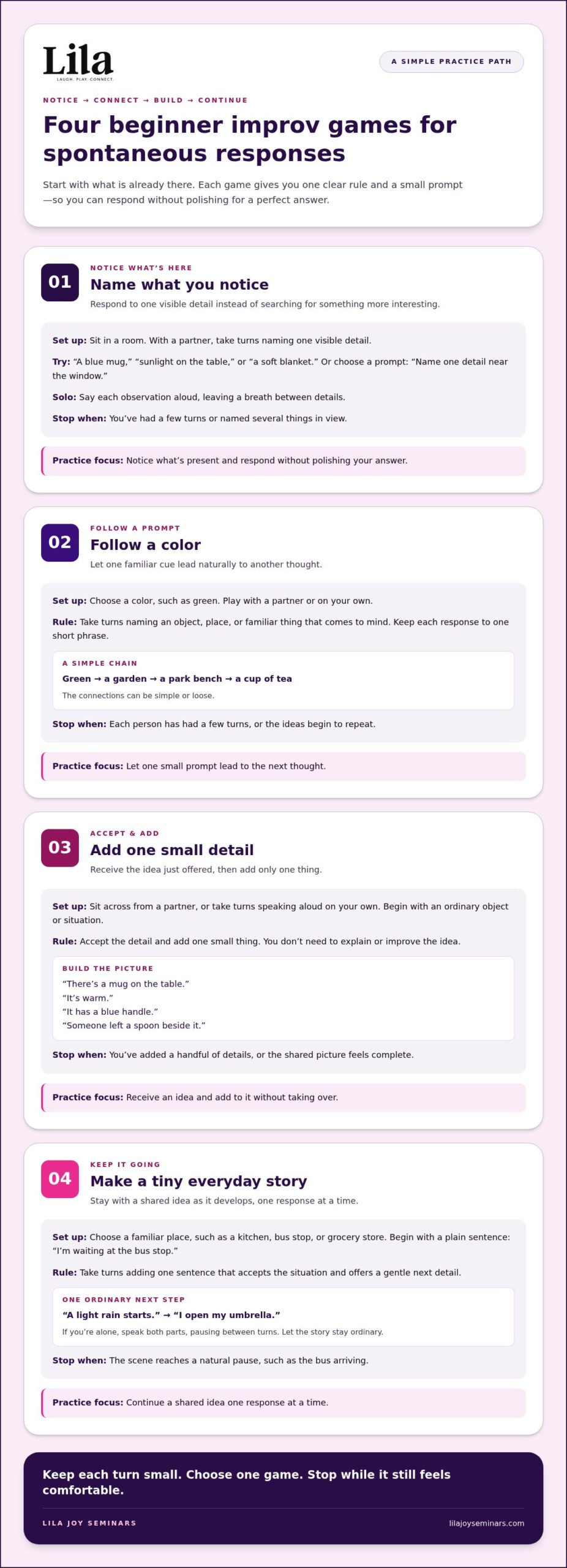
Try these games in order, moving from noticing what’s around you to building on someone else’s idea. You can play alone or with another person. Keep each turn small, and stop while it still feels comfortable. There’s no need to make the answers unusual. These improv games to practice spontaneity work best when you respond to the first ordinary detail you notice.
1. Name what you notice
Setup: Sit in a room and look around. If you’re playing with someone, take turns naming one visible detail each. Rule: Say the first thing you notice, such as “a blue mug,” “sunlight on the table,” or “a soft blanket.” Don’t search for something more interesting. Try: “Name one detail near the window.” Playing solo? Say each observation aloud, leaving a breath between details. Stop: End after a few turns or when you’ve named several things in view.
Practical aim: Notice what’s present and respond without polishing your answer.
2. Follow a color
Setup: Choose a color, such as green. Play with a partner or on your own. Rule: Take turns naming an object, place, or familiar thing that comes to mind when you hear the color. Keep each response to one short phrase. For “green,” you might say “a garden,” then “a park bench,” then “a cup of tea.” The connections can be simple or loose. Stop: Finish after each person has had a few turns, or when the ideas begin to repeat.
Practical aim: Let one small prompt lead naturally to the next thought.
3. Add one small detail
Setup: Sit across from a partner, or take turns speaking aloud on your own. Start with an ordinary object or situation. Rule: Each response accepts the detail just offered and adds only one small thing. For example: “There’s a mug on the table.” “It’s warm.” “It has a blue handle.” “Someone left a spoon beside it.” You don’t need to explain or improve the idea. Stop: Pause after a handful of additions, or once the shared picture feels complete.
Practical aim: Practice receiving an idea and adding to it without taking over.
4. Make a tiny everyday story
Setup: Choose a familiar place, such as a kitchen, bus stop, or grocery store. One person begins with a plain sentence: “I’m waiting at the bus stop.” Rule: Take turns adding one sentence that accepts the situation and offers a gentle next detail: “A light rain starts,” then “I open my umbrella.” If you’re alone, speak both parts, pausing between turns. Let the story stay ordinary. Stop: End when the scene reaches a natural pause, such as the bus arriving.
Practical aim: Stay with a shared idea as it develops, one response at a time.
Choose just one game to begin. If trying these with others makes practice feel easier, guided online improv practice offers another way to explore games and reflection with a group.
How to choose and adapt an improv game to your comfort level
The best starting format is the one that feels easy enough to try today. You don’t have to work up to a group or push through an uncomfortable game. Pick one clear rule, use a familiar prompt, and decide how you’d like to take part. Improv games to practice spontaneity can be adjusted to fit your energy, your company, and how much structure you want.
Which game format feels manageable today?
Think about how much interaction feels comfortable right now. Solo play lets you try an idea aloud without anyone else listening or waiting for a turn. With a partner, you can practice hearing a response and taking turns, while keeping the exchange simple. A small group offers several people to build on ideas together. You don’t need to lead or hold everyone’s attention. Each format offers a different amount of interaction, so choose the one that feels easiest to begin.
- Solo: Try a prompt aloud, or silently notice a detail and respond to it. You set the pace and can stop whenever you like.
- Partner: Agree on one rule, such as taking turns adding a detail. Listening and responding are shared, and neither person needs to carry the whole game.
- Small group: Let each person contribute one short response. You can join when your turn comes, without needing to steer the activity.
What can you change if a game feels awkward?
A game can be made gentler without losing its point. If an open-ended prompt leaves you searching for ideas, swap it for something familiar, like a household object, a nearby place, or an everyday activity. If a timer makes you rush, take it away. If the turns feel long, agree to offer just one word or one sentence each. The aim is to stay involved, not to follow a rule that’s making practice feel tense.
- Make the prompt familiar: Replace an unfamiliar setting with a room you know or an object you can see.
- Shorten the exchange: Take fewer turns, or keep each contribution to a single detail.
- Remove the clock: Let responses arrive at their own pace instead of racing a timer.
- Keep a choice: Pause, pass on a turn, or suggest a different prompt if you need a softer starting point.
A pause isn’t a mistake to cover up. It’s part of the exchange, and you can take a breath before deciding what to do next. You can also stop and return to the game another time. Having that choice can make practice feel more welcoming and help you stay curious about what comes next.
Gentle routine for practicing improv at home or online
A helpful routine doesn’t need a strict schedule or a long session. Give yourself a simple shape to return to: choose one game, play a few turns, pause, and notice what happened. The point isn’t to measure progress or make every response feel easy. You’re making room to try, then deciding whether you’d like another turn.
- Choose one game. Pick an exercise you already understand, rather than learning several rules at once.
- Set a familiar prompt. Use something close at hand, such as a mug, a window, or the sound of rain.
- Play a few turns. Keep responses short and let the activity stay simple.
- Pause and notice. Ask yourself what you responded to, or whether anything felt more comfortable than you expected. You can finish there.
Keep the practice brief if that suits you, and adjust it from one day to the next. There’s no fixed duration that guarantees a particular result. If you have only a moment, one turn can be enough to begin. If you’re enjoying the game, continue a little longer. These improv games to practice spontaneity are meant to fit into your day, not become another task to complete.
How can you practice on your own?
Choose an object nearby and describe it aloud in a new, simple way with each turn. A cushion might be “soft,” then “a place to rest,” then “the color of the afternoon sky.” Or respond aloud to a neutral prompt, such as “a familiar place,” with the first reasonable idea that comes. You can keep the activity private, with no recording or audience. A quiet start counts.
How can you play with someone online?
With a trusted partner, agree on one prompt, then take turns adding one connected detail. For example, begin with “There’s a plant by the window,” and let each response add one small observation. Before starting a video call, decide together whether you’d rather use video or audio. Either is fine if it feels comfortable to both of you. The aim is to listen and share the moment, not create a finished scene.
If you’d like a little more structure, try the same routine with a trusted person in the room or on a call. Choose a familiar object, agree to take turns, and stop whenever either of you wants. Passing is okay, as is changing the prompt midway through. Small, comfortable steps can be a useful way to explore improv games for confidence without turning practice into a test.
If you’d enjoy exploring games and reflection with others, try a free live online improv class with Lila.
When you want a little company, try guided improv practice
Practicing on your own can be plenty. You can return to a game whenever it suits you, skip a turn, or stop without explaining. A group is another option if you’d like to hear how other people respond to the same prompt. Their ideas can offer new directions to notice and play with, while your own response can be as simple as it needs to be.
Guided group practice adds a shared structure. Instead of choosing every prompt and keeping the activity moving yourself, you can take part in games with other adults and reflect together on what you noticed. It’s not about being the funniest person in the room or getting a particular result. It’s a chance to explore spontaneity and connection through play.
What does guided group practice add?
In a live group, one person’s response becomes something the next person can listen to and build on. You can try an idea, hear a different one, and reflect on what the exchange felt like. That shared rhythm can be a welcome contrast to solo practice, but it isn’t required for improv games to practice spontaneity. A group offers company and guidance, not a promise of a specific personal outcome.
Lila offers adults live online improv classes that use interactive games and group reflection to explore spontaneity, confidence, and connection. Classes run on Zoom and last one to two hours. The focus is personal growth and connection, not acting or performance training, and the classes aren’t therapy or clinical treatment. You can approach it as guided play with room to notice your own responses.
Are live online improv classes a fit for you?
Consider whether live Zoom classes of one to two hours fit your schedule and whether you’d enjoy exploring games with other adults. You don’t need previous acting or improv experience. Your first class is free, so you can experience the format before deciding whether it suits you.
There’s no need to be ready to speak perfectly or know what you’ll say. You can arrive as a beginner and take the activities one response at a time. If you’d like to try guided group practice, Try your first class free.
Let one small response be enough
You don’t have to wait until you feel completely ready to respond. The next time a small moment catches your attention, meet it with one honest thought, a question, or a simple observation. It doesn’t need to be clever. A little curiosity can help you stay with the moment instead of editing it away.
That’s a gentle way to carry improv games to practice spontaneity beyond the exercise itself. Some days, you may feel like trying another turn. Other days, simply noticing that you had an idea is enough. There’s no need to turn practice into a scorecard or expect every conversation to feel different. You’re making space for a response, one moment at a time.
If you’d like to keep exploring with others, Lila offers adults live online improv classes with guided group play and reflection. Your first class is free.
Try your first class free and take your next small step when you’re ready.
Frequently Asked Questions
What improv games help you practice spontaneity?
Simple games that give you one clear thing to respond to are a good place to start. Try describing an object from a new angle, responding to a sound you hear, or adding a detail to a partner’s suggestion. These improv games to practice spontaneity don’t need elaborate prompts. Pick the game you can explain in a sentence and try a few turns before deciding whether to continue.
Can you practice improv games by yourself?
Yes. Solo practice can be as simple as choosing a familiar object and saying one new thought about it aloud. You might notice a spoon on the counter and describe its shape, color, or what it reminds you of. There’s no need to record yourself or share the response. Keeping the exercise private can make it easier to begin, and you can finish when the activity stops feeling playful.
Do improv games make you more spontaneous?
Improv games give you a place to practice responding to a prompt without planning every word first, but they can’t guarantee how you’ll respond in every conversation. Treat each game as a small opportunity to try something, not a measure of progress. After a round, for example, notice whether you listened to the prompt before answering. That observation can be useful even if your response felt ordinary or you needed a pause.
Do you have to be funny to play improv games?
No. Humor isn’t a requirement, and you don’t need to prepare a punchline or keep others entertained. A straightforward answer can move a game along just as well. If someone says, “I brought an orange,” you might respond, “It’s for the walk home.” That gives the next person something to hear and respond to. Let funny moments happen naturally, but don’t make them the goal.
How do you play improv games online?
Choose an activity that works through conversation and agree on the prompt and turn-taking before you start. For example, one person names a familiar place, and each participant adds a detail connected to it. A video call may help you notice facial expressions, while an audio call can keep things simpler. Choose the format that feels comfortable to everyone, and agree that anyone can pause or stop.
Are improv games suitable for beginners with no experience?
Yes. Beginners can start with a familiar prompt and one simple rule, such as responding with a single sentence. You don’t have to know improv terms or invent a story on the spot. Lila offers adults live online improv classes on Zoom, with games and reflection. No previous improv or acting experience is required, and your first class is free.