


What if caring about others didn’t have to mean letting their imagined opinions steer every choice? You replay a conversation on the way home, wonder whether your comment sounded odd, then promise yourself to say less next time. If you’re searching for how to stop caring what others think, the answer probably isn’t to become colder or stop valuing your relationships. It’s to make room between someone else’s opinion and your next step.
It makes sense to want to be liked and understood. The difficulty starts when concern turns into constant self-editing, or when a guess about what someone thinks starts to feel like a fact. You can care about people and still choose whose feedback deserves your attention.
In this guide, you’ll find practical ways to question the “everyone noticed” feeling, sort useful feedback from imagined judgment, and return your attention to the conversation in front of you. You’ll also find small ways to act from your values, even when some discomfort comes along. No dramatic personality overhaul required, just steadier steps toward feeling more present and more like yourself.
Key Takeaways
- Separate what someone actually said from the judgment you may be imagining.
- Use a brief pause-and-check process to decide whether feedback is useful, without treating it as a verdict on your worth.
- Explore how to stop caring what others think without becoming cold or waiting to feel completely fearless.
- Try five small ways to meet everyday self-consciousness with more curiosity and choice.
- See how improv games and group reflection can offer a playful way to practise responding in the moment.
Why caring what others think can take up so much space
A conversation ends, but your mind keeps going. You replay the pause before someone answered, the look on their face, or the joke that may not have landed. Then come the questions: Did I talk too much? Should I have agreed? What if they took it the wrong way? Replaying an ordinary moment can be tiring, especially when you don’t have any new information to work with.
Wanting to belong is human. Other people’s reactions can help us feel connected and offer clues about how we affect one another. But uncertainty can make those clues feel especially important. If you can’t tell what someone thought, your mind may rush to fill in the blank. And if you’ve been criticized or dismissed before, staying alert to possible disapproval can feel like a way to avoid being hurt again.
The aim isn’t to stop caring about people. It’s to make room for their opinions without letting each one choose your words, preferences, or next move. You don’t have to wait for worry to disappear before you practise. Start with a small choice, then notice what happens when you make it while some discomfort is still there.
What does it mean to care less about other people’s opinions?
Caring less means relying less on approval to decide whether you’re allowed to be yourself. It doesn’t mean becoming indifferent, dismissing feedback, or treating relationships as unimportant. Your values and the people you love can matter deeply, while your own perspective still gets a place in the room. Self-esteem is connected to how you regard your own worth, not simply to whether everyone approves of you.
Picture friends choosing a place for dinner. You’d rather have noodles, but you’re tempted to say, “Anything is fine,” so nobody can disagree with you. Caring less might mean saying, “I’d really enjoy noodles tonight,” then staying open to the group’s response. You’ve shared a sincere preference, not demanded your way.
Why does fear of judgment linger after a conversation?
After a conversation, you no longer have new words or expressions to interpret. The gaps can invite guesses: a short reply becomes “They’re annoyed,” or a quiet moment becomes “I made things awkward.” Replaying the exchange is a familiar response to uncertainty, not proof that you’ve done something wrong. You may simply be trying to make sense of a moment that had no clear ending.
A thought about being judged is not proof that someone judged you. Hold both possibilities gently: perhaps the person had a reaction, or perhaps their expression meant something else. You don’t need to solve the mystery before carrying on with your day.
When you notice the replay, ask what you can know for sure. What words were actually said? What are you filling in? Then choose one small action that reflects what matters to you, such as sharing a preference, asking a question, or letting a pause pass without rushing to fix it. Learning how to stop caring what others think isn’t a switch you flip. It can begin with letting your own voice count, even while uncertainty is still there.
How to tell useful feedback from imagined judgment
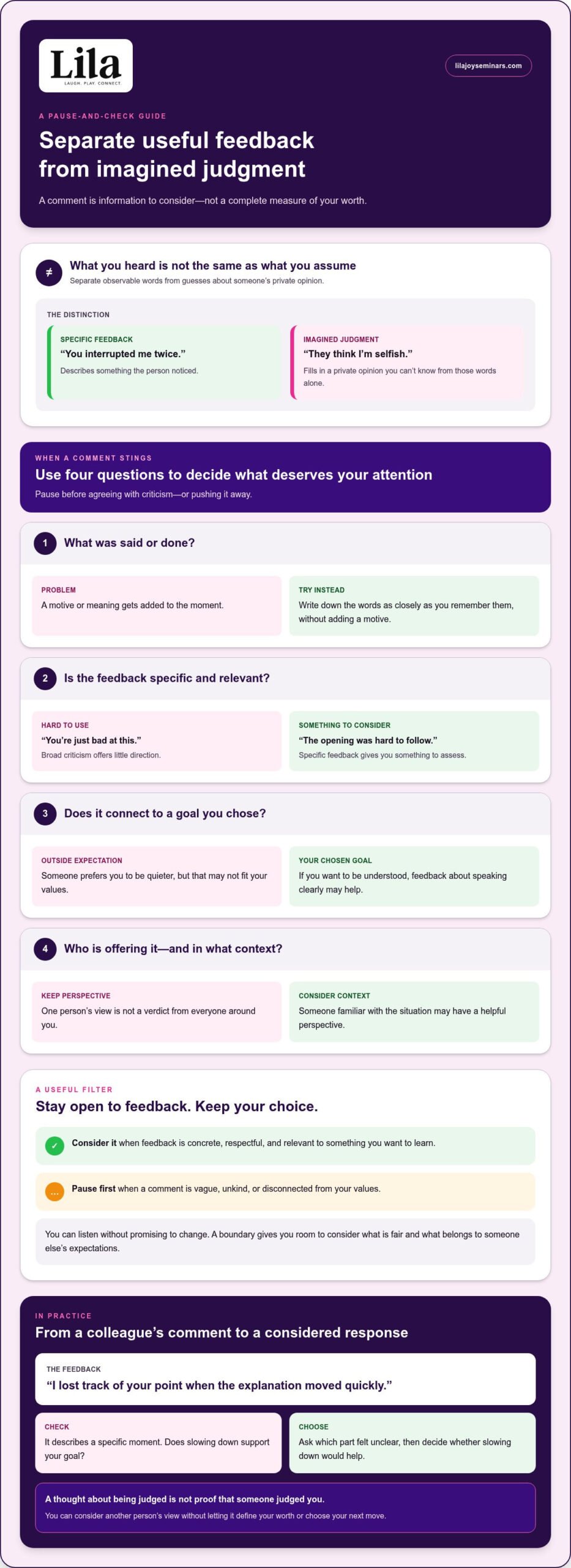
A comment can sting, especially if you’re already wondering how you came across. But feedback is information to consider, not a complete measure of your worth. Instead of asking, “Did they approve of me?” try asking, “Is there something here that helps me understand what happened or move toward something I care about?”
Separate the words you heard from the story forming around them. “You interrupted me twice” is specific feedback about behavior. “They think I’m selfish” is a guess about someone’s private opinion. Specific feedback describes something a person noticed; imagined judgment fills in what you can’t know without asking. Asking may clarify one person’s view, but it can’t make that person speak for everyone.
What questions help you assess someone’s opinion?
Give yourself a moment before agreeing with a criticism or pushing it away. Group expectations can shape how people respond to one another; Conformity offers a useful lens on why fitting in can feel pressing. Still, a group’s preference isn’t automatically the right guide for your choice. Ask what was said, what you inferred, and whether the comment connects to a goal you actually hold.
- What was said or done? Write down the words as closely as you remember them, without adding a motive.
- Is the feedback specific and relevant? “The opening was hard to follow” gives you something to consider. “You’re just bad at this” is broad and offers little direction.
- Does it connect to a goal I chose? Feedback about speaking clearly may be useful if you want to be understood. A preference for being quieter may not fit your values.
- Who is offering it, and in what context? Someone familiar with the situation may have a helpful perspective. Their view still isn’t a verdict from everyone around you.
When should you take criticism seriously?
Stay open when feedback is concrete, respectful, and relevant to something you want to learn. You can listen without promising to change. If a comment is vague, unkind, or disconnected from your values, pause before giving it authority. A boundary doesn’t mean refusing all input; it gives you room to consider what’s fair and what belongs to someone else’s expectations.
For example, a colleague might say, “I lost track of your point when the explanation moved quickly.” You could ask which part felt unclear, then decide whether slowing down would help with your goal. If the comment is instead, “Nobody likes how you explain things,” notice that it makes a sweeping claim you can’t verify. You don’t need to accept it as fact or work out what everyone thinks.
This pause-and-check practice can make how to stop caring what others think feel less like shutting people out and more like choosing what deserves your attention. For a playful way to practise responding in the moment with others, Lila’s live online improv classes use improv games and group reflection in a low-pressure setting.
Common myths about how to stop caring what others think
The phrase how to stop caring what others think can sound like an invitation to shut people out. It isn’t. You can care about how your choices affect others and still stop treating every possible reaction as a reason to hide, agree, or wait. The aim isn’t to erase discomfort or become fearless overnight. It’s to make choices with care, even when you can’t be certain everyone will like them.
Another common myth is that you need to feel completely confident before you act. That can keep everyday decisions on hold while you wait for a feeling that may arrive only after you’ve tried. A small, respectful choice can be enough practice for today. It may still feel awkward, and that doesn’t make it the wrong choice.
Does caring less mean becoming selfish?
Consideration means listening, noticing how your actions affect people, and making room for their needs. It doesn’t mean asking everyone for permission to have a preference. Your values can guide you while you stay open to compromise. For instance, if you can’t take on an extra task, you might say, “I’m sorry, I can’t help with that this week.” It’s a clear no, offered without blame or a long defense.
You can also ask whether there’s a kind alternative you genuinely want to offer. If there isn’t, a warm, honest boundary is still more considerate than saying yes and growing resentful. Someone may feel disappointed; that feeling matters, but it doesn’t automatically mean you’ve treated them badly.
Do you have to feel confident before you speak up?
Not necessarily. Confidence can grow through repeated practice, rather than appearing first and making every choice feel easy. You don’t have to make a dramatic leap or share something deeply personal. Choose a low-stakes moment: suggest a lunch spot, ask someone to repeat a question, or share a different opinion on a movie. Notice what it’s like to speak while a little uncertainty is still there.
Keep the step small enough to feel possible, not punishing. You might feel a flutter in your chest or wonder afterward how your words landed. That doesn’t cancel out the choice you made. Reflect on what happened without grading yourself or demanding that the next attempt feel effortless. Small steps toward feeling more at ease can offer a gentle way to think about practising at your own pace.
There’s no single pace that works for everyone. Some days you may speak up; other days, you may decide a preference isn’t worth sharing in that moment. The point isn’t to prove you don’t care. It’s to give your own values a say alongside your care for other people, and to let ordinary moments become practice.
Five small ways to worry less about judgment in daily life
Learning how to stop caring what others think doesn’t mean waiting until every conversation feels easy. Try these small actions in everyday moments. Choose just one to practise; there’s no need to turn them into another test you have to pass.
- Notice the worry. When you catch yourself scanning a face or replaying a sentence, pause and name what’s happening: “I’m worried they didn’t like what I said.” Naming the worry helps you notice it without immediately treating it as a fact.
- Name the assumption. Ask what you know and what your mind is adding. “They looked away” is something you noticed. “They thought I was boring” is an interpretation. You may not know what they thought, and you don’t have to solve that uncertainty right now.
- Check what matters to you. Before changing your answer to match someone else’s, ask, “What do I actually prefer?” or “What kind of person do I want to be here?” Your response might be honest, considerate, curious, or simply relaxed. Let that value offer direction.
- Share one low-stakes preference. Say which tea you’d like, suggest a place for a walk, or mention a genuine reaction to a film. Keep it simple. You’re not asking everyone to agree; you’re giving your own voice a little space.
- Reflect without grading yourself. Afterward, describe what happened plainly: “I suggested the café, and my friend chose somewhere else.” Notice what you tried, rather than deciding the moment proves you’re awkward or confident. One interaction doesn’t define you.
Notice the worry, name the assumption, check your values, try one small response, and reflect with kindness. This simple sequence can help you meet judgment worries more steadily, though it won’t make every moment feel comfortable.
How can you practise speaking before you feel completely ready?
Choose a moment that feels manageable. Ask a question during a conversation, or offer one sincere reaction, such as “I liked that part.” Then bring your attention back to the other person’s words instead of checking how your voice sounded or whether you looked nervous. If there’s a pause or your words come out imperfectly, that still counts as trying.
How can you respond kindly to the inner critic afterward?
Trade “I made a fool of myself” for a simple description: “I shared an opinion, then felt self-conscious.” What would you say to a friend who’d done the same? You might remind them that an imperfect response is still a human one. Improv doesn’t depend on being funny either; a playful moment can begin with simply responding as you are, as this piece on why improv does not require you to be funny explains.
To practise responding in the moment with others, you can join a live online improv class, where improv games and group reflection offer a low-pressure space to try.
How improv can help you practise caring less about judgment
Private reflection can help you notice a worry. A shared activity gives you a chance to try responding while another person is right there. That’s one way improv for personal growth can offer practice: you listen, respond to what’s happening, and experience letting go of the search for the perfect line. The aim isn’t to impress anyone. It’s to meet a moment with more attention and room to play.
Improv games and group reflection offer a way to practise confidence, spontaneity, communication, laughter, and connection. They’re practice, not treatment, and there’s no guaranteed result. You may still feel self-conscious sometimes. Learning how to stop caring what others think can include noticing that feeling while choosing to stay curious about the activity and the people around you.
What might improv practice feel like for someone who overthinks?
You might be invited to respond to a partner’s words or build on a simple suggestion. Instead of planning a clever answer, pay attention to what you heard and offer the first honest response that comes to mind. A quiet or imperfect answer is still a response. The focus is personal growth and communication, not acting or performance training.
A supportive, low-pressure group can make it easier to try without previous experience. You don’t have to be quick, funny, or polished. The games create a shared moment to respond to, while reflection gives you space to notice what felt easy, surprising, or a little uncomfortable. You can take that noticing with you without expecting one session to change everything.
How can you decide whether a group practice feels right?
Consider whether meeting live with a group feels manageable and interesting, even if it brings a little uncertainty. You don’t need to arrive feeling confident or know what to say. Curiosity is enough of a starting point. If a group setting doesn’t feel right for you now, you can keep practising through small everyday conversations instead.
Lila offers adults live online improv classes on Zoom, each lasting one to two hours, using improv games and group reflection. No acting or improv experience is required. This is an optional way to practise responding in the moment with others, not a necessary step or a promise that judgment worries will disappear.
If trying a shared, playful practice sounds interesting, you can try your first class free. There’s no need to prove anything before you begin. Simply notice how it feels to join in, respond, and connect at your own pace.
Let your next small choice be enough
You don’t have to feel completely at ease before you let yourself be heard. The next time you notice yourself holding back, pause long enough to ask: “What would feel honest and kind here?” Then take one small step in that direction, even if uncertainty comes along.
That’s a gentle way to practise how to stop caring what others think without turning away from the people who matter to you. Some moments may still feel awkward. Let them be imperfect and keep learning from them, rather than treating each one as a test of who you are.
If practising with others feels like a welcome next step, Lila offers adults live online improv classes on Zoom, with improv games and group reflection. No previous acting or improv experience is required, and your first class is free. Try a free class, and see how it feels to take part at your own pace.
Frequently Asked Questions
Is it normal to care so much about what other people think?
Yes, caring about others’ reactions is a common part of being connected to them. It can feel stronger in a new group, around someone whose opinion matters to you, or during a change such as starting a job. Notice whether the worry eases after the moment passes or keeps you from sleeping, working, or enjoying relationships. You deserve support if it’s making daily life feel smaller.
Can you stop caring what others think completely?
Probably not, and you don’t need to. People’s opinions can sometimes offer useful information, while also being incomplete or shaped by their own preferences. The aim is to let their views matter without making approval the price of every choice. Progress might look like noticing a worry, choosing what you want to do, and returning to the present sooner, even if you still feel a little unsure.
How do I stop worrying about what one specific person thinks of me?
Start by asking what makes this person’s view feel so important. Is there a real decision you need to make together, or are you hoping for reassurance about something they haven’t said? If it’s a close relationship and a real misunderstanding may be involved, consider a calm check-in: “I’ve been wondering how that conversation felt for you.” Ask once, listen, and leave room for an answer you can’t control.
What should I do when I keep replaying an awkward conversation?
Try giving the replay a gentle limit. Jot down one thing you learned, such as “I want to pause before answering next time,” then close the note and move into a simple activity that uses your attention, like making tea or taking a short walk. If the scene returns, remind yourself you’ve already taken what’s useful from it. You don’t have to keep reviewing the moment to prove you care.
How can I care less about criticism without ignoring useful feedback?
Look for something you can act on, rather than trying to accept or reject the whole comment at once. If a teammate says your update was hard to follow, you might ask which part needs more detail and revise that section. You can keep the practical suggestion without adopting a harsh label about yourself. If the feedback remains unclear, it’s okay to wait and reflect before responding.
Does caring less about others’ opinions mean I am being selfish?
No. It can mean making room for your needs alongside other people’s, not placing yours above theirs every time. For example, you can listen fully in a meeting, share your view, and make space for a colleague to disagree. Kindness doesn’t require you to hide every difference or prevent anyone from feeling disappointed. What matters is how you treat people, not whether they approve of each preference you express.
When should I consider getting professional help for fear of judgment?
Consider speaking with a mental health professional if fear of being judged leads you to avoid important situations or regularly disrupts work, relationships, or daily routines. You don’t have to wait until things feel unbearable. A professional can help you understand what’s happening and discuss support that fits your needs. Persistent, intense fear and avoidance over several months are also good reasons to seek an assessment, not a basis for self-diagnosis.