


What if improv has less to do with landing a punchline and more to do with listening? If you’ve wondered, “do you have to be funny to do improv,” you’re not alone. It’s easy to picture a room full of quick-witted people trading jokes while you worry you’ll freeze or have nothing clever to add.
That’s not the whole story. Improv isn’t a comedy audition, and you don’t need perfect jokes or instant comebacks. It’s about noticing what someone offers, responding in the moment, and building something together. Sometimes that leads to laughter. Sometimes it’s simply a small, unexpected connection.
Here, you’ll learn what people actually do in improv, why humor isn’t a requirement, and how to try it without putting pressure on yourself. Lila’s live online improv classes for adults run on Zoom for one to two hours. They use improv games and group reflection in a supportive setting. No prior experience is needed, and your first class is free. You can start with curiosity, not a goal to impress anyone.
Key Takeaways
- If you’re asking “do you have to be funny to do improv,” the short answer is no. Quick jokes and clever comebacks aren’t the entry fee.
- Learn how noticing what’s happening and accepting a partner’s idea can keep a shared scene moving.
- Discover why humor can emerge from surprise and connection, without anyone trying to be the funniest person in the room.
- Try a simple way to respond when you freeze: pause, notice, listen, and offer something small.
- Explore a low-pressure adult option through Lila’s live online improv classes, with improv games and group reflection.
Do You Have to Be Funny to Do Improv? The Short Answer
Do you have to be funny to do improv? No. Being naturally funny isn’t a prerequisite, and you don’t need a pocketful of jokes or a fast comeback ready to go. If you picture everyone else effortlessly making the room laugh while you search for the perfect thing to say, that worry makes sense. But improv isn’t a contest to see who can produce the cleverest line.
Instead, you respond to what another person says or does, and they respond to you. One person offers an idea; the other can accept it and add a small detail. The moment grows through attention and exchange, not through one person carrying the whole scene. You can contribute something simple, sincere, or even a little uncertain. It still gives your partner something to meet.
Improv participation is about sharing a moment, not proving you have comic talent.
What does it mean to be funny in improv?
In improv, humor often comes from an unplanned turn in the conversation, rather than a prepared joke with a polished setup and punchline. Someone might say they’ve brought snacks to a meeting, and their partner calmly asks whether the crackers have completed the paperwork. The response is ordinary in shape but surprising in context. That can create a laugh without either person setting out to be a comedian.
And not every exercise needs to be funny. Some may simply invite people to listen, notice, or build on an idea. Laughter can happen along the way, but it isn’t the only sign that participants are engaged. A quiet exchange can work, too.
Is improv always comedy or acting?
Improv has roots in theatre, but the word describes a range of forms and activities. The overview of improvisational theatre shows how varied the practice can be. Some improv is presented as comedy onstage; other activities are collaborative exercises, with no rehearsed scene or show as the goal. Formats differ, so it helps to distinguish the broad art form from the experience of a particular group.
A playful exercise doesn’t automatically mean you’re being asked to act a character or perform for an audience. You might simply take part in a shared activity, respond to a partner, and see what unfolds. That can feel lighter than the word “performance” suggests.
If you’re new, you don’t need to decide whether you’re a comic person or an actor before you try. Treat improv as a chance to pay attention and join in one moment at a time. You don’t need to arrive with a finished idea. Notice what’s already happening and offer a response that keeps the exchange alive.
What Improv Actually Asks You to Do Instead of Be Funny
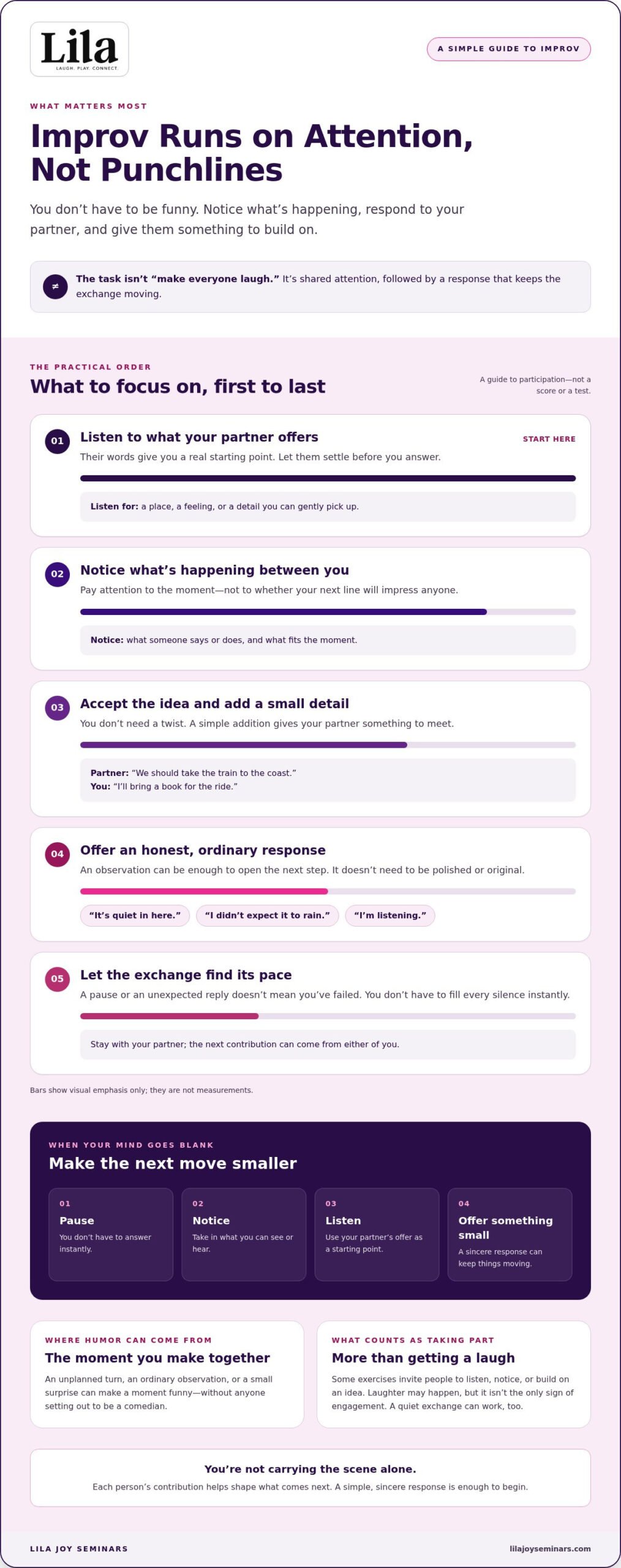
Once you’re in an improv exercise, the task is usually much smaller than “make everyone laugh.” Notice what your partner says, pay attention to what’s happening between you, and offer a response that fits the moment. You don’t need to plan a brilliant idea before you speak. A simple answer can be enough to keep the exchange moving.
Improv is shared attention, followed by a response that gives someone else something to build on.
That’s why the question “do you have to be funny to do improv” can be misleading. It focuses on the quality of your line, rather than on how you take part. You’re not responsible for entertaining the room by yourself. You’re in a shared activity where each person’s contribution helps shape what comes next.
Listening and building on another person’s idea
Listening gives you something real to respond to. If a partner says, “We should take the train to the coast,” you might answer, “I’ll bring a book for the ride.” That reply doesn’t need a twist. It accepts the plan and adds a small detail your partner can pick up, perhaps by asking what book you chose. The exchange grows through collaboration, not through getting a scene exactly right.
Let the other person’s words settle before you answer. You might notice a place they mentioned, a feeling in their voice, or a detail you can gently add. This kind of attention makes your next response feel less like a test. You have a starting point because your partner has already offered one.
Responding naturally when you do not have a big idea
Some moments may still feel blank. That’s okay. Respond to what you can see or hear: “It’s quiet in here,” “I didn’t expect it to rain,” or simply, “I’m listening.” An ordinary observation can open a next step for your partner. It doesn’t have to be original or especially polished to count as participation.
A pause may happen, and a reply may come out differently than you intended. Neither means you’ve failed. Notice the moment, stay with your partner, and offer the first honest response that fits. You’re not required to fill every silence instantly. Sometimes the other person will add something, and the exchange will find its pace together.
This is a skill you can explore gradually, without turning every conversation into a performance. Lila’s adult improv classes use games and group reflection in a supportive, low-pressure setting, giving participants room to practice responding and listening together. For a broader look at improv for personal growth, explore how these small practices can connect with everyday life.
Why Improv Can Be Funny Without Requiring a Funny Person
Humor in improv often comes from the space between what someone expects and what happens next. A small detail, a sincere reaction, or an unexpected connection can catch people off guard. The laugh belongs to the moment the group made together, not necessarily to one person’s talent for telling jokes.
Imagine two people talking about a rainy morning. One says, “I forgot my umbrella.” The other glances at their own dripping sleeve and replies, “I brought mine, but apparently the rain came inside anyway.” That ordinary observation might feel amusing because it fits the shared situation. It might also pass without a laugh. Either way, the response gives the conversation somewhere to go.
How humor can emerge from an ordinary response
Context does a lot of the work. A plain phrase can feel surprising because of what was said just before it, or because a partner responds with unexpected sincerity. You don’t have to manufacture that surprise. Stay curious about the moment and let your answer connect to it. Sometimes the group finds a funny turn; sometimes the scene simply continues.
That distinction can help if you’re wondering, do you have to be funny to do improv? Trying to make people laugh can pull your attention toward judging every line before you say it. Responding to your partner keeps your attention on the exchange itself. Humor may follow, but it doesn’t have to be the job you assign yourself.
A helpful comparison:
- Performing for laughs: You focus on inventing a joke, earning a reaction, or being the funniest person in the moment.
- Responding together: You notice what your partner offers, share a relevant thought, and leave room for them to continue.
The second approach doesn’t ban humor. It takes the pressure off producing it on demand. A quiet moment, a kind response, or a sincere answer can be just as welcome in an exercise. Not every exchange needs a punchline to feel complete or worthwhile.
Different ways people bring something to improv
People can contribute in different ways, and no one way needs to take over. You might listen closely, ask a curious question, add one concrete detail, or make room for someone else’s idea. These aren’t fixed personality types or levels of ability. They’re ordinary ways of being present with a group.
For example, if a partner says they’re planning a garden, you could ask what they hope to grow or mention the herbs you keep forgetting to water. Either response gives them a new thread to pick up. You don’t need to steer the whole conversation. Shared humor has room to appear when everyone can offer something and no one has to carry the moment alone.
What to Do When You Freeze or Worry You Are Not Funny
Freezing can happen, especially if your inner critic is asking for the perfect line while someone waits for a response. You don’t have to make the pause disappear or turn it into a joke. Give yourself a moment, notice what’s happening, listen to your partner, then answer simply. One small response is enough to rejoin the exchange.
If your mind goes blank, bring your attention back to something specific: a word your partner used, the way they said it, or a detail in the shared moment. You might say, “You sound excited about that,” or “I’m not sure what to say yet.” A truthful, short reply can give the other person something to respond to without asking you to invent a whole scene.
A simple way to find your next response
Try this gentle sequence: pause, notice the moment, listen, then respond to one detail. If your partner says they’ve never cooked before, you could ask what they’re making or admit that you’ve burned toast. You don’t need to find the funniest angle. A pause is an ordinary part of conversation, not proof that you’ve failed. Let the next thought be small.
That’s useful to remember if you’re still asking, do you have to be funny to do improv? The exercise doesn’t depend on you having a clever response ready at every turn. Focus on being present with the other person. If a line comes out awkwardly, stay with it rather than judging yourself from the sidelines.
How to think about mistakes without judging yourself
Maybe you miss a detail, speak at the same time as someone else, or offer an idea that doesn’t lead where you expected. That beat can simply become part of the shared moment. Listen for what your partner does next and respond from there. Improv isn’t a promise that you’ll never feel nervous; it’s a chance to take part even when a moment feels uncertain.
It may also help to remember that you aren’t practicing alone. In a supportive group, people share the activity and reflect together, so experimentation doesn’t have to feel like a solo test. Notice what happened without grading yourself, then try another response in the next moment. For a few more gentle ideas, explore this guide to improv to build confidence.
Lila offers adults a low-pressure way to try improv through live Zoom classes. Classes use improv games and group reflection, and no prior experience is required. Live online improv classes give participants a place to practice listening and responding together.
A Low-Pressure Way to Explore Improv as an Adult
You don’t need to wait until you feel naturally quick or funny to try improv. A welcoming first experience gives you room to explore the activities themselves, rather than testing whether you can perform. Lila offers adults live online improv classes on Zoom lasting one to two hours. Classes include improv games and group reflection.
No prior acting or improv experience is required, and your first class is free. You can approach it with curiosity: take part, notice how the exercises feel, and get a sense of the group setting without needing to arrive with a polished idea or a comedy background.
What a supportive adult improv setting can offer
A low-pressure class is centered on trying exercises together, not impressing an audience. Games offer a shared starting point, while group reflection creates space to consider what happened. Focus on listening, responding, and joining in at your own pace. Lila’s live format brings adults together for improv games and reflection, rather than asking you to arrive with performance experience.
A live group also means other people are part of the moment with you. You don’t have to carry every exchange, and the activity isn’t a solo test of your comic instincts. Some exercises may feel playful; others may simply invite you to notice and respond. There’s room for different ways of participating, without promising that everyone will feel the same or have the same experience.
A gentle next step if you are curious
If you’re still asking yourself, “Do you have to be funny to do improv?” treat a beginner experience as a chance to find out what participation actually feels like. You don’t need to decide in advance whether improv is for you or set a goal to become funnier. Start with a little curiosity and see how the exercises unfold.
Lila’s live online classes are a way to explore improv as an adult in a supportive group. Your first class is free, so you can begin with a single class rather than making the experience feel like a big leap. If that sounds like a comfortable next step, try a free class.
Take One Small Step Toward Trying Improv
You don’t have to decide whether you’re “the funny one” before you begin. Be curious about what it feels like to join in, listen, and respond without needing to impress anyone. If the question “do you have to be funny to do improv” has been holding you back, set that expectation aside and approach the experience one moment at a time.
Trying something new doesn’t require a grand commitment or a perfect first attempt. It can simply be a chance to meet a new kind of activity with openness. You’re allowed to feel unsure, take a breath, and discover what feels comfortable as you go.
If you’d like to explore a welcoming place to begin, try a live online improv class. A little curiosity is enough to take the next step, and you can bring exactly who you are.
Frequently Asked Questions
Do you have to be naturally funny to do improv?
No, you don’t have to be naturally funny to do improv. If you tend to think of a reply only after a conversation has moved on, that doesn’t rule you out. Improv gives you a chance to practice responding in the moment with other people. Begin with a plain observation or question, rather than trying to invent a joke or imitate a comedian.
Can you do improv if you are shy or quiet?
Yes. Being quiet doesn’t prevent you from taking part. You might contribute by asking a question, noticing a detail, or offering a brief response when it feels right. Participation doesn’t have to mean speaking the most. If a group activity feels unfamiliar, focus on one exchange at a time and become more familiar with the format gradually.
What if I freeze or cannot think of anything funny during improv?
Take a breath and respond to something specific your partner has already said. If they mention a long bus ride, for example, you could ask where they were going or whether they found a seat. The reply doesn’t need to be funny to give the other person somewhere to go. If your mind stays blank for a moment, that’s a moment to notice, not a verdict on your ability.
Is improv always comedy?
No. Some improv is created for an audience, and some is used as a shared exercise without a show as its purpose. Activities can invite people to listen, respond, explore an idea, or play with a situation. The format and focus depend on the group. Lila’s adult classes use improv games and group reflection in a supportive setting, with no prior experience required.
Do improv classes teach you how to be funny?
Some improv experiences may explore comedy, but not every class has the same aim. A group focused on shared exercises may spend more time on listening, responding, and collaboration than on joke-writing or comic timing. If your main hope is to try something playful with other people, approach improv as an activity to experience, not a promise that you’ll become funnier.
Can improv be fun if you are not trying to make people laugh?
Yes. Enjoyment can come from playing with an idea, noticing how a partner responds, or discovering where a shared activity leads. For example, a group might build an imaginary picnic by adding ordinary details, such as a blanket, sandwiches, or a very windy day. The pleasure can be in creating something together, whether or not anyone laughs.
Do I need acting experience to try an adult improv class?
No, prior acting experience isn’t required for Lila’s adult improv classes, and no previous improv experience is needed either. Classes run on Zoom for one to two hours and use improv games and group reflection. Your first class is free, so you can get a feel for the live format before deciding whether you’d like to continue.