


What makes a low pressure improv class feel gentle isn’t necessarily the ease of its games. It’s whether you can try an idea without feeling you have to get it “right.” A supportive class makes room for different ways of participating. You don’t need to be quick, funny, or comfortable performing to begin.
If the thought of being judged or feeling awkward makes you hesitate, that’s understandable. Online classes can bring their own questions: Will you have to speak on cue? Will you be visible the whole time? A supportive class explains how participation works and treats uncertainty as a normal part of trying something new. This guide will help you recognize low-pressure class design, compare formats, and picture a first experience, even with no acting or improv background.
We’ll look at the difference between performance-focused improv and guided practice for everyday confidence and connection. You’ll also see how games and group reflection can work in a live online setting, including Lila Joy Seminars’ eight-week Zoom seminar, which meets weekly for about two hours. The first session is free.
Key Takeaways
- Look at how participation is guided and mistakes are treated, not just whether the games seem simple.
- Notice whether activities and group reflection help you learn from an experience without turning it into a performance review.
- Compare performance training with learning-focused improv by looking at goals, audience, feedback, and expectations.
- Consider your goals, comfort with group participation, preferred format, and schedule before choosing a class.
- Lila Joy Seminars offers a free first session of its live online seminar, so you can experience the format before deciding about the eight-week program.
What Makes a Low-Pressure Improv Class Feel Different?
It can feel exposing to imagine people watching while you search for something to say. Maybe you worry that a pause will look awkward, someone will judge your idea, or the group will expect you to be funny. Those nerves make sense, especially if your picture of improv comes from performers making quick jokes for an audience.
A genuinely low-pressure class is shaped by how the facilitator guides the group, how activities are introduced, and whether people have room to learn as they go. A low-pressure improv class is a place to explore ideas and connection without being measured against performance goals. Improv includes many forms, from comedy to practices beyond entertainment. The history and forms of improvisational theatre offer helpful context for understanding that range.
How can you recognize a low-pressure class?
Start with the class description. Beginner-friendly wording should make clear whether you need previous acting or improv experience. Look for a stated purpose, such as growth, curiosity, or connection, rather than an emphasis on polished scenes or stage readiness. That distinction helps you picture what you’re joining.
Clear expectations matter, too. Before a first session, look for information about the format, the kinds of activities, and how participation is guided. You may still feel uncertain, but knowing the general shape of the class can help you decide whether it feels like a manageable next step.
Low pressure does not mean no participation
A welcoming class can still involve active group participation. You might respond to a prompt, build on another person’s idea, or try a brief exercise with others. The difference is that you’re invited to take part in learning, not asked to impress an audience or prove that you’re naturally quick.
There’s room for an imperfect idea, a pause while you think, or a moment when you don’t know what to add. A considerate learning environment treats these as ordinary parts of trying something new, rather than mistakes to be judged. You can become more familiar with the activities as you take part.
If you’re wondering whether improv feels scary for beginners, separate the activity from the pressure you imagine around it. A prompt may be unfamiliar, but that doesn’t mean you’re expected to get it right. Look for a class that makes its purpose and participation expectations understandable, then consider whether that kind of practice feels approachable to you.
How Do Games and Group Reflection Create a Gentler Improv Experience?
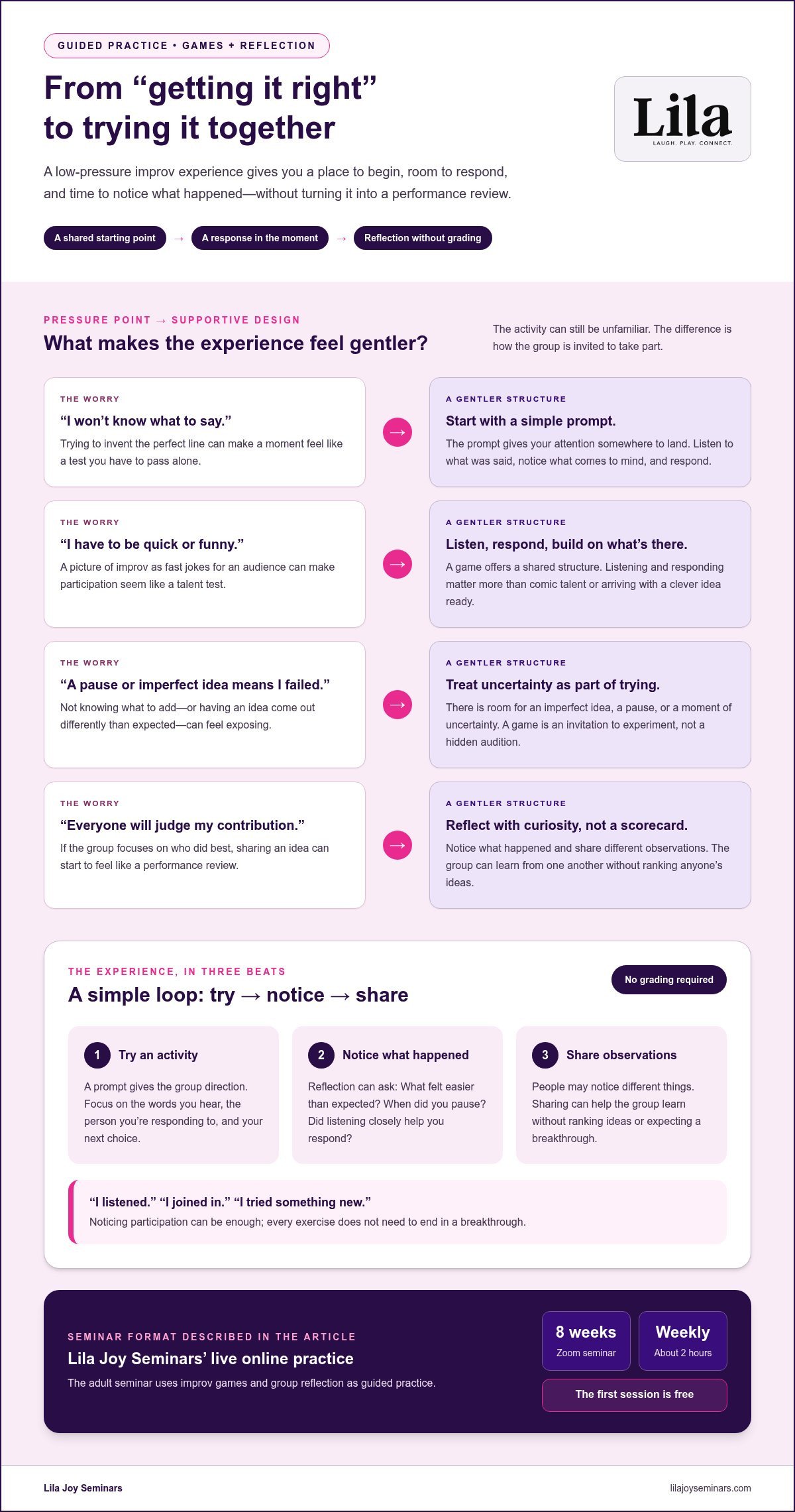
A simple prompt gives your attention somewhere to land. Instead of trying to invent the perfect line, you can listen to what someone just said, notice what comes to mind, and respond. The moment becomes something to meet together, not a test you have to pass alone.
Games offer a shared starting point and a reason to listen, try an idea, and build on what’s already happening. The aim isn’t to show that you’re naturally funny or quick. It’s to take part and discover what unfolds, one response at a time.
What role do improv games play?
Think of a game as a simple structure for participation. A prompt offers direction, so you don’t have to plan an entire scene or arrive with a clever idea ready. You can focus on what’s in front of you: the words you hear, the person you’re responding to, and the next choice you make.
There can still be surprises, but surprise doesn’t have to mean pressure. In a low pressure improv class, a game is a shared invitation to experiment, not a hidden audition. If an idea comes out differently than you expected, that’s part of the experience. Listening and responding matter more than comic talent.
Why include reflection after an activity?
Reflection gives you a moment to notice what happened after an activity. What felt easier than you expected? When did you pause? Did listening closely help you respond? These questions don’t need to become a scorecard. They can simply help you get curious about how you participated.
People may notice different things. One person might feel at ease following a prompt; another might be surprised by how much they enjoyed listening. Sharing observations can help the group learn from one another without ranking anyone’s ideas. It also makes room for details that a focus on performance could miss.
Lila Joy Seminars’ live online seminar for adults uses improv games and group reflection as part of its guided practice. Reflection gives participants a chance to look back with curiosity and make sense of what they experienced. For a closer sense of how games and reflection fit together, you can explore Lila’s live improv seminar.
Together, guided games and reflection can make trying something unfamiliar feel more supported: the activity gives you a place to begin, and the conversation afterward lets you notice what happened without grading yourself. You don’t have to leave each exercise with a breakthrough. Simply noticing that you listened, joined in, or tried something new can be enough.
How Does a Low-Pressure Improv Class Compare With Performance Training?
Both learning-focused improv and performance training involve trying ideas with other people. The difference is what the practice is for. One setting may prepare you to act, make comedy, or speak in front of an audience. Another may focus on exploring spontaneity, communication, and connection without working toward a polished result.
That distinction can help if you’re interested in improv but don’t want a stage or spectators. Live group interaction can mean listening and responding to classmates, not performing for an audience. A low pressure improv class can be lively and active while keeping its purpose centered on practice and discovery.
What is the difference in class goals?
Performance training suits people who want to prepare for acting, comedy, or public presentation. Activities may build toward performance skills or a finished scene. Personal-growth improv uses shared exercises to practice being present, responding to others, and communicating more freely. Neither purpose is better; they offer different experiences.
Lila Joy Seminars’ adult seminar focuses on personal growth through improv games and group reflection, not acting or performance training. No previous acting or improv experience is required. Knowing the class’s purpose can help you decide whether it matches what you’re looking for.
| What to compare | Performance training | Learning-focused improv |
|---|---|---|
| Primary goal | Prepare for acting, comedy, or public presentation | Practice spontaneity, communication, and connection |
| Audience focus | May work toward sharing material with spectators | Centers on interaction among participants |
| Feedback style | May focus on performance choices and craft | Can invite reflection on what participants noticed |
| Expected experience | May build toward polished scenes or presentation | Emphasizes participation and learning along the way |
What should you compare before choosing?
Look beyond the word “improv” and compare the purpose, format, session length, and experience expected. Clear descriptions help you picture the setting: Do you meet live with a group? Are activities guided? Is the class intended for beginners, or does it build on existing skills? These details can make the choice feel less like a leap.
Lila’s seminar meets live on Zoom once a week for about two hours across eight weeks. This regular group format is different from a one-time performance event, and its focus is guided practice rather than performing for spectators. A playful session can still leave room for learning instead of polished results.
If you’re comparing online formats, consider how live interaction fits your comfort and learning preferences. Lila’s online improv seminar for adults is one example of guided group practice with games and reflection. The useful question is whether the class’s purpose and expectations feel right for you.
How Can You Decide Whether a Low-Pressure Improv Class Fits You?
You don’t have to know exactly what you want from improv before trying it. Curiosity is enough to start exploring. Ask whether a class suits your goals and feels like a manageable way to participate, rather than expecting yourself to become instantly outgoing.
Use this self-check to make the choice more concrete:
- Name your goal. Are you curious about connection, spontaneity, or communication? Or are you hoping to build acting, comedy, or presentation skills? Choose a class whose purpose matches what you want to practice.
- Consider your comfort with participation. Live group activities may feel engaging, unfamiliar, or both. Think about what kind of guided interaction sounds approachable, rather than expecting yourself to feel completely at ease from the start.
- Picture the group format. Would you rather learn with others in a live session, or explore material on your own? Neither preference is wrong. Choose a setting that fits how you like to learn.
- Check the time commitment. Look at how often the class meets and how long each session lasts. A schedule that works in your everyday life can make it easier to show up without added pressure.
What do you hope to get from improv?
Your reason can be modest. Maybe you want to try responding without planning every word, meet people through a shared activity, or simply see what improv feels like. If performance skills are your main goal, a performance-focused class may make more sense. If you’re interested in personal growth and connection, look for a class built around those aims. Your goals can shift as you learn more.
Separate a genuine “I wonder what this is like?” from “I should take this so I’ll become outgoing right away.” Curiosity leaves room for an honest first experience. Pressure to change yourself immediately can make any class feel like another test.
What class details help you feel prepared?
Before you join, look for clear information about the live format, meeting frequency, session length, and experience expectations. A useful description helps you imagine the class and understand how activities are guided. Lila Joy Seminars’ adult seminar meets weekly on Zoom for about two hours across eight weeks, and no prior improv or acting experience is required.
A first session can give you a more grounded sense of fit than imagining every possible outcome in advance. Lila’s first session is free, so you can experience the live format before deciding about the full seminar. Notice whether the pace, group interaction, and approach feel right for you. You don’t need to leave certain about everything; a clearer sense of your own response is useful, too.
If you’d like to try a guided live session, experience the free first improv seminar session.
What Is Lila’s Low-Pressure Online Improv Seminar Like?
If you’re looking for a place to explore improv without preparing for a show, Lila Joy Seminars offers an eight-week live online seminar for adults. The group meets weekly on Zoom, with each session lasting about two hours. It’s guided practice, not a stage show or acting training.
Sessions use improv games and group reflection to make room for trying ideas and noticing what happens. The seminar focuses on confidence, spontaneity, and connection, while each person’s experience can be different. You don’t need acting or improv experience to join. The free first session lets you experience the live format before deciding about the full seminar.
What can participants expect from the format?
Expect recurring live group sessions, not recorded lessons to work through alone. Improv games give participants shared activities to try together, while reflection offers a chance to notice what the experience was like. The emphasis is on learning and personal growth, rather than rehearsing for spectators or working toward a polished performance.
The weekly rhythm gives the seminar a clear shape: eight sessions, meeting once a week, for about two hours each time. No detailed script or previous improv background is needed. You can join as a beginner and take part in the guided practice as each activity unfolds.
“Low pressure” doesn’t mean that nothing is asked of you. It means the experience centers on exploration rather than impressing an audience. Games and reflection offer ways to participate and learn, while the seminar focuses on confidence, spontaneity, and connection.
How can someone take a first small step?
A first session can help you get a feel for the live format before you commit to the eight-week rhythm. Notice practical details: whether the guided activities make sense to you, how it feels to participate with a group, and whether the seminar’s focus fits what you’re curious about.
The first session is free. It’s a way to experience the class without deciding in advance that you have to become outgoing, funny, or comfortable with everything. You can simply get a closer look and see how the experience sits with you.
If that sounds like a manageable first step, Try the first live session free. You can also Explore Lila’s live online seminar and consider whether a weekly, eight-week format fits your life. A little curiosity is a perfectly good place to begin.
Let Curiosity Set the Pace
You don’t have to make a big promise to yourself before trying something new. Begin with one small question: “Would I like to see what this feels like?” That leaves room for your own response, without turning a class into a test of how confident or outgoing you are.
A low pressure improv class can be a chance to explore, notice what interests you, and decide what you’d like to try next. You’re allowed to take your time. Your first step doesn’t need to lead anywhere beyond a little more information about what feels right for you.
If you’re curious, experience the seminar firsthand. Try Lila’s first live session free. Show up, take in the experience, and see how it sits with you. Whatever you discover, beginning gently is enough.
Frequently Asked Questions
Is a low-pressure improv class still interactive?
Yes. “Low pressure” describes the learning atmosphere, not a lack of interaction. You may listen, respond to someone else’s idea, or contribute to a shared activity. For example, you might build on a classmate’s suggestion rather than inventing a scene alone. Interaction is part of the practice, but it isn’t the same as entertaining spectators or delivering a polished performance.
Can I take an improv class if I feel nervous speaking in a group?
Yes, feeling nervous doesn’t automatically mean a class isn’t for you. Consider what specifically feels difficult: speaking up without overthinking, being seen on camera, or not knowing what to say. That can help you look for clear guidance and beginner-friendly expectations. Lila Joy Seminars’ adult seminar doesn’t require previous acting or improv experience, so you don’t need to arrive with practiced skills.
What is the difference between improv for personal growth and acting training?
Improv for personal growth uses activities to practice skills such as listening, communication, and spontaneity in a group. Acting training is oriented toward developing performance abilities, such as preparing a scene or character. Ask what you want the practice to support in your everyday life. Lila Joy Seminars focuses on personal growth, not acting or performance training.
Do I need to be funny to join an improv class?
No. You don’t need a store of jokes or a quick comic comeback. Improv activities give you something to respond to, so you can focus on noticing what another person offers and contributing an idea of your own. A response can be simple or unexpected; it doesn’t need to make anyone laugh. In a learning-focused setting, curiosity and participation matter more than comic talent.
Can an online improv class help me practice listening?
A live class gives you a setting where listening is part of taking part. On Zoom, a classmate’s words or ideas can become the starting point for your response. Instead of planning your next line while someone speaks, you can notice what they’ve shared and respond to it. This is a chance to practice attention in the moment, not a guarantee of a particular change in your communication.
Is an improv seminar a substitute for therapy?
No. An improv seminar is a learning experience, not therapy or clinical treatment. It may offer group activities and reflection, but it isn’t designed to assess or treat a mental health condition. If you’re seeking help for ongoing distress or a specific concern, consider speaking with a qualified mental health professional. You can decide separately whether a creative group activity also interests you as a personal learning experience.
How can I try an improv class before joining a full program?
Lila Joy Seminars offers a free first session, so you can experience the live class before deciding whether to continue. Notice how the activities are introduced, whether the group format feels comfortable, and whether the focus matches your interests. There’s no need to decide that improv is right for you beforehand. You can try the experience and see what you learn about your preferences.